Showing posts with label ‘New Way’ podcast. Show all posts

Saturday, July 5, 2025

Mission Yearbook: ‘New Way’ podcast guest the Rev. Rola Al Ashkar offers ways to avoid burnout

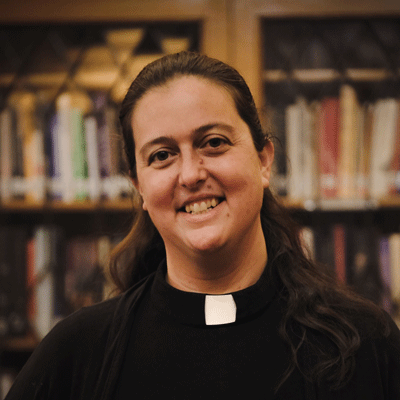
Image
Rev. Rola Ashkar
Rev. Rola Al Ashkar

“Are you really loving others? Are you really loving God when you're doing it at the expense of your own well-being?” the Rev. Rola Al Ashkar asked during a recent podcast exploring the need for ministry leaders to set boundaries, practice self-care and attune to their bodies in the midst of their calling to serve God and others.

“Because burnout is a clear sign of a deficit in self-love,” Al Ashkar posed to her “beloved colleagues” before admitting that “this is the sobering and the hardest lesson I had to learn: Your worth does not come from what you give to the church. Your worth is assigned to by your Creator. How would your ministry be different if you operate from that understanding?”

Al Ashkar was a guest on the “New Way” podcast, a production of 1001 New Worshiping Communties. In its 12th season, “New Way’s” host, the Rev. Sara Hayden, and its producer, the Rev. Marthame Sanders, focused on spiritual practices that deepen what Dr. Howard Thurman called “the sound of the genuine.”

In two episodes, Al Ashkar describes the ways she felt hemmed her in by what she called the “legacy church.” At the same time, Al Ashkar felt pressured to not set boundaries of time and space around her work in the congregation, to ignore habits of self-care and to dampen authentic expression of emotions. Like many congregational pastors, Al Ashkar experienced a prolonged season of burnout followed by an extended sabbatical and finally a decision to leave traditional ministry for the experimental and experiential space of new worshiping communities.

Al Ashkar is a teaching elder in the PC(USA), a dancer, a yogi and the founder of ἴαμα yoga, described as a community integrating yoga, somatics, spiritual exploration, trauma-informed care, breathwork and connection. Inspired by “ἴαμα (ee-yah-mah)” the Greek word for healing, Al Ashkar began focusing on healing the body-mind-spirit connection as a form of ministry by offering free yoga classes in the courtyard at Westminster Presbyterian Church in Sacramento before expanding into the online communal spaces of Instagram and TikTok, where she is found at “@embodiedpastor.”

During two episodes totaling 45 minutes, Hayden’s conversation with Al Ashkar covers Al Ashkar’s personal history of dissociation through her experience as a Lebanese war baby, her efforts to fit in culturally in the American mainline church while at times challenging it politically, her sabbatical year on learning permaculture farming in Hawaii and the practices she dedicated to in order to bring herself back to the Imago Dei within her.

“That whole year of farming and being out and being so close to the earth just reminded me of how wide and how deep this universe is,” said Al Ashkar, who wondered why our views of God and ministry are so narrow. “I feel like I did a lot more ministry in that year off than I did in seven years of being in the church.”

When Al Ashkar immigrated to the United States to become a pastor, her whole community was the church. But she felt herself being called out of that context and community for good. “I'm not serving any traditional church, and I don't plan on ever going back, because I simply realized this is not my gift to the world,” she told Hayden.

“I think our first call was to be pioneers of change in society, and I’m not sure if we're doing that,” said Al Ashkar, who described how the church is still a part of the system that maintains the status quo even when it feeds the hungry or prays for the suffering.

“I found this disconnection in the church’s values and what I value, and what most people my generation value,” she explained as she described the forms and focus of her new ministry as a new worshiping community leader.

Al Ashkar creates community by encouraging embodiment and supporting showing up as our whole selves. “When we are expecting and creating an environment for people to show up with all of them, with their emotions, this is where a community becomes a refuge, a place for people to go to find that nourishment, rather than just another chore to add to their week,” said Al Ashkar.

Listen to Hayden’s conversations with Al Ashkar here.

Beth Waltemath, Communications Strategist, Interim Unified Agency, PC(USA)(Click here to read original PNS Story)

Let us join in prayer for:

Joseph RussGlobal Ecumenical Liaison Global Ecumenical Partnerships Interim Unified Agency
Yvette Russell, Vice President, Customer Engagement, Board of Pensions  

Let us pray:

God of compassion and justice, let us and all siblings in Christ work together in love to right the wrong and give hope. Amen.

Wednesday, March 12, 2025

Mission Yearbook: Small churches living well on the frontier

“It doesn’t get more marginal than the frontier,” the Rev. Catherine Neelly Burton, a recent guest on the “New Way” podcast, told host the Rev. Sara Hayden. Burton was speaking about the imagination and hope she witnesses among church members and commissioned ruling elders in rural Kansas.

“A lot of the imaginative work comes from the people themselves,” Burton told Hayden, a native Kansan, as she described the realities of church on the literal frontier. Burton described what sustainable ministry can look like in places called to sustain the rest of us. “This is where your food comes from,” Burton exclaimed.

According to the state of Kansas, if a county has fewer than six people per square mile, it’s considered a frontier county. These are the counties Burton serves in a newly created role of the Presbytery of Southern Kansas called the “Mission and Ministry Connector.” As of last January, 30 of the 46 churches within the presbytery were in rural or frontier areas. Only 12 of those had paid PC(USA) leadership.

Burton came to rural ministry only recently after serving a congregation in Wichita and has learned a few things about sustainable ministry from churches with 20 members in towns with populations in the hundreds.

The values that Hayden associates with her home state and the ones she sees reflected in Burton’s stories include “not making a big deal about yourself, humility, hard work, taking care of one another, but also minding your own business, always being willing to offer a helping hand, but not judging why that helping hand is needed.”

“The good news is that these people, they’re the ones with the imaginations,” Burton said, laughing. “They have said, ‘What do we need? And how do we make this work for us? We’re pretty capable people. If we can get the right training, then we can do a lot of this.’”

When a young retiree moved back to Chase (population 400), she recognized the need for children at Chase Community Church (membership: 13; 3% of the town’s population). She went door to door, but still no one showed up on Sunday, so she helped the church start an after-school program on Wednesdays with activities and a meal. Now they have 20 kids who regularly show.

A similar situation happened in Pratt, Kansas, where Pratt Presbyterian Church hosts a children’s ministry on Wednesdays for the children of the town. At Cherryvale First Presbyterian Church, the church hosts a dinner twice a month and serves anyone who wants to come. When Burton broke bread with that community, she felt it was a special grace for retired cafeteria workers from the elementary school living on fixed incomes to be served in such a way.

Fulfilling the baptismal vows to children or feeding the stranger are not the only ways Christians on the frontier get creative. They also organize how they provide for the proclamation of the Word, even if only a few can gather or train to lead.

Tribune Presbyterian Church hosts Bible study before worship on four lectionary texts. One member then takes the same study to the senior center and shares the Word of God with others later that week.


Burton finds hope in the witness of pastor-less churches that aligns with the Book of Order F-1.0202, part of the Constitution of the Presbyterian Church (U.S.A.).

“Christ calls the church into being, giving it all that is necessary for its mission in the world, for its sanctification and for its service to God. Christ is present with the church of both spirit and word. Christ alone rules, calls, teaches and uses the church as He wills.”

“I like to talk about that with churches,” said Burton, “because Christ has given the church everything it needs to be the church, and sometimes that includes a pastor, but sometimes it doesn’t.”

Listen to the two episodes of the “New Way” podcast with the Rev. Catherine Neelly Burton.

Beth Waltemath, Communications Strategist, Communications Ministry, Interim United Agency (Click here to read original PNS story)

Let us join in prayer for:

  • Ginger Harris, Associate for Lending Services, Presbyterian Investment & Loan Program 
  • Jimmie Hawkins, Director, Office of Public Witness-Washington, Interim Unified Agency 

Let us pray:

Glorious God, we praise you for your faithfulness. We pray for those who are searching for you without success that they will find peace in you. We thank you for the faithful. We ask that you continue to encourage and challenge them to accomplish your work as you lead them. In the name of our Savior. Amen.

Tuesday, September 17, 2024

Today in the Mission Yearbook - Jesus and jazz in the wilderness

Endless Field musician Ike Sturm is a guest on the ‘New Way’ podcast

September 17, 2024

“What’s the worst that could happen?” musician Ike Sturm asked his co-composer and bandmate, Jesse Lewis, as they stood with their instruments and recording gear on top of a glacier in Alaska.

Lewis answered, “There’s a lot on the line, actually.” Sturm and Lewis make up the atmospheric jazz and folk acoustic duo Endless Field. Lewis, a guitarist, and Sturm, a bassist, compose and record songs out in the wild.

Sturm is also the convener of a new worshiping community that meets in the Times Square neighborhood of New York City. He was a recent guest on the 1001 New Worshiping Communities movement’s podcast, “New Way,” hosted by the Rev. Sara Hayden and produced by the Rev. Marthame Sanders.

Hayden described Sturm, who has “recorded everywhere from Denali to Acadia and in between,” as “living intentionally in the balance of wild and tame and responding to both poles by integrating the experiences into thoughtful and transformative gatherings and compositions.” As their podcast conversation reveals, Sturm approaches worship and community as thoughtful and transformative gatherings and compositions as well.

In the first of two episodes titled “Finding Our Way Home: A Conversation with Ike Sturm,” Sturm discussed the evolution of his path as a musician and how it coincides with his understanding of faith.

“The last two summers, we’ve been in Alaska scouting, and then last year we went and filmed an entire project,” said Sturm, who talked about the process he and Lewis used to challenge themselves as musicians through longer compositions in more remote locations. “We actually wrote everything in the moment and in the spaces.”

Sturm also described how long it took Lewis and him to hike up a glacier with their gear and set up and compose the music in the space before recording. “It was very raw.” Sturm said he could feel God moving them even while feeling “really freaked out to do it.” Sturm described a point at which they realized, “Wow, we have everything we need. Everything is right here and inside us and around us.”

In the second episode, “Endless Field: More with Ike Sturm,” he and Hayden discussed how to understand Jesus through a jazz framework and break God out of institutional boxes.

“We like to kind of institutionalize Jesus, or we like to put him in these very understandable spaces, and it’s just not how it was,” said Sturm, who describes how he likes to imagine “who would Jesus be hanging out with in my little framework, in my little community. And I always try to take a hint from that and be like, ‘Oh, this cat.’ That’s what I would say in my jazz language for ‘This is the person.’”

“How can I be loved being that way?” Sturm asked when he considers the “pretty funky combination of different things” that he or “that cat” is.

Inspired by the image of an “endless field,” Hayden called Sturm’s approach to music in open spaces and community with all sentient beings beautiful, open and generous. “I see the endlessness of this field of God holding this space where we can find ourselves at any point. If the field is endless and we are all in the field, then it’s OK to be at countless and infinite places in that space, within that space,” said Hayden. “We can find and connect with one another. It’s such a beautiful and open way to foster spirituality, foster a sense of self-awareness and deeper connection to the people in our lives and even the creatures in our lives, the non-human beings we’re surrounded by and fed and uplifted by and nurtured by. It’s so generous.”

Beth Waltemath, Communications Strategist, Presbyterian Church (U.S.A.)

Today’s Focus: Endless Field musician Ike Sturm is a guest on the ‘New Way’ podcast

Let us join in prayer for:

PC(USA) Agencies’ Staff
Yvette Russell, Vice President, Customer Engagement, Board of Pensions 
Alicia Samuels, Vice President of eCommerce & Marketing & Flyaway Books Editorial, Presbyterian Publishing Corporation 

Let us pray

Almighty God, our Creator and Sustainer, you provide richly for your people and for the mission of Jesus Christ. Anoint us with your Spirit that we might trust your word and hear the good news of Christ to the nations. In Jesus’ name. Amen.

Saturday, September 14, 2024

Today in the Mission Yearbook - Modeling faith at home

The Rev. Neema Cyrus-Franklin of Around the Table is a guest on the ‘New Way’ podcast

September 14, 2024

The Rev. Neema Cyrus-Franklin, Around the Table’s project coordinator for its nationwide initiative supporting faith practices in the home, recently appeared as a guest on the “New Way” podcast.

Cyrus-Franklin is a pastor, parent, part of a clergy couple, an advocate for youth, a certified coach, a trauma-informed yoga instructor and a group facilitator. The “New Way” podcast is hosted by the Rev. Sara Hayden, associate for the 1001 New Worshiping Communities movement, and produced by the Rev. Marthame Sanders of Mudeif Productions.

In the first of two episodes, “Modeling Lives of Faithful Transparency,” Cyrus-Franklin discussed the “third phase” of her ministry and reflected on how God has been faithful in the midst of constant change and flux.

As a preacher’s kid, Cyrus-Franklin described a childhood surrounded by a household of faith and a community of faith with parents who expressed their faith publicly.

“My dad’s a Presbyterian pastor. I’m not one of those who didn’t grow up with faith in the home,” Cyrus-Franklin said as she described how affected she was by her parents’ practice of “casting our cares” (1 Peter 5:7). “My parents were very intentional about showing us and not hiding the concerns, problems, issues that they faced as ministry leaders, as parents and as folks who had bills to pay.” In front of her and her siblings, her mother talked to the Lord out loud in plain language while doing household chores. “My dad was the pastor, but my mother was the practical theologian at home,” Cyrus-Franklin said.

As an adult, Cyrus-Franklin answered the call to ministry and found the constantly changing landscape of contemporary congregational ministry. She found herself called upon to be creative and offer solutions to new situations, especially regarding supporting the faith formation of families.

In the second episode, “The Gift and Challenge of Parenting in the Faith,” Cyrus-Franklin, who lives in Los Angeles, described the challenges of parenting children in a world where gun violence in schools and racist crimes and policing policies are an ever-present reality. She also discussed some of the ways her spiritual practices have evolved through life’s difficulties and the surprising ways the faith she models has empowered her kids.

Cyrus-Franklin brings her experience to her work with the Around the Table initiative. She shares insights through the Around the Table blog and will be launching online cohorts of others involved in supporting faith formation in communities and in the home in the fall of 2025 and the spring of 2026. Around the Table also offers resources like a faith practices toolkit with offerings on prayer, Sabbath, hospitality, service and retreat. The initiative is also developing ways to explore topics like holy listening, mental health, sharing individual stories and God’s story, and trauma-informed parenting.

“We’re looking to work with individuals to help us to craft a way forward in this new, untraversed terrain,” said Cyrus-Franklin. “We call this initiative Around the Table. It’s a callback to the table because most people aren’t gathering around the table.”

Time together may not be traditional, but it can be intentional and formational, according to Cyrus-Frankin, who described the initiative as “a place where we can learn, because what we know for sure is the way that we’ve done ministry in the past is not going to be the way forward for how ministry is done in the future.”

Beth Waltemath, Communications Strategist, Presbyterian Church (U.S.A.)

Today’s Focus: Rev. Neema Cyrus-Franklin of Around the Table is a guest on the ‘New Way’ podcast

Let us join in prayer for:

PC(USA) Agencies’ Staff
Jermaine Ross-Allam, Director, Center for Repair of Historical Harms Visioning, Rebuilding, and Innovation, Presbyterian Mission Agency 
Jashalund Royston, Research Analyst II, Research Services, Administrative Services Group (A Corp) 

Let us pray

Loving God, open our hearts and minds to the leading of your Spirit that we may continue to grow in faith and knowledge. Guide us as together we study your work and word. May we respond with dedication and commitment in the places to which you call us and send us. Amen.

Tuesday, July 30, 2024

Today in the Mission Yearbook - Without passages on justice for the poor, the Bible is a very slim volume

‘Lift from the bottom, and everyone rises,’ the Rev. Dr. Liz Theoharis says on the ‘New Way’ podcast

July 30, 2024

The Rev. Dr. Liz Theoharis

“I was raised to see that faith and justice were completely linked, and so I just think it’s about living out one’s faith,” says the Rev. Dr. Liz Theoharis, who talks with the Rev. Sara Hayden on the “New Way” podcast about being raised by an activist mother and where she is finding hope and challenge in her own activism and motherhood today.

The “New Way” podcast is a production of the 1001 New Worshiping Communities movement, hosted by Hayden and produced by Rev. Marthame Sanders through Mudeif Productions.

Theoharis is the executive director of the Kairos Center For Religions, Rights & Social Justice  and the co-chair of the Poor People’s Campaign: A National Call for Moral Revival.

“Church was my second home,” says Theoharis, who remembers accompanying her mother every week to North Shore Presbyterian Church in Shorewood, Wisconsin, and to social justice meetings in the city. Theoharis taught Sunday school by age 13 and was ordained a deacon by age 16.

Theoharis encourages people, “especially church folk,” to see solutions beyond charity. Citing Deuteronomy and the Jubilee and Sabbath codes, Theoharis describes the idea in the Bible as “lift from the bottom, and everyone rises.” While she admits that this is the opposite of the logic of our current economic system, there is evidence that it works.

Theoharis estimates that the United States spends $1 trillion annually on children in poverty, because childhood poverty results in more expansive policing and higher incarceration rates later in life. “A $1 investment in ending child poverty saves $7 in the future,” says Theoharis, who calls this “good economics.”

Investments like this are possible through policy changes. She cites the success of the child tax credit offered during the Covid pandemic shutdown. “That raised tens of millions of people up, and 4 million kids who are living below the poverty line were raised above the poverty line with just one social program of a couple hundred dollars a month.”

“When we organize society around the needs and demands of those who have little instead of those who have much, then actually everybody is lifted up,” she adds. The lifting up is both physical and spiritual for Theoharis, who describes how accepting the scarcity mentality and injustice of our current system limits our capacity to envision and worship a God who created enough and supports the thriving of Creation. “It’s literally only a very small percentage of the [wealthiest] 1% who do not benefit. And those folk will lose some resources, but probably they’ll gain more humanity,” says Theoharis.

In the second part of their conversation, Hayden and Theoharis look to the Bible for inspiration regarding anti-poverty programs and healthier societies through tending to the needs and health of the most vulnerable. Theoharis describes the “arc that starts in Genesis and goes all the way to Revelation,” where caring for the poor, welcoming the immigrant, and including and supporting others are the most common themes in the Bible. “There are 2,000 passages in the Bible about justice for the poor,” says Theoharis. “If you cut those passages out, you don’t have a Bible anymore. It all falls apart.” Alongside this imperative to care for the downtrodden and the disenfranchised is a vision of a society living within God’s spiritual and economic blessing.

“There need be no poor people among you,” Theoharis reads aloud from the Jubilee codes of Deuteronomy 15 (NIV), “for in the land the Lord your God is giving you to possess as your inheritance, he will richly bless you, if you only fully obey the Lord your God and are careful to follow all of these commands I am giving you today.”

To live into this vision, Theoharis draws on the communities and movements she’s helped to establish and sustain, such as the Freedom Church of the Poor and the Poor People’s Campaign, but she also leans into daily reflection and practice. Theoharis tells Hayden she reads the Bible daily and asks herself, “What am I doing today and every day to help poor people take action together?”

Beth Waltemath, Communications Strategist, Presbyterian Church (U.S.A.)

Today’s Focus: Rev. Dr. Liz Theoharis, guest on the ‘New Way’ podcast

Let us join in prayer for:

PC(USA) Agencies’ Staff
Martha Miller, Manager, Ministry Education & Support, Office of the General Assembly 
Victor Min, Senior Translator, Global Language Resources, Administrative Services Group (A Corp) 

Let us pray

Loving God, help us to be people of faith, hope and love in a world that needs them desperately. Help us to express your love. Teach us to cling to the possibilities of your transforming power and allow us to help others to do the same. In your loving and welcoming presence, we pray. Amen.

Mission Yearbook: Milwaukee church commits to education, inclusion and support of community

Tippecanoe Presbyterian Church in Milwaukee is featured in a video highlighting a summer arts and science literacy camp led by Jane Borden. ...