Showing posts with label Today in the Mission Yearbook. Show all posts

Wednesday, May 7, 2025

Mission Yearbook: Taste of Peace helps refugees to flourish as purveyors of sweet and savory treats

Taste of Peace “New Neighbors” (TOPNN) is a ministry that helps
refugees to market their sweet and savory treats in Ohio.
(Contributed photo)
After leaving difficult situations in their home countries, a group of refugee women in central Ohio is learning to be culinary entrepreneurs in the United States.

The women from Sudan, Iraq, Afghanistan, Eritrea and Venezuela are part of Taste of Peace “New Neighbors” (TOPNN), a ministry that helps them to market their sweet and savory treats to farmers market patrons and other customers in the Columbus area.

“Our mission is to work with, assist and provide equitable opportunities and enfranchisement for our local refugee population within the Greater Columbus area, specifically in the northwest portion of the city,” said Irma Chon, director of Taste of Peace. “The purpose of TOPNN is to help our diverse cultural friends by providing the tools, resources and opportunities to create economic stability and support” as they rebuild their lives.

Between seven and 11 women take part in the program, selling food at the Hilliard Farm Market during warmer months as well as harnessing other opportunities that arise. For example, “K,” a refugee from Sudan, was able to cater a corporate luncheon for 40 people after being approached at the market.

Participants in Taste of Peace also get the chance to receive training, including learning about business, menu and logo development from a local coffee shop entrepreneur. “Because of this training, our ladies were able to create their own logos and menus as well as learn some tips on how to expand their own catering businesses within and outside the farmers market,” Chon said.

The women, whose full names are being withheld at Chon's request, share their excitement in brief bios on the TOPNN website.

“Since moving to America, I found I really appreciate EVERYTHING that is available here,” “R,” a refugee who fled Afghanistan in 2021, notes in her bio. “I really am so grateful for the welcome I received when I came here, not even knowing how to speak English. I enjoy sharing my Afghan culture and food with my new friends.”

“M,” a refugee from Eritrea, says in her bio that the U.S. is “a nice place with nice people that are so helpful. We came from [a] very dangerous situation in our country and spent 12 years in Israel. Again, we needed to move for safety and we’re grateful to be here, especially for my two children — aged 9 and 6. You have to try my injera bread with the vegetarian sauce!”

In addition to sharing their food at the farmers market, participants in the program gain business exposure through dinners that serve as opportunities to share their background and skills. As part of these Taste of Peace Cultural Exchange meals, the women, their families and cuisine are introduced to the community.

For participants, the dinners are “an opportunity to increase their income along with showcasing their food for future catering opportunities,” Chon said.

Taste of Peace, a ministry of Cornerstone Christian Fellowship, is a partner of the Presbyterian Committee on the Self-Development of People, and having SDOP’s support has been a big plus, Chon said.

“Because SDOP has been generous to us over the past three years and has been willing to invest in the lives of these ladies, we have been able to expand their business development and see consistent growth in their individual lives,” she said. “We are sincerely thankful to SDOP for helping to make a difference in the lives of these precious ladies!”

Darla Carter, Communications Strategist, Interim Unified Agency (Click here to read original PNS Story)

Let us join in prayer for:

  • Teresa Mader, Project Manager, Direct Response, Special Offerings/Appeals, Administrative Services Group (A Corp)
  • Monica Maeyer, Director, Communications, Board of Pensions  

Let us pray:

Thank you, great God and Father, who is able to do immeasurably more than all we ask or imagine, according to your power that is at work within us. To you be the glory in the church and in Christ Jesus throughout all the world and all generations. Amen.

Sunday, April 20, 2025

Minute for Mission: Easter/Resurrection; One Great Hour of Sharing

Repairers of the Breach – Fixing What’s Broken

“In a broken and fearful world,
the Spirit gives us courage
to pray without ceasing,
to witness among all peoples to Christ as Lord and Savior,
to unmask idolatries in Church and culture,
to hear the voices of peoples long silenced,
and to work with others for justice, freedom, and peace.”
~ from A Brief Statement of Faith of the Presbyterian Church (U.S.A.)

How do we heal brokenness and fear in the world when it feels so pervasive?

How do we offer hope in the midst of a world so divided?

Our world is fractured — political discord, cultural strife, environmental collapse and religious divides. And this brokenness isn’t just external; we feel it deeply in our own lives, too. Physical, emotional and spiritual wounds abound. Coupled with these fractures is the fear that often accompanies them — fear of the unknown, fear of the future and fear of the “other.”

Yet brokenness is the human condition. And though it’s deeply embedded in the world, it is not God's will for us. God doesn’t desire for us to accept brokenness; rather, God calls us to be repairers of the breach.

In Isaiah 58, God speaks through the prophet, calling all people to repair the breach between humanity — a breach caused by oppression, injustice, hunger, homelessness and affliction. This chapter provides us with a roadmap for how we are to act. It's not just about spiritual acts of devotion, but about tangible action. Shout. Announce. Loose. Undo. Break. Cover. House. Share.

The work of repairing brokenness is active, and it requires more than mere words. God calls us to pray with intention, to welcome those in need, to unmask the false idols of power and privilege, to hear the voices of those long silenced, and to work with others for justice, freedom and peace. Ultimately, we are called to give — our time, our resources, our hearts.

The call to repair the breach might look different for each of us. It might be offering shelter in the wake of a natural disaster, providing economic support to protect someone from poverty, or simply offering food to someone in need through participation in One Great Hour of Sharing is an important starting place. The key is that, when we answer the call, God will guide us towards a new season of justice, freedom and peace.

Remember, when we all do a little, it adds up to a lot.

Let us, by God’s grace, be faithful repairers of the breach.

Rev. Wilson Kennedy, Associate Director, Special Offerings and Appeals

Let us join in prayer for:

  • Maha Kolko, Project Manager, Community Outreach and Volunteerism, Human Resources, Administrative Services Group (A Corp)
  • Karla Ann Koll, former Mission co-worker serving in Costa Rica, World Mission, Interim Unified Agency 

Let us pray:

Help us to delight in you, O God, that we might become agents of healing and hope, repair and restoration. Transform our brokenness and fear into justice and mercy and bless our work to share your love. We pray in Jesus’ name. Amen. 

Friday, April 18, 2025

Mission Yearbook: Good Friday: A service of darkness

Aliaksei-Lepik-Unsplash
“Then Jesus gave a loud cry and breathed his last,” is the way Mark’s gospel records the central event of Good Friday. When the centurion sees Jesus breathe his last, he concludes, “Truly this man was God’s son.” The women who’d “followed him when he was in Galilee and ministered to him,” including Mary Magdalene and Salome, watched the crucifixion from a distance after they’d come up with Jesus to Jerusalem.

Many PC(USA) churches will hold some kind of Good Friday observance today. I’m most familiar with the Tenebrae service, Latin for “darkness.” John’s account of Jesus’ suffering and death is divided into readings, and a candle is extinguished after each one until the worship space is more or less shrouded in darkness. It’s wrenching because it tries to mimic the darkness the followers of Jesus experienced on that day.

Growing up, I’d say Good Friday was just the price we youngsters paid for the privilege of enjoying Easter and the springtime that usually accompanies it. Older me recognizes the darkness that is descending on our world, and not only on Good Friday. We are flawed human beings who keep falling into the same old unhelpful practices and sinning in ways that are both familiar and innovative.

I plan to attend a Tenebrae service this evening. It won’t be well attended, but those of us who are present will be a blessing to one another. It helps to have other beacons in the darkness that now surrounds us.

Mike Ferguson, Editor, Presbyterian News Service

Let us join in prayer for:

  • Jim Kirk, Associate, Disaster Response USA, Presbyterian Disaster Assistance, Interim Unified Agency
  • Lara Kirwan, Administrative Project Manager, President’s Office, Administrative Services Group (A Corp) 

Let us pray:

Holy God, be with us today as we remember Jesus’ suffering and death. Create in us clean hearts, that we may serve you and others with clarity of purpose and with a willingness that will please you and surprise those we serve. We pray this in the name of the One whose determined willingness remains our example. Amen.

Sunday, April 13, 2025

Mission Yearbook: The Rev. Paul Timothy Roberts Sr. is the inaugural guest on a ‘Leading Theologically’ series on reconciliation

“Leading Theologically,” a show hosted by the Rev. Bill Davis of the Presbyterian Foundation, recently kicked off a series on reconciliation with a guest who’s thought deeply and taken actions to help bring that about — the Rev. Paul Timothy Roberts Sr., president of Johnson C. Smith Theological Seminary. Listen to their 35-minute conversation here.

Through grant funding and a willingness to hear from a range of Presbyterians, JCSTS has hosted a number of listening sessions across the country. “Our aspiration was to test the readiness of faith-based communities and congregations to mount up a national reparations effort,” Roberts said. “There are a lot of congregations in the country who are engaged in this work. We wanted to do our homework to see what kind of barometer we could use to determine who’s doing what and how widespread it is.”

The Rev. Paul Timothy Roberts Sr.
Among the surprising findings: “Faith communities are all over the map, especially on controversial topics like reparations,” Roberts reported. “We learned that there is not a consistent understanding of what reparations is” and “how it relates to our theology as Presbyterians.”

“We found there is not a readiness for a national effort,” Roberts told Davis. “Some groups are doing great work” but “many congregations around the country don’t even talk about reparations for fear of conflict and divisiveness.”

Asked by Davis for stories of “the good work people are doing at the local level,” Roberts mentioned congregations that are repurposing their buildings “in an effort to make their facilities more hospitable as an act of repair. There are congregations and presbyteries using the proceeds from the sale of buildings for faith-based repair work.”

“We also got wind of some faith communities raising money within their congregations and granting those funds to communities and individuals in need as an act of repair.”

Davis asked: “What’s been the relationship between reparations and reconciliation for you?”

Reconciliation isn’t even a word Roberts uses very often these days.

“It’s loaded,” he said. “Many of us, although well-meaning when we use the word, are prone to skip over all the work that needs to be done in order to arrive at a place where a community, a group of people, a relationship can be reconciled.”

Acknowledgement is a starting place, he said. Then there are “those acts of healing that we call repair, which is the nature of reparations.”

“One of the things we have learned is when people are talking about reparations, they go right to the money,” Roberts said. “That’s not where it’s at. Reparations is about repair. It’s about implementing a healing process that leads to repair. Sometimes that involves money because we live in a capitalistic society.”

“Those who have been harmed have been harmed by deprivation of opportunity, education or access, and all that involves money,” Roberts said. “The heart of the matter is, how do we repair a breach, a wrong?”

The Rev. Bill Davis
“Are there things folk like me who are white can do to accompany the work you’re doing around this reparations study? I was about to ask you for advice to soothe my white soul,” Davis said, and Roberts laughed.

Davis shared this quote from the South African cleric Allan Boesak: “Reconciliation devoid of justice is under savage strain. Social cohesion remains elusive, and racism never conquered is resurgent.”

Then Davis wondered: “How are we partners in this work of reparations and repair?”

Roberts recalled meeting Boesak about eight years ago at a Samuel DeWtt Proctor Conference. “Allan Boesak helps people wrap their brain around the societal hurts that people experience, and even the hurts that happen within any faith-based community. Some of those hurts are part of the human experience, but some of them cut very deeply and run along racial lines, gender lines, orientation — you name it. They are deeply entrenched in our society. Allan Boesak helps people understand you are very much — even 400 years in as we are in the United States — what you were at your origin.”

Watch previous editions of “Leading Theologically” here.

Mike Ferguson, Editor, Presbyterian News Service (Click here to read original PNS story)

Let us join in prayer for:

  • Stephen Keizer, Vice President Ministry Relations, Presbyterian Foundation 
  • Jessica Kelley,   Acquisitions Editor, Presbyterian Publishing Corporation 

Let us pray:

Lord, we are humbled that you gave us the life-changing message of the gospel to share with the world. May we wisely use the abundant resources you have given us in and through Christ Jesus. Amen.

Saturday, April 12, 2025

Mission Yearbook: Delegation from the Presbyterian Church in Taiwan meets with national, seminary and mid council leaders

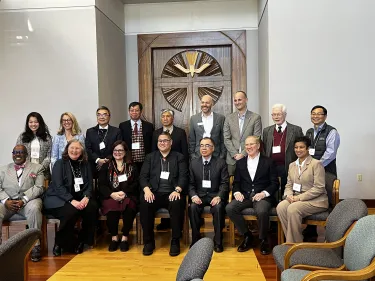
Seven leaders of the Presbyterian Church in Taiwan, including the Rev. Fuyan Suda, the PCT’s moderator, and the Rev. Chen Hsin-liang, PCT General Secretary, recently met with national staff of the Presbyterian Church (U.S.A.) and leadership of both Mid-Kentucky Presbytery and Louisville Presbyterian Theological Seminary.

A delegation from the Presbyterian Church in Taiwan met with
representatives of the PC(USA) and the Presbyterian Foundation
at the Presbyterian Center in Louisville. (Photo by Jacklyn L. Walker)

Accompanying the delegation was the Rev. Ralph Su, Associate for Asian Intercultural Congregational Support in Racial Equity & Women’s Intercultural Ministries, and the Rev. Carlton Johnson, RE&WIM’s interim director. The Rev. Jihyun Oh, Stated Clerk and Executive Director of the Interim Unified Agency, spent about an hour with the delegation, bringing its members greetings on behalf of the General Assembly of the PC(USA).

She expressed “how grateful” she felt receiving letters of support, prayers and a financial contribution from the PCT to bolster the PC(USA)’s disaster response following Hurricanes Milton and Helene and the wildfires in Southern California.

“I know you have been deepening our partnership and bond of connection,” Oh said, adding she shared those PCT messages of support with mid council leaders in North Carolina, Georgia and Southern California. “They were so touched to receive those expressions of care from across the globe,” Oh said, “and to know they were not alone, that Christian siblings were praying for them.”

Members of the PCT delegation exchanged gifts with Oh, who said she’d work to attend a future PCT General Assembly.

“Before Covid, delegations would regularly visit the Presbyterian Center,” said the Rev. Mienda Uriarte, director of World Mission. “This delegation has had a shift in leadership, and that’s usually what prompts this kind of visit.”

In October, a five-member delegation from the United Church of Christ in the Philippines visited Louisville and Jeffersonville, Indiana, the home of the Presbyterian Foundation. Presbyterian Foundation leadership, including the Rev. Dr. Tom Taylor, the Foundation’s president and chief executive officer, also participated in the more recent meeting. Later, the PCT delegation met in Washington, D.C., with staff from the Office of Public Witness, led by the Rev. Jimmie Hawkins.

“I think their challenge to us is their training in civil disobedience. It reminds me of Dietrich Bonhoeffer and the church’s need to bear witness and resist oppressive forces,” Sara Lisherness, deputy executive director for Mission Program in the Interim Unified Agency, said in a reference to support PCT is looking for as a result of what Taiwan sees as Chinese actions provoking Taiwan’s 23 million residents.

“The courage they’re displaying equipping their church members to engage in nonviolent civil disobedience is something we need to examine in our church’s life,” Lisherness said. “As privileged as I have been over the years, every chance I have to learn from our global partners, they are reality checks. People in the past who were purveyors of mission and wisdom now need to be the receivers. Our global partners are leading the way.”

The delegation’s visit to Mid-Kentucky Presbytery “brought back good memories of my participation in a PC(USA)-PCT consultation in Taiwan in 2003,” said McClure Taylor, the presbytery’s interim general presbyter and the former director of World Mission. The Rev. Dr. Mary Nebelsick, a member of the presbytery’s Mission Committee who served as a mission co-worker for many years in the Philippines, was also present.

“I wanted them to know I understand the feeling of living with an existential threat,” McClure Taylor said, “so I passed around the military-style dog tag I was issued as a child. Living near the Oak Ridge National Laboratory in the early 60s meant we were perpetually preparing for an attack from outside, as are many people in Taiwan.”

The conversation about partnership “took a practical turn,” she said. Mid-Kentucky Presbytery has had a partnership with Changhua Presbytery on the western coast of Taiwan for almost 20 years, McClure Taylor noted. “An exchange of visits was interrupted by the pandemic, and so now in a mutual way we are looking for what would be meaningful to do together.”

“We also talked about whether the medical communities in our two areas could have some exchanges to foster collaboration,” McClure Taylor said. “During the pandemic, religious communities helped get around some of the obstacles China placed on Taiwan’s health responses.”

Mike Ferguson, Editor, Presbyterian News Service (Click here to read original PNS story)

Let us join in prayer for:

  • Andy Keeney, VP, Director, Information Systems, Presbyterian Foundation
  • Tamron Keith, Associate Director for Finance and Administration, Interim Unified Agency 

Let us pray:

We hear your question, loving Lord. We go where you lead. We see what you want us to do. And we are grateful. For we have found and offered loaves. And in our feeding, we are fed. Amen.

Friday, April 11, 2025

Minute for Mission: Black Maternal/Birthing Health Week begins (April 11–17)

Care for those who brought you into the world. This feels like one of the most straightforward messages we find in Scripture. We’re all familiar with the commandment “Honor your father and your mother” (Exodus 20:12). Yet, when it comes to Black mothers, neither the world nor the church has figured out how to honor them. Black women in the United States are 3.5 times more likely to die from pregnancy-related complications than white women. In my own hometown of Pittsburgh, a place known for its great hospitals and care, the Black maternal mortality rate is higher than the national average (and even when they make it through childbirth, Black mothers face higher rates of drug testing). Black women still hold spiritual scars from the racist legacies of America, from the commodification of their children in chattel slavery to the legacy of forced sterilization to the vilification of their identities through dog-whistle politics. This is all on top of the wage disparities, micro and macroaggressions, and toxic theology Black women face every day. Black mothers (and Black people who give birth overall) bring life forth into our world, yet they have never been truly honored.

We don’t have to continue in this legacy, though. We, as individuals and as the Presbyterian Church (U.S.A.), can decide that Black birth and maternal care are things that matter to us. We can choose to honor Black people in their choices on whether to have children, how they will have children, and how they will care for the children they have. We can advocate for health-care policies that put Black birth at the forefront. We can offer mutual aid and support for Black pregnant people to access doulas and other maternal care. We can support Black women in their maternal care. We can support Black people of all genders as they give birth. We can do all of this and more, starting right now, for it is never a wrong time to start honoring those who bring life into the world.

Ashley DeTar Birt, a member of the Advocacy Committee for LGBTQIA+ Equity and former member of the Racial Equity Advocacy Committee                       

Let us join in prayer for:

  • Deepika Karnayana, Administrative Assistant, Young Adult Volunteer Office, World Mission, Interim Unified Agency
  • Kevin Keaton, Church Consultant, Houston, TX, Board of Pensions 

Let us pray:

Nurturing God, parent to us all, hold those who bring life into our world in your hands. Where race and birth intersect, let our hearts be loving and our actions be strong. Help us to care for Black women and all Black people who give birth. Let us not treat them with discrimination and disregard but with dignity, nurture and care. Help us to lift up their needs and honor them as you call us to do. Amen.

Thursday, April 10, 2025

Mission Yearbook: Preaching with a movie director’s sensibility

“Lights! Camera! Sermon!”

Those who gather for worship in PC(USA) faith communities aren’t likely to hear those words spoken from the pulpit anytime soon. But the Rev. Dr. Shauna Hannan, Professor of Homiletics at Pacific Lutheran Theological Seminary (of California Lutheran University), urged those attending a recent Synod of the Covenant webinar to consider using a filmmaker’s techniques and sensibilities when crafting and delivering their sermons.

Along with filmmaker Gael Chandler, Hannan wrote “Scripting a Sermon: Using the Wisdom of Filmmaking for Impactful Preaching,” published in November by Westminster John Knox Press. Watch her 88-minute webinar hosted by the Rev. Dr. Chip Hardwick, Synod of the Covenant’s executive, here.

The extent to which we are wired to our screens, big and small, “makes it worth a preacher’s time to become adept at the language of film,” Hannan said. “It’s what our congregation knows. It’s what we know. Increasingly, people are becoming literate in the contemporary language of cinema … likely at a rate faster than our biblical and theological history.”

The Rev. Dr. Shauna Hannan
For many people, Hannan said, “visual images — whether still images or moving images — have replaced text as the central tool of communication.”

For years, Hannan has been pondering “might screen and cinematic literacy be today’s printing press of sorts — the way to get the word out, the way to get the conversation started?” In the book and in the presentations, she makes, Hannan tries to both boost preachers’ cinematic literacy and “seek convergences between filmmaking and homiletics for the purposes of enlivening the preached word, communicating the gospel and impacting hearers and their world, and our world,” she told the preachers gathered online.

Participants pointed out some of the many differences between making a film and developing a sermon. Among them was the former can take years, and the latter must be repeated weekly.

Hannan pointed out a number of similarities. Both “seek to impact others and/or the world.” Both “do so by paying attention to the reactions and subsequent actions of the ‘audience.’”

Hannan encourages her seminary students to study the first three minutes of a film they admire. “Try to identify the impact. What’s it doing to you? How is it doing that?” she tells them. “How does it make me sit on the edge of my seat?”

“What’s the learning for us as preachers? Do we engage a similar variety in the way we open our sermons?” Hannan said. “Could you add to your homiletical repertoire multiple ways of opening a sermon?”

Those in worship have the capacity for only “five or six major moves” during a sermon, Hannan said. Fortunately for preachers, “the Spirit shows up and does things. We have more available to us than we’re using.”

Her students write “here’s what I’m doing and why” in the margins of their sermons, Hannan said. “They’re giving me the director’s cut. … I’m opening here because this is what I want to happen” or “I’m doing a closeup on the Samaritan woman.”

Then Hannan asked webinar participants: Have you ever wondered why so many people share the impact a film has made on them? “Most worshipers rarely talk with one another about their worship experience, especially the sermon,” she said. “Imagine if churchgoers were impacted by a sermon and could share their experience beyond ‘I liked it’ or ‘I didn’t like it.’”

Hannan quoted filmmaker Alfred Hitchcock, who once noted, “One doesn’t set the camera at a certain angle just because the camera [operator] happens to be enthusiastic about that shot. The only thing that matters is whether the installation of the camera at a given angle is going to give the scene its maximum impact.”

We do this in our sermons as well, Hannan said. “Wherever the camera is and whatever it’s looking at is where [preachers] are putting our hearers into the story,” she said. Preachers who are stuck with where to go next in their sermon preparation can think of using a wide shot, a medium shot or a closeup.

“Be the cinematographer. Be the director,” Hannan said. “Before you launch into the sermon crafting, hang out with the biblical story.”

Mike Ferguson, Editor, Presbyterian News Service (Click here to read original PNS story)

Let us join in prayer for:

  • Hyo Jin Kang, Senior Administrative Assistant, Asian & Korean Intercultural Congregational Support Offices, Interim Unified Agency
  • Shawn Kang,  Associate, Central & West Regions, 1001 New Worshiping Communities, Interim Unified Agency 

Let us pray:

Creator God, thank you for those you have called to serve in ministry. Bless the work that is done in your name. Amen.

Wednesday, April 9, 2025

Mission Yearbook: ‘Won’t you be my neighbor?’

While Fred Rogers, the beloved Presbyterian pastor and children’s television pioneer, is perhaps best known for creating the TV “Neighborhood of Make-Believe,” the fictional community of his imagination became remarkably real as a roomful of Christian educators embodied his vision and celebrated his legacy.

No longer confined to the world of make-believe, erstwhile strangers attending a workshop at the Association of Partners in Christian Education (APCE) 2025 Annual Event quickly became neighbors.

And friends.

As the animated participants cheerfully colored and conversed around tables in the generous, warm and interactive space led by Miatta Wilson, they wistfully recalled — and openly shared with one another — their earliest memories of the beloved early childhood educator and television personality.

“Neighbors” who attended the APCE workshop included (from left): Josh
Archey, commissioned pastor of Crossroads Presbyterian Church,
Commerce Township, Michigan; Diane Stapleton, director of Family
Ministries, Timnath (Colorado) Presbyterian Church; and Deborah
Huggins, Associate Pastor of Youth and Children, Central Presbyterian
Church, Summit, New Jersey. (photo by Emily Enders Odom)
“I grew up with Mister Rogers,” said Josh Archey, commissioned pastor of Crossroads Presbyterian Church in Commerce Township, Michigan. “I really gravitated toward his message, his inclusiveness.”

As did Wilson.

Wilson, an associate in the Office of Christian Formation for the Interim Unified Agency of the PC(USA), told the group that she remembers watching “Mister Rogers Neighborhood” for the first time at the age of three on a “little black & white TV.”

In fact, the origins of her Jan. 31 APCE workshop, titled, “Won’t You Be My Neighbor? A Simple, Unassuming Question. Or Is It?,” lie deep within her own faith story.

“I am a Fred Rogers ‘groupie,’ wearing my socks and sweater,” Wilson would later say at the APCE awards dinner that evening after being recognized as APCE’s Enrich Educator of the Year. “My ministry, our ministry and work, I believe, among other things, is about neighborliness, the kind Fred Rogers lived both on the screen and off. Neighborliness is being kind, helpful, thoughtful, welcoming, curious, listening, friendly and a willingness to live in harmony. This is something desperately needed by our communities, country and world.”

After sharing with the group some of Fred Rogers’ history and background — as well as inviting them to contribute what they knew about Rogers — Wilson dedicated much of her workshop to exploring Fred Rogers’ “Six Fundamentals of Learning.”

The “six fundamentals” are the educational principles that “inform and inspire the research, resources, professional learning opportunities, and community building work” of the Fred Rogers Institute at St. Vincent College in Latrobe, Pennsylvania, through which she was part of an online cohort of educators last year.

Miatta Wilson
Included with Wilson’s introduction to each of the six — which are (1) a sense of self-worth, (2) a sense of trust, (3) curiosity, (4) the capacity to look and listen carefully, (5) the capacity to play, and (6) times of solitude — were conversation starters for the “neighbors” to engage around their respective tables.

As members called out their responses to the various prompts Wilson offered, the Rev. Dr. Deborah Huggins, associate pastor of Youth and Children at Central Presbyterian Church in Summit, New Jersey, said of “curiosity” that her congregation models “I wonder” questions with children.

“We try to cultivate questioning as part of the walk of faith,” she said.

Following a closing section devoted to “Fred and Faith” — Fred as neighbor, Fred as peacemaker — Wilson introduced the group to a host of resources created, compiled and curated by the Office of Christian Formation.

Wilson’s previewing and sharing several of the many available resources also served as a timely reminder for congregations to join with the PC(USA) in celebrating Mr. Rogers Day on March 20, which would have been Fred Rogers’s 97th birthday.

For Wilson, the time she spent in Memphis among her ministry colleagues was indeed “a beautiful day in this neighborhood – the neighborhood of APCE.”

“Now,” she offered as a charge, “let us go and be good neighbors.”

Click here to access all the Mr. Rogers Day resource pages.

Emily Enders Odom, Associate Director of Mission Communications, Interim Unified Agency (Click here to read original PNS story)

Let us join in prayer for:

  • Bequi Jump, Associate translator, Spanish, Global Language Resource, (A Corp)
  • Sharon Kandel, Regional Liaison for the Horn of Africa, World Mission, Interim Unified Agency 

Let us pray:

Holy and loving Father, we praise you and glorify your holy name. We are grateful for all your gifts to the church. Give us your mercy and compassion for the sake of our brothers and sisters who need it more, so we can share with them your gifts of love. In your holy name we pray. Amen.

Tuesday, April 8, 2025

Minute for Mission: International Roma Day

In Belgrade, Serbia, many Roma families live in settlements scattered about the city. In one that we visited, the streets were flooded, water mixed with sewage, and there were mounds of garbage between and behind their homes. Trucks drive through the settlement daily, and one day recently, one truck ran over a Roma child. The public response was to blame the victim — Roma chooses to live this way. But who chooses to live in a slum?

The Roma are still one of the most marginalized people in Europe (and elsewhere in the world). Maintaining their cultural traditions and language, people too often perceive a threat, where none is intended. The stereotypes against Roma are ugly.

Many Roma adults are functionally illiterate, because they were not welcome in schools or faced discrimination that did not motivate them to stay. Access to well-paying jobs is rare, if not nonexistent. If a job is advertised, Roma are not welcome to apply. The kind of work they might find pays so little that they cannot support their family, and any job takes away the small stipend they receive from the state.

The Center for Youth Integration (CYI), an NGO in Belgrade, is trying to change the future for Roma children in Serbia today. Roma children do have access to school, but if they are not clean or do not have shoes and good clothing, they face discrimination from other children. They often end up in the back of the class. The slum-like conditions of the settlements make good hygiene very difficult. Recognizing the very real barriers to education, CYI works with the parents and the children to change the future. They have established day centers across the city that provide showers and laundry machines, clothing closets, warm meals, tutoring and encouragement. The centers are open seven days a week. The children are always welcome. When we visited on a Sunday morning, the center was full of kids working on homework, having a warm lunch and playing games.

The word “integration” is perhaps a misnomer. No one is trying to erase Roma culture, which is distinct and beautiful. CYI is working to erase the barriers to inclusion in Serbian society and to change the narrative.

Ellen Smith, Regional Liaison for Central and Eastern Europe

Let us join in prayer for:

  • Rick Jones, Director of Communications, Interim Unified Agency
  • Rebecca Jordahl, Administrator, Church Relations, Board of Pensions 

Let us pray:

Dear Lord, open our hearts and minds to those suffering from discrimination, that we may sit together at one table, discovering our commonality in the midst of our differences. We give thanks to Jesus for teaching us to love our neighbor as we do ourselves. Amen.

Monday, April 7, 2025

Mission Yearbook: Presbyterians train in local advocacy

Presbyterians have been raising their voices on social media sites and elsewhere wondering what the church can do to address issues and how to exercise moral action in an increasingly polarized political climate. Presbyteries, synods and seminaries are hosting several upcoming events designed around advocacy training.

Presbyterians for a Better Georgia, a partnership of churches and individual Presbyterians within the Presbytery of Greater Atlanta, recently hosted its annual online advocacy training.

The event began with a short presentation about how to communicate effectively and develop relationships with elected officials. These tips can be used in many contexts, both in local municipalities and at the state level. Focused on best practices and feedback from elected officials themselves, they are not restricted to the state of Georgia. Later, Elizabeth Appley, Presbyterians for a Better Georgia’s policy advocate, discussed proposed legislation related to PBG’s core concerns: homelessness, affordable housing and accessible health care. PBG also hosts an annual event at the state capitol to give Presbyterians a chance to meet with their elected officials in person.

A Georgia state senator takes a selfie with members of Presbyterians
for a Better Georgia who show up to the state capitol every year for
Lobby Day. (Contributed photo)
Since 1999, Presbyterians for a Better Georgia has been an “issue-based, non-partisan organization” working across the aisle and with churches all along the political and theological spectrum following the call of Matthew 25 to speak on behalf of the health, shelter and protection of their neighbors. While the focus is on policy specific to Georgia, PBG’s advocacy training can inform others eager to organize churches and people of faith in learning how to influence local and state laws.

“The best way to make change at the state level is through long-term, committed advocacy on specific issues,” the Rev. David Lewicki, a PBG board member and the pastor of North Decatur Presbyterian Church, who described PBG’s approach to “creating small legislative victories that begin to change public policy over time.”

Lewicki highlighted the importance of “getting deep inside specific issues like housing or health care,” which can “allow the advocates to create meaningful victories that change people’s lives.” In addition to PBG’s Online Advocacy Training on Tuesday and Lobby Day, he also be presented on affordable housing for a national advocacy training conference at Columbia Theological Seminary.

CTS’s event, “Call to Justice: Advocacy Days of Training,” focused on equipping people of faith and engaged citizens in the art of effective advocacy. The event featured expert advocates from the PC(USA)’s national Office of Public Witness, Presbyterians for a Better Georgia, Georgia Interfaith Public Policy Center, the Hosanna Preaching Project, and Georgia Interfaith Power and Light.

The Rev. Jimmie Hawkins, the PC(USA)’s director of advocacy, opened the conference with a talk titled “Why Do Public Witness?” The rest of that afternoon, speakers and organizations like the PC(USA)’s Office of Public Witness and the Presbyterian Committee on the Self-Development of People program addressed specific issue-based advocacy on topics such as immigration, poverty, affordable housing, environmental justice and reproductive justice, and international concerns like the conflict between Israel and Palestine.

"Connection to Transformation: Creating a Partnership Culture in Faith Communities" is an innovative and intentionally interfaith and ecumenical conference hosted by the Synod of the Northeast at the First Presbyterian Church in Jamaica in New York City. The conference focused on community transformation through interfaith and civic partnerships, collaborative and sustainable funding models, accessing state resources and navigating public policies, and promoting equity in access to community services.

By bringing together experienced advocates across issues, cities and regions, leaders in presbyteries, synods, seminaries and the national office are finding ways to equip Presbyterians to create change that positively impacts the well-being of their neighbors.

Beth Waltemath, Communications Strategist, Interim Unified Agency (Click here to read original PNS story)

Let us join in prayer for:

  • Jose Jones, Mission co-worker, Democratic Republic of Congo, World Mission, Interim Unified Agency
  • Ray Jones, Director, Theology, Formation & Evangelism, Interim Unified Agency 

Let us pray:

May the tender mercy of Christ cause God’s love-light to shine upon us so we can reflect light to those sitting in darkness and together follow the Spirit’s guidance into the way of peace — for ourselves, our neighbors and the world. Amen.

Sunday, April 6, 2025

Minute for Mission: Congregational Vitality

Have you ever played with Legos — those colorful building blocks that can transform into anything your imagination desires? You can follow detailed instructions to build a skyscraper or a race car, or let your creativity run wild, crafting something unique and beautiful. This freedom to build resembles the journey of faith and community within the church.

“Upon this rock, I will build my church,” said Jesus, emphasizing the importance of a strong foundation. Just as Legos need a sturdy base to support the structures built upon them, so too does a church need a solid foundation to thrive — one built on faith, love and the teachings of Jesus Christ.

First Presbyterian Church, Jeffersonville, Ind. (Marla Edwards)
In the heart of a small town in Indiana stands a church with approximately 150 members. The congregation’s major demographic is beyond retirement age, yet they are vibrant and full of life. Actively seeking spiritual guidance and direction, they remain deeply engaged in missional activities, demonstrating remarkable congregational vitality through their diverse and impactful initiatives.

The Green Team’s commitment to environmental stewardship, the transparent budget and finance team’s efforts to maintain financial clarity, and the Quilters’ creative contributions of prayer blanks for those in need all play vital roles. Special groups for men and women focus on mission work, fostering a sense of community and purpose. Additionally, the congregation's dedication to supporting organizations through initiatives like the Hope Chest, which collects essential items such as school supplies and diapers, showcases a deep commitment to helping others. These activities not only strengthen the bonds within the congregations but also extend the church’s positive influence on the broader community.

This church understands that while the message of Jesus remains unchanged, the methods of delivering that message can evolve. Traditional congregations like this one and many others have their place in the ever-evolving tapestry of faith.

The seven marks of congregational vitality serve as building blocks for a thriving church community: lifelong discipleship formation, intentional authentic evangelism, outward incarnational focus, empowering servant leadership, spirit-inspired worship, caring relationships, and ecclesial health. By embracing these principles, the church builds a robust and dynamic community that can withstand the test of time.

As the members of First Presbyterian Church in Jeffersonville, Indiana, continue to build their community, they are reminded that Jesus remains the same yesterday, today, and forevermore. His teachings are the cornerstone upon which they construct their faith, much like the foundational blocks of a Lego creation.

Marla D. Edwards, Mission Specialist, Interim Unified Agency

Let us join in prayer for:

  • Caralee Jones, Program Associate, Presbyterian Foundation
  • Debra Jones,  Risk Management Assistant, Administrative Services Group (A Corp) 

Let us pray:

Lord, help us build our faith and community on the unshakable foundation of your love and teachings. Guide our efforts as we seek to serve others, grow in faith, and spread your message of hope and compassion. Amen.

Friday, April 4, 2025

Mission Yearbook: Around the Table Initiative fosters faith formation through cohorts

Kim Ness
“The church is changing, and we, as a denomination, can be leaders in finding new ways of teaching faith formation,” said Kim Ness, a Christian educator with decades of experience. Ness is offering her experience and her skills as a certified coach to others through the Around the Table Initiative, a Lilly Endowment Inc.-funded initiative through the Presbyterian Church (U.S.A.).

Ness is one of five coaches leading test cohorts in this coached cohort model that is a hallmark of the Around the Table Initiative, along with the creation of resources and skill-building webinars. “Our initiative is dedicated to creating vibrant, intergenerational communities where meaningful conversations about faith can flourish in everyday life with children and youth at home,” said the Rev. Neema Cyrus-Franklin, director of the Around the Table Initiative. “These cohorts are designed to strengthen the role of households in nurturing lifelong faith and discipleship in Jesus Christ.”

The Around the Table Initiative will offer two waves of online learning cohorts: the first beginning in August 2025 and the second in August 2026. Cohorts will meet in person once during a regional kickoff gathering and then online seven times for 90 minutes over 9-18 months. Applications are now being accepted. Participation is free, and each faith community that actively engages and completes the cohort will receive $1,500 to host a concluding intergenerational retreat.

The Rev. Dr. Sarah Erickson
“I love the sense of community that comes from bringing folks together in cohorts,” said Ness, who serves two Presbyterian churches in Georgia. “These cohorts are more than just opportunities to learn about spiritual practices and brainstorm how to help families practice faith at home. They are reminders that we are not alone in ministry.”

Ness describes the cohort she leads as comprised of leaders in churches with large numbers of active children and youth. The majority of cohort members are Christian educators and ordained pastors that serve in seven states, from Florida to Michigan.

Madeline Alvarez
The Rev. Dr. Sarah Erickson began with the initiative in August 2024 at a training retreat at Highlands Presbyterian Camp and Retreat Center in Allenspark, Colorado. Erickson, who is retired from the Center for Lifelong Learning at Columbia Theological Seminary and who is involved in the Presbyterian Older Adult Ministry Network, leads a cohort of grandparents active in the faith development of the younger generation. The cohort, which has five individuals and a couple whose members hail from Georgia, Virginia, Colorado, Texas and Mexico, has met monthly since the cohort launched in October 2024. The group is faithful to the curriculum set out by the Around the Table Initiative using the Faith Practices Toolkit, which highlights key spiritual practices such as hospitality, prayer, service, storytelling and retreat.

Listening to each other share their stories about the faith practices in their context is its own source of learning in the cohort led by Madeline Alvarez. Alvarez leads one of three test cohorts of Spanish-speaking members. Members of her cohort include pastors originally from Colombia, Venezuela and Puerto Rico who are serving in New Jersey, Georgia, and Puerto Rico, as well as ruling elders and educators from three other Spanish-speaking contexts. Together their cohort reflected on the question: “How can the act of listening to the stories of others deepen your empathy and understanding of God’s work in their lives?”

“Every story is a window into the unique challenges, achievements and faith journeys that shape people's lives,” said Alvarez. Around the table, faith formation practices can be as formal as lighting Advent candles or saying prayers together or as informal as sharing stories.

“By listening to people’s stories, we learn to approach others without judgment and to be curious rather than critical,” Alvarez said as she described the insights her cohort had while reflecting on storytelling as a spiritual practice: “This practice helps us recognize how God’s love and purpose unfold in diverse and beautiful ways. A story that is truly heard brings us closer to understanding and honoring human dignity.”

Beth Waltemath, Communications Strategist, Interim Unified Agency (Click here to read original PNS story)

Let us join in prayer for:

  • Mikyle Johnson, Administrative Support, REWIM, Interim Unified Agency
  • Sandy Johnson, Financial/Budget Analyst, Budgets & Forecasting, Administrative Services Group (A Corp)  

Let us pray:

Creator God, you send us miracles that help us know that in you everything is possible. When we work together and gladly serve one another, great things happen. We are grateful for anyone who takes the equivalent of loaves and fishes and generously feeds others. Amen.

Thursday, April 3, 2025

Mission Yearbook: ‘Coldest Night of the Year’ 3K walk raises funds, awareness for Wisconsin warming shelter

The Rev. Dr. Matthew L. Sauer of Manitowoc Cooperative Ministry
is pictured with his dog, Gus. (contributed photo)
Cold weather kills.

When mid-January brought days of near and below-zero temperatures and wind chills approaching minus-40 to Manitowoc, Wisconsin, the local Warming Shelter had to turn away people because of limited space.

Manitowoc Cooperative Ministry is partnering with others to bring warmth and hope to those in need.

On Feb. 22, a “winterrific” family-friendly fundraising Coldest Night of the Year 3K Walk helped raise money to expand the shelter’s services, install clothes washers and dryers so that no one must wear dirty clothes, and provide showers for guests.

The Rev. Dr. Matthew L. Sauer is pastor at Manitowoc Cooperative Ministry, an innovative partnership of the historic Presbyterian Church (U.S.A.) and United Church of Christ congregations serving the community for more than 170 years. The city is located on Lake Michigan, south of Green Bay and north of Milwaukee.

The church’s long-term goal is to raise $1.2 million to purchase and remodel a building for a shelter that will serve 24 people daily, Sauer said.

“Never give up on God! We are a small congregation, 40 in worship,” he said. “But we listened, and God spoke a dream on our hearts and now we are leading a community to live out the Matthew 25 gospel. We are frightened, we don’t know how we can fund this, but our faith is stronger than our fear.”

The Manitowoc Warming Shelter provides a safe, warm refuge for neighbors facing temporary homelessness during the harsh Wisconsin winters. It is more than just a shelter — it’s a place of compassion and connection, Sauer said.

The facility’s permit and space provide shelter for a maximum of 12 people — but on cold nights they may have to turn away double that number, Sauer said.

More than 125 volunteers help run the Warming Shelter, open nightly from November through April, when temperatures can drop into single digits or colder at night, and sometimes the daily high is still below freezing.

“The Manitowoc Warming Shelter is an emergency low-barrier drop-in warming shelter with a simple mission, ‘No one deserves to freeze to death at night,’” Sauer said.

“We operate only in the coldest months, but we also provide two program-based homeless shelters in town: Hope House for single women and families and The Haven, for single men. Folks in our community understand the Warming Shelter stands in the gap and have been very supportive.”

John C. Williams for the Presbyterian Foundation, Special to Presbyterian News Service (Click here to read original PNS story)

Let us join in prayer for:

  • Kirstie Johnson, Administrative Assistant, Director’s Office, Theology, Formation & Evangelism, Interim Unified Agency                                                      
  • Melissa Johnson, Mission co-worker, Zambia, World Mission, Interim Unified Agency 

Let us pray:

Heavenly Father, help us to keep our focus on you and on what we have in common through Jesus Christ. Keep our eyes on your mission so that we will see what is possible and what is already happening when we work together. In Jesus’ name. Amen.

Tuesday, April 1, 2025

Mission Yearbook: ‘Along the Road’ podcast explores the global Presbyterian family

The Rev. Dr. Mofid Wasef
When it comes to what it means to be Presbyterian and why it matters, it turns out that which country you come from makes a big difference.

In January, the “Along the Road” podcast hosted a conversation with Rev. Dr. Mofid Wasef, associate pastor of Rancho Bernardo Community Presbyterian Church in San Diego, and his daughter, Ruling Elder Dr. Mirna Wasef, about their experiences as Presbyterians in Egypt and in the United States.

Speaking with “Along the Road” host valerie izumi, a ruling elder in the PC(USA), the two were quick to clarify that the cultural expectations around denominational identity are vastly different in the two countries.

Mirna described finding that in the U.S., “there seems to be a fear of offending somebody if you talk about your own faith.” People don’t feel comfortable saying they are Presbyterian or Christian. In Egypt, however, it’s the opposite, she said. “It’s legally recognized that you’re going to talk about your religion because even on your ID card it says your religion.”

Mofid went further, explaining that in childhood in Egypt, there was a sense of competition even between various faiths and especially different Christian traditions, which motivated young Presbyterians to know the specifics of their tradition inside and out. He said that by middle school, young Egyptians were articulating their beliefs and representing their faith to others. This culture motivated them all, whether Coptic Orthodox or Presbyterian, to study and learn even more about their denomination.

“Along the Road” is a weekly podcast designed with mid council leaders and congregational leaders in mind and hosted by izumi, Manuel Silva-Esterrich, and Martha Miller. New episodes are typically released on Wednesdays and alternate between “Nourish” episodes geared toward ruling elders and deacons, and “Encounter” episodes geared toward mid council leaders. This season has focused on the theme of Presbyterian identity.

In the Jan. 15 episode, titled “Encounter: We Are Part of a Bigger Family Around the World,” izumi reminded listeners that the church — made up of its members, deacons, ruling elders, and teaching elders or ministers — is called “to go forth as agents of God’s mission in the world” (Book of Order, W-3.0502).

Dr. Mirna Wasef
Mirna shared that her journey of coming to understand and embrace her own Presbyterian identity was borne out of her experiences teaching Sunday school as a high school student in the U.S. and recognizing herself and her own upbringing in those teachings. This sense of identity was further deepened as she traveled back and forth between Egypt and the United States and saw what shared beliefs connected the Presbyterians she interacted with in each place.

Both Mirna and Mofid emphasized that understanding one’s Presbyterian identity isn’t just important for knowing how you are different from other Christians, but also how you are connected to other Presbyterians around the world.

“There is a history behind Presbyterians that’s rich and deep,” Mirna said. “Sometimes we lose ourselves in the U.S. context of Christianity. We think being Presbyterian is just about being in the U.S. and the Bible was written for us right now in the U.S. context. But we take out the richness of the culture of Scripture, and the richness of the people who read their own lives into Scripture, too.”

Mirna went on to point out that the Presbyterian Church is global and “every culture has their own experience with Scripture that we should be able to take into account.” Doing so is what it means to be a family, she explained.

Mofid said he believes the pulpit provides a crucial opportunity to teach churchgoers what it means to be Presbyterian.   

“If we teach our people, our members, what we believe and that we are part of a bigger family around the world, that will help the people understand. It’s very important to know that you’re a Presbyterian church and what you believe and who you are.”

All episodes of the “Along the Road” podcast are on the PC(USA) website or on Spotify, Apple and wherever else you get your podcasts.

Layton Williams Berkes, Communications Strategist, Interim Unified Agency (Click here to read original PNS story)

Let us join in prayer for:

Let us pray:

Generous God, we give thanks for new opportunities to hear your word and see your grace transforming our lives. Your abundance bridges our cultural chasms and connects us in new communities of discipleship. In Christ’s service we pray. Amen. 

Monday, March 31, 2025

Mission Yearbook: Financial Health Assessment tool helps churches discern future paths

The second edition of the Presbyterian Foundation's Financial Health Assessment
tool helps church leaders learn more about their church's finances and how those
figures compare to similarly sized congregations in the region. (Contributed photo)
The Presbyterian Foundation has launched the second iteration of its Financial Health Assessment tool for churches.

The tool helps church treasurers, stewardship teams and pastors learn more about their congregation’s church finances and how they compare to other congregations of similar size in their region. Each assessment provides a report with comparative data along with suggestions for stewardship resources and other financial assistance.

The tool’s origins began in 2012 with “three or four people sitting in the Charlotte airport saying, church treasurers don't have the ability to compare their data with others,” says Paul Grier, the Foundation’s vice president for Project Regeneration.’’

“We saw that clergy people have these networks, and they talk to each other, but church treasurers don’t usually have that,” he continued. “We said, what if we built some kind of tool, not so much to tell people you’re doing great or you’re doing poorly, but just to say, here's how you’re doing compared to everybody else.”

The omission of giving data from information collected by the PC(USA) statistical services group from 2020–2022 temporarily disrupted the real-time use of the assessment tool. In 2022, Foundation representatives asked the General Assembly to re-add these data points into the annual report from congregations, to which it agreed, and subsequent years’ reports have been built on this financial information.

The pause in use of the Financial Health Assessment tool allowed the Presbyterian Foundation to rethink its approach to what information it needed to be most effective and the reports it produced. Making the information easier to use and allowing mobile access were top priorities for “version 2” of the instrument, says Karl Mattison, the Foundation’s vice president of Planned Giving Resources. This new version of the Financial Health Assessment was built by Via Studio, a Louisville-based marketing agency.

People using the assessment tool are required to have basic information about the church’s giving such as how many “giving units” — individuals, couples, or families — regularly contribute, total annual contributions, percentage of budget that comes from contributions, bequest information and capital campaign history. While Grier cautions the tool is not “sophisticated” in the way it does financial analysis, it is a useful comparative tool for congregations to find solutions to common problems.

“The relevance of the data sometimes isn't so much in the data itself, but it starts the conversation in that finance committee or in that session meeting,” he says. “Folks have something to respond to and to talk about and to say, ‘Gosh, we thought we were doing terrible. Turns out we're doing pretty well in this category, but we are trailing behind in another category.’”

The assessment’s report is broken down into three sections, highlighting criteria congregations are “Doing Well In,” “Needs Attention,” or “For Immediate Review.” Categories analyzed are Endowments & Major Givers, Leadership, Planning, Participation & Online Giving, Capital Campaigns, Building an Endowment, Bequests & Planned Giving, Preaching & Communication, and Deficits & Debt.

“There are two directions that it sends you,” Mattison says. “One is it gives you this self-help immediately: it produces a report and says, Hey, this is an area that really needs attention for you, and here's the different resources that we provide for you.”

One of the most common online resources the report points congregations toward is Stewardship Navigator, a tool for Presbyterian congregations that offers practical help with everything from a narrative budget builder and stewardship campaign ideas to examples of thank you notes, a brochure maker and multimedia educational tools.

Dozens of other resources include helps for legacy giving, charitable trusts, the church financial leadership academy and coaching, the annual Stewardship Kaleidoscope conference, endowment resources, and the Presbyterian Investment and Loan Program are included as links to relevant areas in the assessment report.

Mattison says the second direction the tool recommends is to seek the help of a Presbyterian Foundation Ministry Relations Officer (MRO).

Since the tool is available to all congregations, and churches of different sizes have different financial needs, he says offering additional resources along with the report allows the assessment tool to scale to serve the entire denomination.

Gregg Brekke for the Presbyterian Foundation (Click here to read original PNS story)

Let us join in prayer for:

Let us pray:

O God, when the world’s needs seem to overwhelm our ability to help, let us remember that you ask us to give what we have, not what we do not have. By your Spirit, we can do more than we ever dreamed. Give us faith to trust your Word and obey your commands through Jesus Christ our Lord. Amen.

Sunday, March 30, 2025

Mission Yearbook: Scripture says to ‘make a joyful noise,’ not a perfect noise

Hunter Steinitz
When Hunter Steinitz, M.Div., co-moderator of Presbyterians for Disability Concerns (PDC), once said that if the dedicated team of PDC volunteers had a motto, it might be, “We are small but mighty,” she could just as well have been describing the workshop she co-led recently.

Titled “Inclusion is Worship,” the workshop at the Association of Partners in Christian Education (APCE) 2025 Annual Event attracted a “small” group from across the PC(USA), all “mightily” advocating for disability inclusion in church and society.

And calling for action now.

“The problem isn’t with the disability,” Steinitz said, “but with the barriers that get in the way.”

And yet despite the many barriers to full inclusion, attendees offered signs of hope.

“Our church is pretty much all accessible except for one upstairs room,” one participant shared with the group, “so that a girl with disabilities couldn’t go to the youth group room. Then, because they made a policy that no church activities can happen in a non-accessible space, the youth group room moved. I thought that was so amazing because often their reaction is to not do the right thing. I was thrilled with how that worked out.”

At the workshop, Steinitz — a ruling elder at Riverview United Presbyterian Church in Pittsburgh and the oldest woman in the U.S. with a rare genetic skin condition called Harlequin ichthyosis — was joined on Zoom by PDC clerk Marijo Hockley, M.Div., and in Memphis by the Rev. Dr. Deborah Huggins, PDC co-moderator, who shared in facilitating the conversation.

The Rev. Dr. Deborah Huggins
Huggins, associate pastor of youth and children at Central Presbyterian Church in Summit, New Jersey, is also president of the Presbyterian Health, Education, and Welfare Association (PHEWA). Hockley serves as the community life coordinator for New Life Presbyterian Church in Sterling Heights, Michigan.

As participants considered together — and in small groups — how and whether people with disabilities are embraced and included in their respective worship spaces, Huggins appealed to Steinitz and Hockley as disability liberation theologians for their guidance on interpreting relevant passages from Scripture.

“It can be very difficult for people with disabilities to lean back and find the hope that we have [in Jesus],” Hockley began. “Jesus heals them not because there is something wrong with them, but because there’s something wrong with society. … Because society is ill, Jesus heals the person with disabilities.”

In the broader context of biblical exegesis, Steinitz further explained the workshop’s title, “Inclusion is Worship.”

“Inclusion is worship because the body of Christ is made up of all these diverse members, all of them with a role to play,” said Steinitz, referencing 1 Corinthians 12:12. “That is very much true of people of faith with disabilities. Because they have gifts that they want to share, it’s all about giving them the opportunity.”

Both Steinitz and Hockley emphasized that while churchgoers have the expectation that everything be perfect, that’s not what scripture teaches.

“As many of you know, it’s hard for people to sit still and be perfect all the time,” said Steinitz. “But what does Scripture say? ‘Make a joyful noise’ — not a perfect noise, not a well-rehearsed noise, but a joyful noise.”

Added Hockley, “Worship is not a Broadway show. We should be a faith family when we’re sitting in church. Things are not going to be perfect, but they are perfect in the eyes of God.”

Using a handout designed by PDC, participants began to build customized action plans for their own worship settings. They received — and were able to suggest additions to — a “Worship is Inclusion” resource list.

Attendees also received a copy of “Speaking Words that Welcome,” a QuickSheet produced by the PC(USA) Interim Unified Agency’s Office of Christian Formation.

If the workshop had a single takeaway, it was perhaps the charge to be creative.

“You don’t just have to preach from the pulpit or be liturgist from the chancel,” Huggins said. “Church isn’t perfect. Church will always be messy.”

For more information about Presbyterians for Disability Concerns or to contact a Disability Consultant, click here.

Emily Odom, Associate Director of Mission Communications, Interim Unified Agency (Click here to read original PNS story)

Let us join in prayer for:

  • Daniel Johnson, Engineer, Building Services, Administrative Services Group (A Corp) 
  • Christopher Jackson, Senior Vice President, Human Resources, Board of Pensions 

Let us pray:

Lord, strengthen, guide, and bless us as we labor together to bring your love to those who need it most. We thank you for those who serve. May their obedient efforts continue to bear fruit in the lives of many. In your name we pray. Amen.

Friday, March 28, 2025

Mission Yearbook: Daring to say — and play — the ‘G’ word

APCE Annual Event workshop participants play “Reverse Pyramid Build.”
From left are the Rev. Dr. Susan Sharp Campbell, associate for Educational
Ministry, Presbytery of West Virginia; Brittany Porch, director of Mission
and Education, Broad Street Presbyterian Church, Columbus, Ohio; the Rev.
Cassie Waits, associate pastor of Discipleship, First Presbyterian Church,
Marietta, Georgia; and the Rev. Julie Erkel Hagee, pastor, First Presbyterian
Church, Cedar Falls, Iowa. (Photo by Emily Enders Odom)
As attendees at the Association of Partners in Christian Education (APCE) 2025 Annual Event entered the meeting room and observed with mounting curiosity the unusual props that surrounded them — decks of cards, mini drinking cups, LEGO® bricks, and even a nickel or two — many wondered what on earth they had signed up for.

Joel Winchip, executive director of the Presbyterian Church Camp and Conference Association (PCCCA)/Campfire Collective, quickly explained.

Winship’s workshop, titled “There is No ‘I’ in Team,” was centered on activities designed to help adult groups develop effective communication and problem-solving skills.

“We’re going to talk and play games,” he said, "but when introducing team building-activities to adults, don’t ever call them 'games.'”

“Don’t use the ‘G’ word,” he cautioned. “You might as well just yell, ‘Fire,’ or say, ‘We’re playing name games,’ and everyone will be gone. Just launch into the instructions for what you want to do with your adult group.”

Joel Winchip (standing at right) teaches a group how to play Up Jenkins during
a workshop at the APCE Annual Event. (photo by Emily Enders Odom)
Winchip, who also serves on the adjunct faculty of Columbia Theological Seminary in Decatur, Georgia, where he teaches camp/conference ministry and recreation courses, said that in his experience, games using tangible things help adults wrap their heads around what they are doing.

“I’m a big fan of props,” he said.

And, if the workshop participants were ever under the impression that they’d be staying seated and taking notes, out came the props.

Winchip then called everyone to their feet as a succession of games with such names as Up Jenkins, Octopus Draw, Flip Flop Tower, and LEGO® Re-Creation — and hearty laughter ensued.

An hour or so later, Winchip led the exhilarated participants through a debriefing on what they had experienced.

“Through games, you can find out the true dynamics of your group,” he said. “For example, some people like to touch everything and show off what they know. You can tell things like who the introverts are versus the extroverts. Normally, people in recreation cannot hide who they are.”

Because leadership teams, committee members, and ministry staff are all groups that need to work together, game play can help group members broaden their abilities and work together.

“I like incorporating games in adult education,” said the Rev. Cassie Waits, associate pastor of Discipleship at the First Presbyterian Church of Marietta, Georgia. “And since I’ve never played any of these games before, the workshop was even better than I expected!”

Emily Enders Odom, Associate Director of Mission Communications, Interim Unified Agency (Click here to read original PNS story)

Let us join in prayer for:

  • Todd Ingves, Vice President, Health & Well Being, Board of Pensions 
  • Jose Irizarry, Vice President, Education, Church Engagement, Board of Pensions  

Let us pray:

Our loving Lord, we humbly return a portion of the bounty you have so generously given, so that, through your Holy Spirit, these gifts may be multiplied and creatively used among our neighbors as you see fit. Amen.

Mission Yearbook: Program helps NWCs build strong foundations

“It’s gatherings like this, where you get together with the people who think like you, who understand ministry like you do, who know that th...