Showing posts with label Presbyterian Church (USA). Show all posts

Friday, October 30, 2026

Mission Yearbook: Different ways of being church are explored on ‘Leading Theologically’ podcast

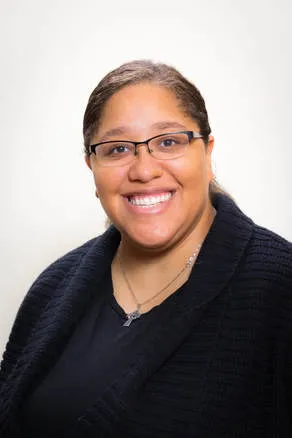
The primary work the Rev. Catherine Neelly Burton puts in with the Presbytery of Southern Kansas is with the 75% of churches in the presbytery with little or no paid leadership. Burton shared an update on how that work is progressing with the Rev. Bill Davis on the first episode of the eighth season of “Leading Theologically,” which is available here.

Davis is senior director for Theological Education Funds Development with the Presbyterian Foundation. During the current season of “Leading Theologically,” he’s exploring the theme “Everything Small Church.” Burton is Mission and Ministry Connector for the Presbytery of Southern Kansas.

On “Leading Theologically,” Burton invited listeners to do the math when it comes to PC(USA) churches being served by a pastor and those being served by someone else. Most Presbyterians go to a church served by a pastor, but most churches can’t afford a full-time pastor, she noted.
Image
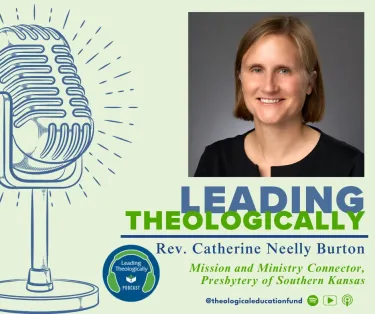
Leading Theologically with the Rev. Catherine Neelly Burton

“Unfortunately for a lot of Presbyterians who can’t fathom being in a church without a pastor, a small church probably sounds like it’s dying,” she said. In the Presbytery of Southern Kansas, only two churches have 300 or more members.

Asked by Davis how she defines a healthy small church, Burton said she goes back to a PC(USA) publication, “7 Marks of Vital Congregations,” which includes these marks of congregational health: Lifelong Discipleship Formation, Intentional Authentic Evangelism, Outward Incarnational Focus, Empowered Servant Leaders, Spirit-Inspired Worship, Caring Relationships and Ecclesial Health.

“Honestly, those have nothing to do with staff and nothing to do with size,” she said. “Is the church focused more on what it’s called to do than it is on itself? Does it see a possibility in the future more than it thinks about what it used to be? Size isn’t an issue.”

Congregational health will look different from place to place, even across one presbytery. One church in the Presbytery of Southern Kansas picks an online sermon to listen to when they gather for Sunday worship and sings along with recorded music. “It’s Spirit-inspired worship, even though it’s not what a lot of Presbyterians think of as real worship,” Burton said.

“There’s very little performative membership in rural small churches,” she said. “You’re apt to be engaged in the theological depth of it.”

Image
Rev. Bill Davis
Rev. Bill Davis

Figuring out what those churches need “gets distilled down pretty quickly,” she said. “At the end of the day, there’s not going to be a lot of fluff.” Generally, “there are people who love their church and want to learn how to lead them.” Many people in pastor-less congregations “are so receptive to being trained, to gaining more leadership and to understanding more about why we do things.”

Burton says she thinks “a lot” about incarnation in her work. “If we say the church is the body of Christ, what does it mean for that church to be the body of Christ in their community?”

“We will be closing some of these churches in the coming years. We know this,” she said. “But there is great value in that presence of the body of Christ in that community.”

There’s “a lot of good in rural America, and it’s important the church shows up for them, too,” she said. Sometimes, churches in the presbytery will call the Rev. Dr. Beth McCaw, the dean of the University of Dubuque Theological Seminary, and ask her, “when are you going to send us a pastor?”

McCaw often replies, “when are you going to send us a pastor to train and send back to you?”

“Our smallest churches just aren’t going to attract someone from the outside,” Burton said.

The work she’s been doing within the presbytery has, she said, taught her a lot about what it means to be the church.

“When you’re in a really small church, you’ve got to distill it down: OK, we want to worship, and so we’ve got to figure out what that looks like. Maybe it’s a recorded sermon and maybe we sing a cappella,” she said. “Probably we’re going to do one more thing. That’s church, as opposed to, ‘what does church do for me?’ That’s a consumer model.”

Upcoming editions of “Leading Theologically” can be seen here.

Mike Ferguson, Editor, Presbyterian News Service (Click here to read original PNS Story)

Let us join in prayer for:

Analise Brown, Mission Associate, Financial Aid for Service, Presbyterian Life & Witness
Joey Brown, Associate, Direct Mail and PILLARS, Administrative Services Group

Let us pray:

Beloved God, we want to love you with all our heart, soul, mind and strength. Help us to read your Word and understand the truth that will set us free. Teach us, dear Jesus, so that we, too, can teach like you. Amen.

Christmas Joy Offering: Walk Humbly with God Video

Watch the Christmas Joy Offering Video

Walk Humbly with God | 2026 Special Offering Video. 
Share this video with folks in your congregation to showcase the impact of the Christmas Joy Offering.

Offline Viewing

Download the video for offline viewing from Vimeo. Here’s how to download a video from Vimeo.
Thank you for generously supporting the Christmas Joy Offering. If you have any questions, reply to this email or call us at (800) 728-7228, Ext. 5047. Update your preferences for the latest information on the Christmas Joy Offering. 
If this email was forwarded to you, sign up for our list. 
Website
Facebook
Instagram
Vimeo
Copyright © 2026 Special Offerings, All rights reserved

Thursday, October 29, 2026

Mission Yearbook: YAV participates in ‘Girls on Fire’ panel at CSW in New York

Image
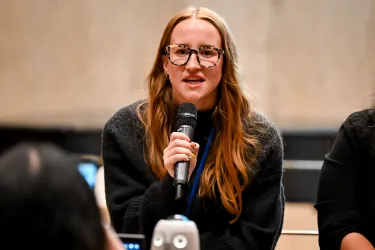
Woman speaking while holding a microphone
Olivia Phelps, a Young Adult Volunteer from Wilmington, North Carolina, participated in the the "Girls on Fire" panel in Tillman Chapel at the Church Center for the United Nations.(Photos by Rich Copley)

Ecumenical Women recently hosted its annual “Girls on Fire” panel, an event highlighting young women’s perspectives in advocacy on justice, leadership and what it means to stand up for girls in their generation. Alongside three other women from Canada, the Netherlands and India, I was honored to be invited to participate in the panel while attending the 70th session of the Commission on the Status of Women (CSW70) as a Presbyterian delegate.

Advocacy has always been an important expression of my faith. I began contacting my elected officials in middle school through emails and phone calls to express my concerns, and by ninth grade, I was arranging in-person meetings with local leaders. The first place I drove after receiving my learner’s permit was to a school board meeting addressing concerns about gun violence. For two summers, I had the privilege of serving as a fellow with the Presbyterian Office of Public Witness in Washington, D.C., where I continued to communicate the concerns of the General Assembly. Now, I serve as a Young Adult Volunteer (YAV) at the U.S./Mexico border, living and working in the communities of Agua Prieta, Sonora, and Douglas, Arizona. 

Earlier this year, I was part of a joint delegation of almost 70 Presbyterians who traveled to New York City for CSW70, the United Nations’ annual review of gender equality. During the event, delegates have the opportunity to attend sessions hosted by both U.N. Member States and nongovernmental organizations.

Image
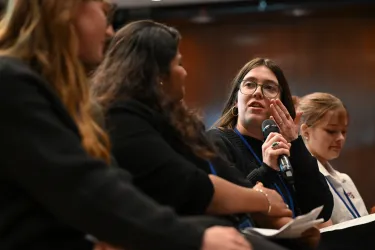
Woman with dark hair looks to the side as she says something during a panel discussion
Clare Balsan, advocacy associate for the Presbyterian Ministry at the United Nations, moderated the panel discussion, which included participants from other denominations. 

During the panel at the Church Center for the United Nations, we were asked a variety of questions related to justice and inclusion, particularly for women and girls. When asked which women or girls inspire us to care about justice, we all shared that our mothers and grandmothers were instrumental in planting that seed within us. I also spoke about how deeply I am inspired by women serving in clergy and other church leadership roles, especially given that this remains a polarizing topic across denominations. When asked about moments in which we have witnessed injustice toward women or girls, I reflected on the stories I encounter daily while living alongside the community at the U.S./Mexico border during my year of service.

When I think about the word “justice,” I am drawn to the themes woven throughout Scripture, which reveal a God of love, kindness, and mercy. In passages such as Micah 6:8, Matthew 25, Psalm 82:3, Isaiah 1:17, Deuteronomy 32:4 and Psalm 89:14, justice is not exclusive, as women and girls are included among those celebrated as being created in the image of a loving God.

Throughout the week our delegation attended CSW, the fruits of the Spirit of love, joy, peace, patience, kindness, goodness, faithfulness, gentleness and self-control were evident in the actions of those within the faith community. The most common theme shared was hope: hope as we walk humbly with God, trusting that all people may experience the justice promised to them in Scripture.

Learn more about Olivia Phelps here, and view a young adult vlog about various CSW-related activities and topics here.

Olivia Phelps, Young Adult Volunteer (Click here to read original PNS Story)

Let us join in prayer for:

Kendra Bright, Operations and Accounting Associate, Presbyterian Publishing Corporation
McKenna Britton, Communications Associate, Presbyterian Life & Witness 

Let us pray:

God, bless those who minister with our young adults. Amen.

Christmas Joy Offering Serves Leaders of the Church

Three kings walking toward a star. The words, "What does the Lord require of you, but to do justice, to love kindness, and to walk humbly with your God. Micah 6:8."

Serving Past, Present and Future Leaders

The Christmas Joy Offering is making a difference for past, present and future leaders of the church. Now joined by causes once supported by the Pentecost Offering, the Christmas Joy Offering is making an impact for children at risk, youth and young adults and leadership development for people of color, Presbyterian-related schools and colleges equipping communities of color, and servants of the church in need (through the Assistance Program of the Board of Pensions).
How Does the Christmas Joy Offering Make an Impact?
Be part of making an impact this year by making a gift to the Christmas Joy Offering through your congregation. Read more about this in our Leader’s Guide.
Download the Leader’s Guide
Thank you for generously supporting the Christmas Joy Offering. If you have any questions, reply to this email or call us at (800) 728-7228, Ext. 5047. Update your preferences for the latest information on the Christmas Joy Offering. 
If this email was forwarded to you, sign up for our list. 
Website
Facebook
Instagram
Vimeo
Copyright © 2026 Special Offerings, All rights reserved.

Wednesday, October 28, 2026

Mission Yearbook: Pastor uses parable to speak to injustices of today

Who are today’s widows?

Relying on Luke 18:1–8, Jesus’ parable of the widow and the unjust judge, the Rev. Ashley DeTar Birt, who preached during a recent Chapel Service, gave online worshipers enough background on this persistent widow to help them identify who might be her modern-day equivalents.

Image
Rev. Ashley DeTar Birt courtesy of Ashley DeTar Birt
The Rev. Ashley DeTar Birt (Photo courtesy of the Rev. Ashley DeTar Birt)

DeTar Birt is co-director of the Center for Jubilee Practice, program manager for New York Unitarian Universalist Justice and a member of the PC(USA)’s Advocacy Committee for LGBTQIA+ Equity, known as ACQ+E. 

The Bible can be a complicated text — except when it comes to widows, she said, “one of the few things [the Bible] is consistently clear on. Over and over again, throughout both the Old and New Testament, Scripture commands that we look out for the widows.” 

Jesus even warns here and here against the scribes who walk around in long robes but devour widows’ houses, she pointed out. “It is clear that special assistance must be given to the widows,” she said, “that something about those societies left widows vulnerable and powerless.”

She said the lesson for today is this: “In a society that leaves certain people vulnerable and powerless, it is our responsibility to act until that society has changed.”

Jesus’ parable pits a “vulnerable and supposedly defenseless woman who was just trying to get justice” opposite a judge “who we know lacks respect for everyone, even God,” DeTar Birt said. The widow asks for justice daily and is denied each time.

Eventually her steady efforts prevail, and the judge relents.

“She wins! Hooray! Her persistence pays off,” DeTar Birt said. “This is a great story about the importance of never giving up and keeping the faith — right?”

“I want to focus on what’s not in this parable. This is a text about a widow, and as we have previously established, if there’s one group of people to help, it’s the widows,” she said.

“So where are the helpers? Who was there to assist this woman? In this woman’s time of need, why was she fighting this judge all alone?”

Image
Tingey Injury Law Firm via Unsplash
Photo by Tingey Injury Law Firm via Unsplash

Scripture talks about two types of widows, she said — the named and the unnamed.

“The named widows in Scripture have a husband who died, but still have access to some resources,” such as Ruth, who has a family to go back to but chooses not to, and Naomi, who ends up with Ruth, “who ends up taking care of her when [Ruth] is with Boaz.”

Unnamed widows are the ones who have no one — no power and no finances, she noted, and if they are of child-bearing age and either had no children or were unable to have children, “they feel extra shame.” These women and their children, if they have children, “were routinely ignored by the men of their time, and thus God had a particular concern for them.” 

Because of all this, “protecting and caring for widows was considered a faithful act,” she said, while “harming them was considered worthy of punishment.”

“That’s what makes today’s parable all the more shocking,” she said. This unnamed widow “manages on her own to defeat the odds and convince this corrupt judge to do what’s right.” It’s a “testimony to her inner strength and righteousness that even though she had so little, she was still able to do this.”

But how can we help, and what should we do?

We can start by asking ourselves, who are the widows of today?

“So many of our trans siblings,” especially trans women of color, “are left nearly invisible, vilified and vulnerable,” she said.

Immigrants and refugee women “fear for their lives while our government ruthlessly kidnaps them and their families,” she said. “All this is happening while families and communities are being torn apart.”

“We have spent most of last year and this year hearing about horrific sexual violence committed against women and girls,” she said, and yet “most of the attention has been on abusers rather than the feelings and needs of survivors.”

“There are too many widows, and none of them should have to fight alone,” DeTar Birt said. “Standing with them, supporting them, fighting alongside them — this is how we honor and celebrate them.”

Mike Ferguson, Editor, Presbyterian News Service (Click here to read original PNS Story)

Let us join in prayer for:

Shonita Bossier, VP, Operations, Presbyterian Foundation
Terri Bowman, Customer Service Lead, Hubbard Press, Administrative Services Group

Let us pray:

Holy God, you call us to love you with our minds. Bless those who are devoted to study and teaching. By their fruits strengthen our minds and wills and so bless your church. In Christ’s name we pray. Amen.

Tuesday, October 27, 2026

Mission Yearbook: Musician Tom Trenney is guest on ‘Sounding Board’

Image
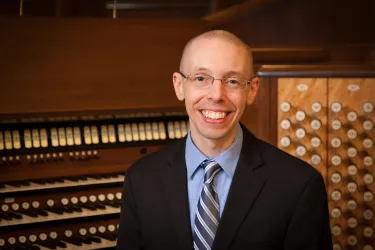
Tom Trenney
Church musician, composer and educator Tom Trenney was a recent guest on “Sounding Board.” (Photo courtesy of Nebraska Wesleyan University)

Tom Trenney, a composer, conductor, organist, preacher and teacher who has blessed and wowed attendees of the Presbyterian Association of Musicians’ Worship & Music Conference during multiple appearances over the past 20 years, was a recent guest on “Sounding Board,” hosted twice each month by Sarah Abushakra and Jeremy Roberts. Watch their 73-minute time together here on YouTube or listen on Spotify or Apple Podcasts.

Trenney is minister of music at First-Plymouth Church in Lincoln, Nebraska, which Roberts also serves, and is an assistant professor of music at Nebraska Wesleyan University, where he also conducts choirs.

Asked about his faith formation, Trenney said he’s not sure if he fell in love with church early in life, “but I did fall in love with making music and worship at church.” He recalls aligning his stuffed animals into a choir, putting on a record of a choir singing, and conducting the makeshift choir — all while wearing a Batman cape as his choir robe.

In fourth grade, he joined a church choir for both boys and men that was affiliated with the Royal School of Church Music. As a result, celebrated conductors would come to town to do summer choir camps for young singers in the region.

“Those experiences connected me with the thrill of church music and how it makes you feel and the way your spirit can vibrate in it,” Trenney said. “I could sense that was something I wanted to be a part of for the rest of my life and career.”

“It’s a reminder,” Abushakra said, “that music draws us in and gives meaning to a lot of people’s lives.”

Image
Jeremy Roberts
Jeremy Roberts

It was music “that brought me into the environment” of faith, Trenney said. “I started my career as a musician who happened to work in the church. I feel certain now that I am called to ministry and happen to be a musician.”

“The cart and the horse can go in different ways, it seems to me,” Trenney said, “and the Spirit will decide how that works for each of us.”

Among his mentors, Trenney cited the children’s television pioneer and Presbyterian pastor Fred Rogers.

“I loved [“Mister Rogers’ Neighborhood”] as a child, but I didn’t understand all the gospel I was learning in those moments. That was revealed to me later,” Trenney said. “That idea of neighboring and caring for people, allowing yourself to be creative and explore your talents rather than just comparing them to someone else’s — all of that had a strong influence on the particular way I go about being and doing the things I am and do.”

“The profession we’re in has for centuries been one that benefits from mentorship. You don’t necessarily know where Bach went to college, but you have an idea of the people he admired and sought out to help him grow and learn his craft,” Trenney said. Some people see a college degree as a signal that “you know everything,” he said, “but if we have an attitude instead that you go out and seek the people who can help you expand and grow, I think that’s why an organization like PAM can benefit us. They help us meet people who see things in a different way, who have eyes that are maybe bigger than ours and can challenge us to live into skillsets we didn’t know we needed to have at the time we went to college.”

He also relies on the work of Maya Angelou, who “had this pithy way of getting to the core of things that was really powerful,” he said. One of Angelou’s teachings is, “People will forget what you said, people will forget what you did, but people will never forget how you made them feel.”

“I think about that in how we relate to each other in ministry and music-making,” Trenney said. “People won’t remember your fancy repertoire … but they won’t forget what it felt like to be in that room when they sensed that presence of the people who gathered.”

Mike Ferguson, Editor, Presbyterian News Service (Click here to read original PNS Story)

Let us join in prayer for:

Dan Braden, Managing Editor, Publishing, Presbyterian Publishing Corporation
Tara Brannigan, Financial Administrative Assistant, Stony Point Center, Presbyterian Life & Witness

Let us pray:

O Jesus, feeder of the multitudes, please feed us. Open us up and lead us to where you are calling us to serve. Thank you for seeing in us someone who could be equipped to serve and be your disciple. Amen.

Mission Yearbook: Different ways of being church are explored on ‘Leading Theologically’ podcast

The primary work the Rev. Catherine Neelly Burton puts in with the Presbytery of Southern Kansas is with the 75% of churches in the presbyt...