In our modern time, the church cannot be silent. But what should it say?
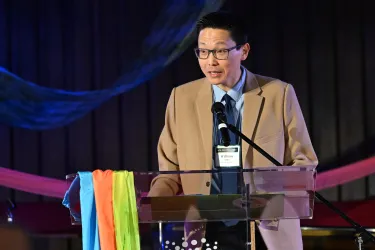
That was the question for Dr. William Yoo, Associate Professor of American Religious and Cultural History at Columbia Theological Seminary, who recently spoke at Montreat Conference Center. View Yoo’s chock-full presentation and the question-and-answer session that followed here.
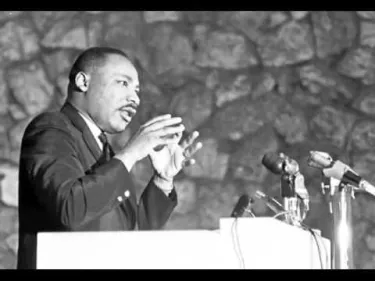
The title of Yoo’s talk is based on something the Rev. Dr. Martin Luther King Jr. said at Montreat amidst the civil rights movement, on Aug. 21, 1965: “When a crisis emerges … the Church has a specific and great responsibility. It has a real responsibility in the midst of this crisis because the problems involved are essentially moral issues. The Church being the moral guardian of the community cannot overlook its moral responsibility at this hour.”
As a moral guardian, the church “is called to be an interpreter of politics rather than an agent of politics,” Yoo said.
Many people believe they are deeply engaged in politics, Eitan Hersh wrote in The Atlantic six years ago. But mostly, “they consume political information as a way of satisfying their own emotional and intellectual needs.
These people are political hobbyists. What they are doing is no closer to engaging in politics than watching SportsCenter is to playing football,” Hersh wrote.
When Yoo talks to churches, he asks them to fulfill the moral guardian role that King mentioned. “I would like churches to talk about maybe not partisan things, but political issues,” he said. “I would like for us to talk about how to do commonsense immigration enforcement. I think we need to talk about being a lawful nation, so people don’t have to live in the shadows, so people are protected and have access and pathways to dignity and flourishing, and I think that belongs in the congregation.”
Faith communities “need to get into the harder work of thinking about politics in the form of morality and what it means to be a guardian” as well as “what it means to be an interpreter of messy politics for the gospel, for the sake of the common good and moral flourishing,” he said. But how do we do that “in these extremes of political polarization?”
In researching Christian nationalism, Yoo ran across Gerald L.K. Smith, a minister and would-be politician who had the idea at the outset of the Great Depression that elderly Americans ought to have a social safety net.
He later formed his own political party, which he initially called the America First Party. He moved from there to call it the Christian Nationalist Crusade, Yoo noted. Smith later told the House Un-American Activities Committee, “I am just an old-fashioned, Bible-believing, Christ-loving American.”
What Yoo takes away from the Theological Declaration of Barmen is “it is right for the church as moral guardian to think deeply about economic struggles and the decline of the American Dream. But authoritarianism and Christian Nationalist parties are not the right prescription for this diagnosis.”
During his speech at Montreat, King, speaking at the time of the Watts Rebellion, noted that “at the bottom of many of the conflicts taking place today in many of our cities is the lack of economic opportunity.”
“Now the church, again the moral guardian of the community, must see this,” King said. “The church must speak to the power structure of the nation.”
It is the lack of opportunity and the decline of the American Dream that we’re witnessing today, Yoo said. Gene Ludwig, the 27th comptroller of the currency and a business and civic leader, called the American Dream “the desire that most parents hold: that with hard work and gumption, their children will be able to do a little better than the generation that came before them. The presumption of upward mobility has long distinguished American life.”
For Yoo, the dream is less about upward mobility “and more about freedom of opportunity to choose a vocation that maybe won’t lead to extravagant wealth, but to a decent wage and flourishing.”
Mike Ferguson, Editor, Presbyterian News Service (Click here to read original PNS Story)
Let us join in prayer for:
Dwayne Batcho, Production Clerk, Presbyterian Distribution Service, Administrative Services Group
Doug Batezel, Senior Vice President & CIO, Information Technology, The Board of Pensions
Let us pray:
O God, we ask your blessing on those whom you have called. Strengthen them in this important service even as they strengthen the church through their work. Amen.


No comments:
Post a Comment