Showing posts with label Minute for Mission. Show all posts

Sunday, October 25, 2026

Minute for Mission: Reformation Sunday

Image
Barmen Declaration
Barmen Declaration - PHS Graphic (provided)

In 1934, representatives of Germany’s Protestant churches gathered in Wuppertal, Barmen, and wrote a letter to the German people on the unity of the church and its freedom in Jesus Christ. We remember this modest text because of its situation — it accused the official church of Nazi Germany, the Reichskirche, of error.

The Theological Declaration Concerning the Present Situation of the German Church, without naming the Nazis, holds that the Fuhrerprinzip is incompatible with Christianity (Book of Confessions, 8.12). It avers that the Church does not orient itself based on “prevailing ideologies and political convictions” (8.18). At its most forceful, it says: “We reject the false doctrine, as though the State, over and beyond its special commission, should and could become the single and totalitarian order of human life, thus fulfilling the Church's vocation as well” (8.23). 

Few German Protestants opposed the Nazis — only about 10% of German ministers were members of the Confessing Church. And the drafters made clear that Barmen was a theological document, not a political one. Wilhelm Niemöller, whose brother Martin was amongst the Barmen drafters, wrote in 1956: “The confessing Church has never, neither during Hitler’s reign nor afterwards, made a point of being understood as a ‘resistance movement,’ or as an ‘opposition,’ or as a ‘front.’ It wanted to witness the one Word in our world and time.”

In preparing a new Book of Confessions for the United Presbyterian Church in the U.S.A. in 1965 and 1966, the General Assembly’s Committee of Fifteen selected the Barmen declaration to represent modern Christendom. One member of the committee preached in his own congregation that in Barmen’s vision of life, “the church may not willingly become the victim of state power.” 

The banner representing Barmen was designed by the duo Avery and Marsh, better known for their musical theater and hymns. It shows the swastika struck through and the cross rising. 

McKenna Britton, Communications, Presbyterian Historical Society

Let us join in prayer for:

Teresa Bidart, Mission Specialist, Self-Development of People, Presbyterian Life & Witness
Ricky Blade, Customer Service Representative, Constituent Ministry, Presbyterian Life & Witness

Let us pray:

Creator God, guide us as we seek to remain faithful to the way of Jesus Christ. Give us wisdom to recognize when faith is shaped by forces that diminish the dignity and freedom of others. Open our hearts to truth, deepen our compassion, and give us courage to follow Christ’s call with humility and love. Amen.

Minute for Mission: United Nations Day

Image
secretary-general
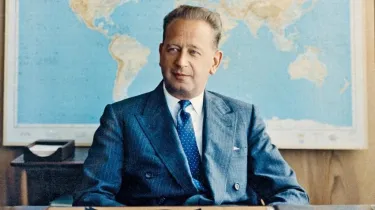
Mr. Dag Hammarskjold (Provided by Presbyterian Ministry at the U.N.)

Dag Hammarskjöld, the second Secretary-General of the United Nations, famously said the U.N. “was not created in order to bring us to heaven, but in order to save us from hell.” 

United Nations began as a great experiment, a new hope, to save future generations from war and to maintain peace and security, to build a better world and to respect human rights. But Hammarskjöld understood that it would take great effort to overcome human frailty. 

“The pursuit of peace and progress cannot end in a few years in either victory or defeat. The pursuit of peace and progress, with its trials and its errors, its successes and its setbacks, can never be relaxed and never abandoned.”

Hammarskjöld lived out his commitment to God through service to the world, who saw his diplomatic mission as a calling. He was a fiercely private man who did not use his public platform to promote his views on religion. It was only after his death that his views were known in his private journal, “Markings.” 

Hammarskjöld pioneered quiet diplomacy and preventive diplomacy through his understanding of human nature to overcome biases, egos and public posturing of the world leaders. In this way, he was able to diffuse major crises of his day, such as the 1956 Suez Canal Crisis. 

When he was asked to step down by the Soviet premier, Nikita Khrushchev, during the Congo Crisis, he refused, stating that the U.N.’s mandate was to protect smaller, more vulnerable countries from the predatory self-interest of the superpowers.  

Tragically, Hammarskjöld died in a plane crash on Sept. 18, 1961, on his way to negotiate a ceasefire in what is now Zambia. He was a man of faith who saw his diplomatic mission as a deeply moral and spiritual calling. 

“Our work for peace must begin within the private world of each one of us. To build for man a world without fear, we must be without fear. To build a world of justice, we must be just. And how can we fight for liberty if we are not free in our own minds? How can we ask others to sacrifice if we are not ready to do so?” 

The United Nations will elect its 10th secretary-general this year. May she or he have the courage of conviction and vision to serve the world as our second SG (as we fondly call them). 

Sue Rheem, Representative to the U.N.; Manager, Presbyterian Ministry at the U.N.; Presbyterian Life & Witness

Let us join in prayer for:

Barbara Betts, Manager, Presbyterian Distribution Services, Administrative Services Group
Beverly Bewley, Customer Service Representative, Operations, Presbyterian Publishing Corporation

Let us pray:

Dear God, we pray that you may grant the new secretary-general a new vision and to lead the United Nations with wisdom and courage, and may we work for your justice and peace in the world. Amen. 

Sunday, October 18, 2026

Minute for Mission: Children’s Sabbath; Educate a Child, Transform the World

Image
A and D Bible Share
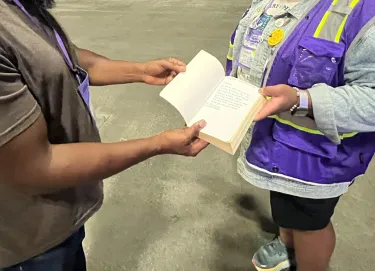
A and D bible share (Photo provided by Alonzo Johnson)

At last year's Presbyterian Youth Triennium, one of my young participants — who was part of the Presbyterian Youth Triennium’s planning team — read Scripture in worship in front of a large audience of enthusiastic young people. Having known this incredible individual for over 20 years, I felt immense pride as I witnessed this. He had been one of the remarkable young people in the urban church I served many years ago. Since my departure from that church, I hadn’t seen him in what seemed to be years, and in that time, he had finished high school and was finishing college, so as one can imagine, I was excited to see him blossom into the amazing leader he is today. When he read Scripture at the lectern during Youth Triennium, my heart was both full and proud. After the service, he approached me and said, “Rev, I have something to show you.” He handed me a Bible and told me to open it. When I did, it contained my writing and words of encouragement to him from over 15 years ago on the first page. This was the Bible that our church had given him at his confirmation. As I held back tears reading my old words to him, he said, “I carry it with me.” This moved me deeply and made me reflect on the important work the church does to care for, nurture and shape its young people. 

Our young people thrive when churches provide consistent care and support, including encouragement in their education. When I think of this remarkable young person now serving the church, I am reminded that our congregations can offer every young person hope, nurture and sustenance. In these ways, we carry them with us.

The Educate a Child, Transform the World covenant describes this supportive work of the church as the practice of Christian Disciplines. These disciplines prepare, propel, ground and sustain children for life, leadership and justice. Through confirmation and other spiritual practices — including worship, prayer and Bible study — the church communicates God’s grace and strengthens both the community and its young people in faithful witness. Practicing Christian Disciplines also means celebrating, honoring and supporting those who educate our children. Our baptismal vows unite us with the universal Church, a covenant community called to pursue justice for every child.

The following links offer ways to support young people and explore issues related to public education:

Educate a Child website: https://pcusa.org/about-pcusa/agencies-entities/interim-unified-agency/ministry-areas/self-development-people/educate-child-transform-world

PC(USA) Poverty Page: https://pcusa.org/how-we-serve/justice-peace/poverty

Rev. Dr. Alonzo T. Johnson, Convener of the Education Roundtable

Let us join in prayer for:

Zenia Baker, Administrative I, Operations, Presbyterian Foundation
Adriana Ballard, AVP, Director of Investment Management, Investments, Presbyterian Foundation

Let us pray:

Because we affirm that all children are a gift of God, created by God and
created good; all children are a gift to the whole of the human community;
all children have a real faith, and gifts for ministry; all children have the
right to be children; and all children are not just tomorrow, they are today.
Therefore, we covenant to act, with God’s grace, to help all children to learn,
to succeed and to fulfill their God-given potential. Amen.

This prayer was adapted from “A Protestant Worship Service,” in Wonderfully Made: Preparing Children to Learn and Succeed. National Observance of Children’s Sabbaths, Copyright 1999, Children’s Defense Fund, and A Vision for Children and the Church. It can be found in our PC(USA) Policy on education: pcusa.org/resource/loving-our-neighbors-equity-and-quality-public-education-k-12

Friday, October 16, 2026

Minute for Mission: World Food Day

mage
World Food Day
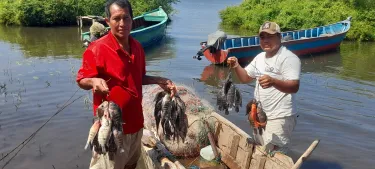
Guillermo and Julio Lanuza show off their catch of the day. (Courtesy of Asofenix)

World Food Day is observed every year on Oct. 16. This year’s theme, “Innovate today. Nourish tomorrow,” asks us to look at how forward-thinking solutions can work alongside traditional knowledge to feed people and protect the planet. On Zapatera Island in Nicaragua, a group of families is showing that innovation doesn’t always require complex technology. Sometimes, it means finding new ways to harness the sun, the sea, and the resources already around them to build a more resilient future.

Zapatera Island, located in the municipality of Granada, faces unique challenges. Reachable only by small wooden boats built by residents, the island suffers from relative isolation. This geographic barrier limits access to government support and broader markets, leaving many families in poverty, suffering from poor nutrition. Yet, the island possesses a wealth of resources: fertile soil, freshwater, forests, abundant fish and plenty of sunlight. 

Image
World Food Day
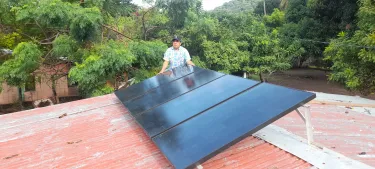
A man installs solar panels on Zapatera Island.(Courtesy of Asofenix)

The Asociación Fénix (Asofenix), a Nicaraguan nongovernmental organization, specializing in renewable energy and sustainable agriculture, has worked for over two decades to improve living conditions in rural areas. Their track record includes installing solar-powered water systems, small hydroelectric plants and more than 500 clean wood-burning stoves across 15 communities. As a partner of the Presbyterian Hunger Program (PHP), Asofenix brings both technical expertise and a deep commitment to community-led development.

Their current initiative, funded by PHP, focuses on capacity building for 28 families, aiming to establish small, community-based businesses powered by solar energy. The project rests on three pillars. First, it promotes sustainable aquaculture and value-added processing of fish, moving beyond subsistence fishing. Second, it revives Indigenous agricultural techniques, helping families cultivate crops like corn and beans for both consumption and sale. Third, it introduces a solar-powered retail system, allowing the community to preserve and sell natural products efficiently. Throughout this process, the families participate in planning, implementation and management through elected committees.

The impact extends to approximately 150 people across four communities. By producing manuals on Indigenous agriculture and compiling a community cookbook, the project ensures that community knowledge will remain within the island. Looking ahead, Asofenix plans to expand the program to more families and develop community-based tourism to secure long-term funding. 

As World Food Day reminds us, true food security is rooted in sovereignty. For the families of Zapatera Island, harnessing the potential of their own land, waters, and the sun is about more than nourishing themselves today, it is about building a future where they can sustain their families and feed their communities for generations to come.

Eileen Schuhmann, Associate for Global Engagement and Resources, Presbyterian Hunger Program

Let us join in prayer for:

Nora Baez, Lead Reservation Specialist, Stony Point Center, Presbyterian Life & Witness
Amber Baker, Donor Advised Fund Specialist, Operations, Presbyterian Foundation  

Let us pray:

May God bless the soil and waters of Zapatera Island, bringing abundant crops, plentiful fish and nourishment for every family. May the sun power their endeavors, giving light and energy to their work and hope for the future. Guide their hands with wisdom and perseverance, and may their harvests bring nourishment, prosperity and a brighter tomorrow. Amen.

Wednesday, October 14, 2026

Minute for Mission: Mothers and daughters find connection at CSW

Image
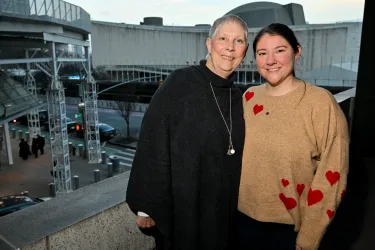
A mom and her adult daughter are all smiles while posing for a photo
Punky Dahl, left, and daughter Haley attended events during the 70th session of the Commission on the Status of Women. (Photo by Rich Copley)

Participating in this year’s Commission on the Status of Women was a family affair for some of the Presbyterians who gathered in New York City in March.

The Presbyterian News Service caught up with a few mother-daughter pairs who took part in the 70th session of CSW, an international gathering aimed at promoting gender equality and the empowerment of women. 

Interviewed at Church of the Covenant were Laura Browne and her daughter, Julianne; Punky Dahl and her daughter, Haley; and Laura Zhang-Choi, whose daughter, Ella Choi, commented later.

The duos were among nearly 70 participants recruited by Presbyterian Women and the Presbyterian Ministry at the United Nations to take part in timely discussions and educational sessions, worship services and advocacy opportunities.

“I thoroughly enjoyed being a part of the CSW,” said Ella Choi of Stewartsville Presbyterian Church in New Jersey. “It was an extremely eye-opening experience, and I learned a lot about how faith and female empowerment are integral to one another.”

Video URL: https://player.vimeo.com/video/1174456753

Before the event, the Brownes of Orangewood Presbyterian Church applied but didn’t expect to get accepted.

“I thought, ‘Are you kidding me?’” said daughter Julianne Browne of Phoenix. “A place where I can actually go and talk to people who are doing good in the world, learn from them, bring stuff back? That sounded like everything I had been wanting for so long.”

When the Brownes learned they had been accepted, “we were screaming” with joy, Laura Browne said. 

This year’s theme, ensuring and strengthening access to justice for all women and girls, prompted sessions on topics ranging from gender-based violence to survival in war-torn regions.

Laura Browne came to learn about the gender wage gap and women in leadership. It’s “very depressing that it's 2026 and there's still a huge gender wage gap in many countries.”

Julianne Browne focused more on sexual violence against women. “It's close to my heart because pretty much every woman I have met in my life, especially my friends — every single woman — has had some kind of violent experience at the hands of a man, including myself.”

Video URL: https://player.vimeo.com/video/1174492307

Zhang-Choi wanted her daughter to witness discussions about challenges that don’t “just exist in Stewartsville or in New Jersey, but worldwide, women face a lot of the same challenges.” She also wanted Choi “to see the beauty of God's imagination for all humankind,” the diversity, and the importance of making space for everyone to belong.

Choi, a junior at Barnard College of Columbia University in New York City, said participating in CSW with her mother “made it even more meaningful and impactful. Not only did it deepen our relationship through faith, but it also connected us through a shared understanding of how gender equality has progressed across generations. It reminded me of the work women, including my mom, have done for gender equality, and it motivated me to advocate for future generations of women by uplifting female voices in faith spaces.”

Video URL:  https://player.vimeo.com/video/1174430656

Punky Dahl, who’s based in Oklahoma City but attends Southminster Presbyterian Church in Tulsa, said CSW provides an opportunity to learn about issues affecting women around the world and bring that knowledge home.

Having her daughter, Haley, with her provided additional support. “Some of the sessions are very heavy, and when you can sit down and you can discuss it with someone you love, and get two different opinions, but come together as one, it makes such a huge difference,” Punky Dahl said.

Haley Dahl attended to get a feel for CSW and participated in events that did not require a U.N. badge. She was particularly interested in a panel on the intersection of homelessness and gender-related issues and began thinking about how to apply what she learned locally.

For Julianne Browne, the experience also offered a new sense of belonging. Before CSW, she said, “I didn’t feel like I belonged or like people would accept me because I am queer and I’m a woman.”

After participating in a regional online orientation, however, “it felt like the first time in a very long time that I had gotten like a sign.”

Upon arriving in New York, she said she felt welcomed by delegates and others she met. “I have felt seen.”

Darla Carter, Communications Strategist, Presbyterian Life & Witness (Click here to read original PNS Story)

Let us join in prayer for:

Roberta Romano, 1001 NWC Apprentice, 1001 New Worshiping Communities, Presbyterian Life & Witness
Rebecca Newgren, 1001 NWC Apprentice, 1001 New Worshiping Communities, Presbyterian Life & Witness

Let us pray:

O Holy Spirit, open each new generation to your renewing wind. Blow afresh in our lives, that we all might be empowered to do your will in service and love. Amen.

Monday, October 12, 2026

Minute for Mission: Celebrating Indigenous Peoples’ Day

Image
The Rev. Irv Porter, left, leads participants at the Presbyterians for Earth Care Conference in the Blanket Exercise at the Stony Point Center in Stony Point, N.Y.

Traditionally, on the second Monday of October, the United States celebrates the anniversary of Christopher Columbus’ arrival in the Americas on Oct. 12, 1492.

However, many communities across the nation celebrate Indigenous Peoples’ Day rather than Columbus Day. Indigenous Peoples’ Day is part of a growing movement to end the celebration of the Italian explorer and rather honor and recognize Indigenous people, the original occupants of the Americas.

Many scholars believe it was Viking Leif Erikson who first came to what would be become known as the New World from overseas. They believe Columbus wasn't the first European to discover what we know as the Americas and that he first landed on the island of Guanahani in the Bahamas. And, according to the Encyclopedia Britannica, Columbus never set foot in North America but in present-day Venezuela on his fourth journey.

While Columbus didn't technically discover America, he was instrumental in the colonization of North America and its lasting effects on this nation.

In an effort to help Presbyterians realize the atrocities enacted upon Indigenous people, the Native American Intercultural Congregational Support ministry has conducted the Blanket Exercise so that individuals can better visualize the impact of Columbus and the Church’s actions against Indigenous people.

The exercise explores the tenets of the Doctrine of Discovery, the 1493 papal edict promoting the appropriation of land and the subjection of inhabitants of that land during the era of European exploration.

Part physical experience and part history lesson, the Blanket Exercise raises awareness of the systemic and systematic process Europeans, the U.S. government and the Church used to steal land, separate families, forcibly take children from parents to boarding schools and murder hundreds of thousands of Native Americans.

During the exercise, individuals are invited to stand on the blanket of their choosing among about 20 or so covering the floor. Four individuals read from a script that outlines the cruel effects the Doctrine of Discovery had on Native Americans. An assistant periodically rolls up corners and edges of the blankets until there is scant room for participants to stand.

As the blanket exercise plays out, crowd members — playing the part of the up to 30 million Native Americans present in what Europeans called the New World when Christopher Columbus landed on Caribbean islands more than five centuries ago — take a seat as disease, warfare, broken treaties, forced migration and mandatory boarding schools took their toll. In the end, very few people remain standing on what’s left of the blankets.

In one presentation of the blanket exercise, Irv Porter, associate for Native American Intercultural Congregational Support, told participants, “If you’ve never heard this before, you’re not alone. This is the kind of history nobody cares about.” The mission, he said, is to “wake us up that this happened. We as a denomination are trying to blunt this racism.”

Although the exact number of communities that observe Indigenous Peoples’ Day,  on the second Monday in October is unknown, at least 10 states, many college campuses and more than 100 cities have replaced Columbus Day with some version of Indigenous Peoples’ Day.

For many Native Americans, Columbus Day is viewed as hurtful and misleading. It’s reminiscent of centuries of violent history and colonial oppression at the hands of European explorers and the Church. For many, the hurt and ramifications of those actions and wounds still run deep today.

However, as Porter said during a blanket exercise, quoting Rio Ramirez, a Tohono O’odham educator in Tucson, Arizona: “No one here today made these things happen. But we are the ones who are living now, and we need to understand that we are all in this together.”

Gail Strange, former Communications Strategist, Presbyterian Life & Witness (Click here to read original PNS Story)

Let us join in prayer for:

Amisi Ngongo, 1001 NWC Apprentice, 1001 New Worshiping Communities, Presbyterian Life & Witness
Eka Tawe, 1001 NWC Apprentice, 1001 New Worshiping Communities, Presbyterian Life & Witness

Let us pray:

Lord Jesus, thank you for inviting all of us to participate in your mission. Guide our congregations as we disciple, giving them opportunities to see your work in and through them in the world. Amen.

Sunday, October 4, 2026

Minute for Mission: World Communion Sunday

Image
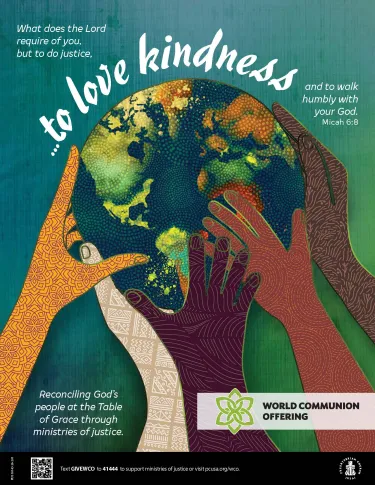
World Communion Offering 2026

Micah 6:8: “What does the Lord require of you? … to do justice and to love kindness and walk humbly with your God.”

The Kingdom of Heaven is like a house with many rooms, so there must be a BIG kitchen table. The Gospels have enough food references to stock a pantry and Scriptures make plain that Jesus loved to sit and share meals with friends and strangers. 

So, I imagine God’s kitchen table is bustling with all types, surrounded by people we know and people we don’t, all brought together for the sake of being together. God, ever the gracious host, greets each of us with a warm hug, pulls out a seat, and invites anyone and everyone to stay awhile.

This image is insightful in the context of our resurrection into new life, but the metaphor extends into our lives on earth as a foretaste. In the Lord’s Prayer, we boldly request that this be made true on earth as it is in Heaven. Graciously, God spoke through the Prophet Micah what is expected to accomplish this monumental task: Do justice. Love kindness. Walk humbly with God. 

Simple, right? Yet despite the thousands of years since we received this guidance, we remain inhabited in a world that is too often unjust, unkind and idolatrous. Our focus on what makes us different is used to justify exclusion, instead of recognizing the gifts of diversity and God’s call to be together. But though we continually fall short, God’s grace impels us to keep trying to live into the fullness of Micah’s prophecy with each new day.

The World Communion Offering is a new way for Presbyterians to “love kindness” by recognizing the inherent worth of every person, practicing hospitality and making room at the table for all people. This Offering works to reconcile God’s children by supporting the wider Church in the work of racial justice, gender justice, global witness, peacemaking, and ecumenical and interfaith relations. 

This World Communion Sunday, I invite you to consider how you can join in this mission. Is there someone you need to extend a merciful hand to? Are there members of your community seeking justice and failing to receive it? Whose love is missing from your table? Can you build a bigger one?

Your gifts, combined with those of other congregations, empower the World Communion Offering to support the PC(USA) ministries, partners, congregations and mid councils addressing these questions and their underlying challenges. While reconciliation begins in our hearts, the Special Offerings recognize how we can do this work together. With God’s help, we can work toward the Kingdom of Heaven with the hope that each and every person can take their seat at the Table of Grace.

Sarah McDowell, Annual Giving Officer, Stewardship and Funds Development

Let us join in prayer for:

Jessica Oms, Reservation Specialist, Stony Point Center, Presbyterian Life & Witness
Njeri Wagana Hughes, Associate, Partners Beyond the PCUSA, Presbyterian Life & Witness

Let us pray:

Holy God, as we come to your table on World Communion Sunday, we thank you for all your servants who enact justice around the world and who ensure that your love is made known. In Jesus’ name we pray. Amen.

Tuesday, September 15, 2026

Minute for Mission: Celebrating Christian Formation Week

Image
Christian Formation
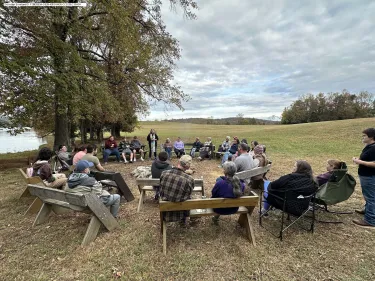
Powell Presbyterian Church Intergenerational Retreat at John Knox Center in TN. (Photo courtesy of Powell Presbyterian Church)

Christian formation is a lifelong process that encompasses all of life’s experiences, actions, and relationships — helping us live out our faith, deepen our spiritual lives and grow in relationship with God. While Christian education often focuses on the formal teaching of Scripture, doctrine and religious concepts, Christian formation invites people of every age to discover God’s presence in the whole of life.

During Christian Formation Week, the Presbyterian Church (U.S.A.) celebrates the people and ministries that nurture this lifelong journey of faith. As congregations begin a new program year, many mark the season with back-to-school blessings, teacher commissioning, and opportunities for people of all ages to learn, serve, pray and grow together.

The Around the Table Initiative offers one powerful example. Through its intergenerational approach to the essential Sabbath practices of hospitality, storytelling, prayer, retreat and service, Around the Table equips parents and caregivers for faith conversations at home while helping congregations practice faith together across generations.

Over the past two years, faith community leaders have gathered online in cohorts to explore these practices and ways to strengthen intergenerational formation. Each cohort concludes with an intergenerational retreat — creating space for communities to experience Sabbath together.

At one retreat, 50 members of Ceiba Baja Presbyterian in Aguadilla, Puerto Rico, participated – a remarkable turnout for a congregation averaging just 54 people in worship. Leadership spanned generations from Gen Z to Boomers, and participants described the experience as “a true sabbath,” marked by “genuine interaction” across generations, according to Pastor Carlos Torres Badillo.

At Powell Presbyterian Church in Tennessee, members ages 12 to 86 traveled to John Knox Center. A teenager who had recently begun attending church confessed, “I didn’t know church could be like that.” Pastor Katina Sharp reported that he said he had never met Christians who cared about what kids thought.

These stories remind us that Christian formation happens when generations gather, listen, pray, serve, and make room for one another — and discover together what it means to follow Jesus.

Find resources like Back to School Blessings, Worship Liturgy, Teacher Commissioning Liturgy, Starting a Children’s Home Library and more at pcusa.org/christianformationweek. Find the Everyday Faith Moments Card Deck, Pull Up a Seat Retreat and other resources from the Around the Table initiative at pcusa.org/aroundthetable as well as upcoming cohort opportunities. In addition, find Quicksheets with program ideas, short studies and leadership helps for working with all ages at pcusa.org/formationresources.

Miatta Wilson, Associate for Christian Formation, Presbyterian Life & Witness, christian.formation@pcusa.org 

Let us join in prayer for:

Carla Wilson, Customer Service Representative, Constituent Ministry, Interpretation & Communications, Presbyterian Life & Witness
Mari Evans, Digital Marketing Manager, Digital Marketing, Interpretation & Communications, Presbyterian Life & Witness

Let us pray:

Loving God, we pray for leaders, faith communities and people of every age. May they deepen their faith through all of life’s experiences and remember that you are with them. Amen.

Sunday, September 6, 2026

Minute for Mission: A Season of Preparation begins

Image
A Season of Preparation (MYB)

For the first time this year, the 226th General Assembly (2024) created A Season of Preparation, which is an intentional time for all PC(USA) congregations to prepare for World Communion Sunday on Oct. 4 and receive the new World Communion Offering.

A Season of Preparation includes movements that reflect the way we Presbyterians join together in liturgy surrounding the sacrament of the Lord’s Supper: pray, bless, take, break, give. Each of these movements has a particular significance as we prepare our hearts to join with siblings all around the globe on World Communion Sunday and share in this sacrament wherever we worship God. We pray for the world and for the Holy Spirit to enliven the bread we eat and the cup we drink so that it might fuel for the journey of faith. We ask God to bless these normal elements so that they serve an extraordinary purpose as we commune with God and remember that night so long ago when Jesus broke bread with his disciples one final time. We take these elements to taste and see that the Lord is good. And finally, we give, we respond to all we have joined together to pray, bless and take, and we do this in a variety of ways. We give of time and talent, and we give of our very lives to ensure that God’s reign of justice, love and peace is made known all around the globe. This is holy movement, a sacred opportunity to dine together — and, on this special Sunday for which we are preparing, we are privileged to do it with siblings in faith here and everywhere.

The World Communion Offering was also created by the 226th General Assembly (2024) to help us live out the hope we find at Christ’s Table of Grace. Through its support of PC(USA) ministries focused on racial justice, gender justice, peacemaking, global witness, and ecumenical and interfaith relations, the World Communion Offering provides a chance for congregations and individuals to give in a way that enlivens our worldwide Table in new ways so that all God’s children could flourish just as God intends for every person. Today, think about all the ways you might do that, too. How might you do your part to work with God to ensure that all God’s children flourish?

Rev. Wilson Kennedy, ECRF, Associate Director, Stewardship and Funds Development, Presbyterian Church (U.S.A.)

Let us join in prayer for:

Lucy Bryant, Online Service Client Relations Specialist, Operations, The Presbyterian Foundation
Rick Jones, Director of Interpretation & Communications, Presbyterian Life & Witness

Let us pray:

Holy God, thank you for the gift of your Son, Jesus Christ, who brought his disciples together to dine, and who invites us to dine together, too, at the Lord’s Table. May our sacramental act of Communion give us fuel for the journey of faith, and may it help us help God to ensure that all people live into the fullness of their creation, just as God intends. Amen.

Tuesday, September 1, 2026

Minute for Mission: World Day of Prayer for the Care of Creation

Image
Earth Care
Water credit: Kayla Eickholtz

Each year, starting on Sept. 1 (World Day of Prayer for All Creation) until Oct. 4, the ecumenical community unites for the Season of Creation, a worldwide celebration of prayer and action to protect our common home. In this season, we celebrate God as Creator and acknowledge Creation as the divine continuing act that summons us as collaborators to love and care for the gift of all that is created. 

The Season of Creation Biblical text for this year is drawn from Ezekiel 47:1–12, which portrays God’s life-giving water flowing from the temple of God. The river grows deeper and deeper restoring barren land, reviving waters, and sustaining flourishing ecosystems. This vision invites human responsibility: recognizing ecological damage, embracing interconnectedness, we are called to immerse ourselves in the water, and actively safeguarding and working for the renewal of Creation so that environmental healing and human well-being may flourish together.

The Season of Creation is a perfect opportunity to include the entire congregation, from the oldest to the youngest members. Some ways to do that could be:

Nature Walks and Exploration: Encourage participants to observe the natural world around them, noticing changes in plants, animals and the weather. 

Creative Expression: Invite participants to draw, paint, or sculpt representations of Creation, or to write poems or songs about nature. Collect leaves, rocks, sticks or flowers to make nature-based art works.

Acts of Service: Engage in simple acts of caring for Creation, like planting seeds, making bird feeders or cleaning up litter. 

Prayers and Reflection: Pray together for the protection of Creation and for those who are most affected by environmental problems. 

Creditto the Celebration Guide for the Season of Creation, which is available to help congregations and can be downloaded here.

Please join the Presbyterian Hunger Program and Creation Justice Ministries on Tuesday, Sept. 1, 2026 at noon Eastern time for a webinar to launch the Season of Creation with special guest Queen Quet, Chieftess and Head-of-State of the Gullah/Geechee Nation. 

Jessica Maudlin, Associate for Sustainable Living and Earth Care Concerns, Presbyterian Hunger Program, Presbyterian Life & Witness

Let us join in prayer for:

Shonita Bossier, VP, Operations, Presbyterian Foundation
Terri Bowman, Customer Service Lead, Hubbard Press, Administrative Services Group (A Corporation)  

Let us pray:

Holy God, whose Spirit hovered over the waters at the beginning, we gather as part of your community of all Creation, thirsty for your grace. May God who brought water from the rock sustain us in the desert. May Christ our Lord who is Living Water refresh us for the work of restoration. And may the Holy Spirit carry us on currents of grace until justice rolls down like waters and righteousness like an ever-flowing stream. Amen.

Sunday, August 30, 2026

Minute for Mission: Presbyterian Higher Education

Image
Presbyterian Higher Education
Agnes Scott Library Student (Jeff Arnold)

Because our colleges and universities are Presbyterian-related, we value learning, faith, service and connection to each other, the Church, and the world, honoring the dignity and worth of every person.

We don’t value learning and all faith traditions represented on our campuses in spite of our church-relatedness. It is because we are church-related that we value and cherish all inquiry and welcome and encourage all faith communities.

Learning, faith, service — the order is important. We are schools, not churches, and our primary mission is education. Learning comes first. Nevertheless, as church-related institutions, we are concerned to educate whole people for the whole world. We strive to graduate students who are not only academically well-prepared but also spiritually and socially mature participants in the religious and civic communities of which they are a part.

We value our relationships with the Presbyterian Church (U.S.A.) and with other schools who share a similar relationship. We are not, and do not wish to be, identical institutions. Yet we appreciate our common connections and commitments. We benefit from our mutual relationship, we are all grateful for the historic and ongoing support of the Church, and we are committed to maintaining that relationship.

Our connection to the world is both social and environmental. We seek to serve the whole world through our service to each student. We understand ourselves to be part of a global community of teaching, learning and inquiry. We also work to exhibit, embody, and encourage environmental responsibility on our campuses and beyond. As stated above, we strive to educate whole people for the whole world.

Honoring our efforts to live out our commitment to learning, faith, service and connection takes place in the context of our ongoing and pervasive commitment to honor the dignity and worth of all people. Our schools are resources and instruments through which the Presbyterian Church (U.S.A.) serves the world as we serve each of our students in all their magnificent variety and particularity.

Jeff Arnold, Executive Director, Association of Presbyterian Colleges & Universities

Let us join in prayer for:

Barbara Betts, Manager, Presbyterian Distribution Services, Administrative Services Group
Beverly Bewley, Customer Service Representative, Operations, Presbyterian Publishing Corporation    

Let us pray:

Gracious God, we are grateful for the Presbyterian emphasis on education and for the many blessings that allow Presbyterian-founded colleges and universities to faithfully serve more than 140,000 students each year. Amen.

Mission Yearbook: Calm in Crisis’ is subject of webinar

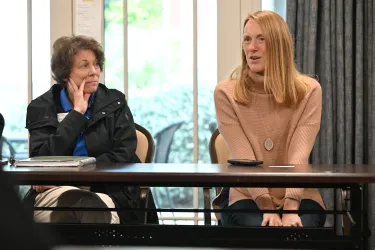
Image The Rev. Megan Katerjian, CEO of Door of Hope, talks about losing her home in the Eaton Fire as PDA's Kathy Riley listens. (Photo ...