| ||||
Convert, Flee or Be Killed | ||||
| In the summer of 2014, militants from the self-proclaimed Islamic State (ISIS) advanced across Syria and northern Iraq. As they entered each village, they marked Christians’ homes and businesses with the Arabic letter “N,” or ن, for “Nazarene.” This symbol served to both identify and threaten Christians, who then had a difficult decision to make: convert to Islam, leave the area or be killed. More than 100,000 Christians were forced to flee in stifling heat. Most escaped with only the clothes on their backs. Many died on the road or were taken by ISIS.
Ten years later, the city of Mosul has been liberated from ISIS. But the Islamic extremism that powered its cause still threatens Christians today all over the world. But our Christian brothers and sisters are not cowering in fear in the face of this aggression. Instead, they are working to advance the gospel, even among their persecutors! We invite you to stand with these bold Christians facing Islamic extremists. Your gifts provide help to those who have been persecuted, tools and training for those reaching persecutors for Christ, and Bibles to strengthen the church and share with others as well. When you give this month to help Christians facing Islamic extremists, VOM will send you a copy of I Am N: Inspiring Stories of Christians Facing Islamic Extremism. In this book, you’ll read the stories and meet the families of believers who boldly follow Christ in the face of Islamic extremism. These stories will deepen your faith in God, who gives us the courage to shine brightly even in places where darkness seems to dominate. | ||||
| ||||
| ||||
|
Friday, June 7, 2024


Thursday, June 6, 2024
Today in the Mission Yearbook - ‘It’s hard work and it’s not always simple work, but it’s important work’
The Rev. Edwin González-Castillo, who directs Presbyterian Disaster Assistance, is the guest on ‘Between 2 Pulpits’
June 6, 2024

The Rev. Edwin González-Castillo, director of
Presbyterian Disaster Assistance, preaches
during closing worship at the Young Adult Advocacy
Conference held in Louisville last fall. (Photo by
Nell Herring)
Given the opportunity to talk about the well-known and well-respected work of Presbyterian Disaster Assistance (PDA), the Rev. Edwin González-Castillo did not hesitate when he took to the Between 2 Pulpits microphone recently.
“Through our work,” PDA’s director told Between 2 Pulpits hosts the Rev. Dr. John Wilkinson and Katie Snyder, “we enable congregations and mission partners of the Presbyterian Church to witness the healing love of Christ through caring for communities that are affected by crisis and catastrophic events.” Listen to their 35-minute conversation here.
PDA is one of three ministries — the Presbyterian Hunger Program and the Presbyterian Committee on the Self-Development of People are the others — to receive support from One Great Hour of Sharing, which about 7,000 PC(USA) congregations participate in either on Palm Sunday or Easter Sunday.
PDA seeks out partners who know the community affected by an overseas disaster, whether it’s natural or human caused, according to González-Castillo. Domestically, PDA works closely with churches and mid councils. And “we don’t do that only for Presbyterians and Christians,” he said. “We serve the people who need assistance and care and need the love of the people of the church in moments of crisis.”

Katie Snyder
“It’s hard work and it’s not always simple work, but it’s important work,” said Wilkinson, director of Ministry Engagement and Support.
Snyder, Special Offerings’ project manager for digital fundraising and interpretations, asked González-Castillo to share some of PDA’s 2023 accomplishments.
“The amount of disasters we face seems to be increasing every year,” he noted, which “puts a toll on many organizations that are trying to provide assistance.” Last year, PDA responded in places near and far, including Indonesia, Mozambique, Afghanistan, the Dominican Republic, Ghana, Haiti, Honduras, Nepal — and across the United States, which thankfully had a relatively quiet wildfire season.

The Rev. Dr. John WIlkinson
Among the organizations PDA has worked alongside PHP to strengthen is the Coalition of Immokalee Workers, a worker-based human rights organization that supports Florida farmworkers. Over the past several years, storms and floods have wiped out many farmworkers’ modest housing. “One thing we mention a lot is when disasters happen, they become apocalyptic events,” González-Castillo said. “It brings up the notion of the apocalypse in the Bible, but it’s more in the sense of revealing things. Disasters tend to reveal things that are there but are sometimes unseen.”
Farmworkers in Florida “are providing food for our tables, but they’re living in unsanitary, poor conditions. After a disaster, they lose their home and they have to start again,” he said. Through the Immokalee Fair Housing Alliance, “we were able to work on grants to build homes for families to live in a safe home” that can withstand hurricane-force winds. “They are affordable homes with better access to schools and health care. We visited with people in the community and saw how grateful they were for this project.”

Two episodes of the “Between 2 Pulpits” podcast dropped last week.
Similarly, PDA representatives recently returned from Inda, “an overwhelming experience that touched the core of our hearts,” González-Castillo said. The group met with people affected by floods and cyclones, many of them Dalit or members of tribal communities who showed PDA staff the cyclone-resistant homes it had helped to fund. Villagers also reported on a more recent problem: The local rat population had grown so fast that cobras were turning out in alarming numbers to feed on the rats. “Now they have rat traps, and they feel safer from both disasters and the snakes in their backyards,” González-Castillo said.
“It’s not likely many of us will get to India or the parts of Florida where the Immokalee workers are,” Wilkinson said. “But what I like to remember is when we give to One Great Hour of Sharing or other Special Offerings, not only does our money go to those places, but Edwin and his colleagues are our representatives, our partners. We believe in a connectional church, and that’s more than just words.”
Hear other editions of the “Between 2 Pulpits” podcast here.
Mike Ferguson, Editor, Presbyterian News Service
Today’s Focus: Rev. Edwin González-Castillo, Presbyterian Disaster Assistance director, is the guest on ‘Between 2 Pulpits’
Let us join in prayer for:
PC(USA) Agencies’ Staff
Caralee Jones, Program Associate, Presbyterian Foundation
Debra Jones, Risk Management Assistant, Administrative Services Group (A Corp)
Let us pray
God, who created the world when all was chaos and void — as we wander, not knowing where we go, and when all seems dark — say again, we pray, “Let there be light.” Amen.
Wednesday, June 5, 2024
Today in the Mission Yearbook - Presbyterians for Earth Care webinar looks at real faith in a sinful world
Susan Krehbiel of Presbyterian Disaster Assistance is a guest on the ‘Between 2 Pulpits’ podcast
June 5, 2024

Photo by Dustan Woodhouse via Unsplash
During a recent webinar offered by Presbyterians for Earth Care (PEC), available here, Avery Davis Lamb introduced participants to Plastic Jesus.
Lamb is co-executive director of a partner of the Presbyterian Church (U.S.A.), Creation Justice Ministries, which developed “Plastic Jesus: Real Faith in a Sinful World,” a prayer, education and worship resource that churches can use. He called his recent talk “From Plastic Pollution to Environmental Justice.”
After explaining the dangers posed by too much plastic and the inadequacy of even dedicated recycling, Lamb turned to what all of this means for the church. “We’re going to think theologically about plastics for a minute,” he said. “Let’s talk about sin. Some of my communities [Creation Justice Ministries counts 39 denominational partners] get a little uncomfortable when we talk about sin. But with plastics, we can talk about sin on an individual and systemic level, and their interplay.”

Avery Davis Lamb
Sin is individual, Lamb noted, but “it’s also the harm that communities and societies and economies do to other communities and society, and harm that is produced within an economy or because of an economy, and it affects the vulnerable and the ecosystems around us.”
He encouraged everyone to think about and act on their own plastic consumption, but at the same time to remember that “we swim in the water of plastic pollution.”
Think of the sin of idolatry, Lamb suggested. Many people see plastic as “a solution to our problems, or we idolize technology as the solution to our plastics crisis,” he said. Rather than believing that’ll get us out of this problem, it’s more helpful to look inward “or toward our economies and the ways we have structured society and make the change there.”

Plastic Jesus (Courtesty of Creation Justice Ministries)
Paul’s revelation in Philippians 4:11–13 about being content with little or plenty is “a superhuman skill Paul has developed that he’s sharing with us here. That’s something we can learn,” Lamb said, “to practice contentment, to get away from idolatry and the accumulation of stuff and be content with what we have — and certainly be content in our lives without single-use plastics.”
The free “Plastic Jesus” resource includes sermon starters and “helpful bits of scriptural wisdom” for use in Bible study or sermons, Lamb said. The look at Exodus 32:1–6 is called “The New Golden Calf.”
“Pushing Our Limits” in “Plastic Jesus” is based on the Tower of Babel account found in Genesis 11:3–4. Lamb wondered: “Are we making a tower of plastics and trying to save ourselves?”
“Plastic Jesus” also features three original songs with sheet music: “Plastic Jesus,” “Creation is Waiting for Us” and “Fall in Love with the Earth.”
“Plastic Jesus” also has possible action steps, including support for the proposed REDUCE Act, for Rewarding Efforts to Decrease Unrecycled Contaminants in Ecosystems Act.

“Plastic Jesus: Real Faith in a Sinful World” can be downloaded for free at creationjustice.org. (Image courtesy of Creation Justice Ministries)
Other possible actions include organizing community cleanups, donating to support communities impacted by pollution, advocating for divestment from fossil fuel and petroleum companies, and engaging local and state governments to seek a ban on plastic bags.
Lamb credited Jessica Maudlin, associate for Sustainable Living and Earth Care Concerns in the Presbyterian Hunger Program, for playing “a crucial role for bringing this resource to life.”
Maudlin called it “a joy and an honor” to work with Creation Justice Ministries staff “to bring this to life and to learn myself about some of the plastic pollution issues I wasn’t aware of.”
The Rev. Bruce Gillette, PEC’s moderator, introduced Dr. C. Mark Eakin, who discussed Overture 14, “On Becoming Free from Plastic Pollution,” for consideration this summer by the 226th General Assembly. The overture, supported by PEC and sponsored by the Presbytery of Susquehanna Valley, reflects action taken “by our sisters and brothers in the United Church of Christ last year,” Eakin said. “This is a real act of solidarity.”
It’s “not a mandate, but there are things we should be doing,” Eakin said, and they’re included in the overture. Among them is educating congregations and mid councils, moving away from single-use plastic, “going to paper as much as we can, and advocating for actions at the state and federal levels,” Eakin said.
Mike Ferguson, Editor, Presbyterian News Service
Today’s Focus: Presbyterians for Earth Care webinar
Let us join in prayer for:
PC(USA) Agencies’ Staff
Sandy Johnson, Financial/Budget Analyst, Budgets & Forecasting, Administrative Services Group (A Corp)
Emma Johnston, Mission Specialist, Office of the Middle East & Europe, Presbyterian Mission Agency
Let us pray
Lord, grant us the wisdom to care for the earth and till it. Help us to act now for the good of future generations and all your creatures. Help us to become instruments of a new creation, founded on the covenant of your love. Amen.
Tuesday, June 4, 2024
Today in the Mission Yearbook - Caring for people on the move
Susan Krehbiel of Presbyterian Disaster Assistance is a guest on the ‘Between 2 Pulpits’ podcast
June 4, 2024

Photo by Barbara Zandoval via Unsplash
The work of Susan Krehbiel, associate for Migrant Accompaniment Ministries with Presbyterian Disaster Assistance, is focused on people on the move.
“I’m responsible for humanitarian responses and for advocating for rights and services for people who are migrating, primarily those who are migrating for humanitarian reasons,” Krehbiel explained during a recent edition of the podcast “Between 2 Pulpits,” which is offered by Special Offerings and the Presbyterian Giving Catalog. Listen to Krehbiel’s 27-minute conversation with hosts the Rev. Dr. John Wilkinson and Katie Snyder here.
During the season of One Great Hour of Sharing, “Between 2 Pulpits” is speaking with representatives of ministries supported by the giving of generous Presbyterians.
Krehbiel began her work more than 30 years ago and came to the denominational office in 2014. Decades ago, she began at the local level in Texas during a time people affected by civil wars were coming to the United States from Central America. “We were part of what was considered the ‘Overground Railroad,’” she explained. “You could work your way up to Canada and apply for asylum there. I had worked on issues of poverty and homelessness prior to that — this idea of asylum being really kind of a sense of homelessness on a global scale.”

Susan Krehbiel, Associate for Migrant Accompaniment
Ministries with Presbyterian Disaster Assistance. (Photo
by Rich Copley)
Asked by Wilkinson to define some terms, Krehbiel called migration “people on the move. In international terms, it’s somebody who has crossed a border,” something people do “for lots of reasons, which can include to seek protection” and can also include looking for work, reunifying with family members or seeking educational opportunities.
“There’s an international agreement that if you have to leave your country because you’re fearful either your government will persecute you or is unable to protect you from persecution, other counties will provide that safety and security,” she said. “That right is called the right to seek asylum.”
Krehbiel said we often hear arguments including “people should wait in line” or “why didn’t they come the proper way?” or “why don’t they have papers?” Often the answer is that people have fled their country quickly and “it’s going to be much harder for you to obtain your own documentation,” Krehbiel said. “That’s why there are special rules and exceptions for people who are seeking protection.”
Among its many focuses of ministry, PDA provides educational opportunities to help churches and communities “understand why they care about migrants and people in need of protection,” she said. “We’re also involved in coalitions that do advocacy for people seeking asylum and refugees and to encourage financial support.” In addition, she said, PDA awards grants to presbyteries and, on occasion, directly through nonprofit partners who do this work, including transit centers such as the Interfaith Welcome Coalition in San Antonio, Texas.
Two episodes of the “Between 2 Pulpits” podcast dropped last week.
When she speaks to church groups, Krehbiel often asks, “Can you tell me a time in history when people did not migrate?”
“We can’t find it. In our own communities, most of us have some type of migration experience — maybe just crossing from one state to the next,” she said, adding she hopes people who may have lived in this country for a long time will recognize “many of our hopes and dreams and aspirations are the hopes and dreams and aspirations of the migrants. I think they’re, for the most part, people we would be very proud to call friend and neighbor.”
The most common way Presbyterians involve themselves aiding people on the move is through providing for direct survival needs, Krehbiel said, including volunteering at reception centers and providing food or clothing. The second most common method is sponsorship or accompaniment, “where a congregation makes a strong commitment to provide housing or some financial support for daily survival,” or assists parents to find work or help enroll their children in schools.
“Often this is interfaith work,” Krehbiel said. Part of PDA’s task “is to network people with existing programs so they can connect up with people in need of those services.” PDA recently hosted a conversation among presbyteries assisting people arriving by bus, “helping them network around issues of housing and how we show up as people of faith in those relationships.”
Listen to other “Between 2 Pulpits” podcasts here.
Mike Ferguson, Editor, Presbyterian News Service
Today’s Focus: Susan Krehbiel of Presbyterian Disaster Assistance is a guest on the ‘Between 2 Pulpits’ podcast
Let us join in prayer for:
PC(USA) Agencies’ Staff
Melissa Johnson, Mission co-worker serving in Zambia, World Mission, Presbyterian Mission Agency
Mikyle Johnson, Administrative Support, Racial Equity and Women’s Intercultural Ministries, Presbyterian Mission Agency
Let us pray
Holy God, whose Spirit brings unity of purpose to people of faith from widely different backgrounds, bless the work of congregations in equipping us for Christian witness and service. In Christ’s name. Amen.
Monday, June 3, 2024
Today in the Mission Yearbook - Seminary professor holds an online Old Testament treasure hunt
The Rev. Dr. Dennis Olson is a guest on the Synod of the Covenant’s ‘Equipping Preachers’ series
June 3, 2024

Photo by Mick Haupt via Unsplash
“Rediscovering Lost Treasure: Old Testament Resources for Christian Faith and Life” is the title the Rev. Dr. Dennis Olson gave to an online talk he delivered recently as part of the Synod of the Covenant’s “Equipping Preachers” series. Watch Olson’s talk encouraging preachers to engage Old Testament texts in their sermons — especially those passages that aren’t part of the lectionary — by clicking here.
Olson is the Charles T. Haley Professor of Old Testament Theology and Chair of the Biblical Studies Department at Princeton Theological Seminary. He lamented that some preachers and faith communities “don’t know the history and background of the Old Testament as well as the New Testament.”
“It’s a crowded and complex history,” Olson said of the Old Testament, “and it’s sometimes hard for us to get our arms around it.”
Some of the Old Testament “seems useless or even repugnant to the modern Christian,” Olson said. Preachers are “sometimes repelled by a God portrayed as an angry judge or divine warrior,” as in Psalm 137:9, another verse often censored by lectionary committees.
Less than 30% of the Old Testament is read in worship among churches following the Revised Common Lectionary in worship, Olson noted, adding, “What happens when we strip down the Old Testament to 30% of its full voice?”
We can miss lessons on the stewardship of Creation, as Leviticus 25 provides. “The theology of the land and its care reflected in Leviticus 25 is actually quite profound,” Olson said. “It reminds us we humans do not own the land or other resources that make life possible. Rather, we are temporary stewards of the Earth.”
One professor calls Psalm 148 “a theological argument for the Endangered Species Act, the independent praise of God by non-human Creation,” Olson said. “The symphony of praise is lessened when a species goes extinct.”
Not only does the Old Testament speak of God and other complicated topics, it tells us about ordinary life, too. “The Old Testament affirms God’s ongoing and blessing activity that often works in hidden, quiet, but no less real ways,” Olson said.
Just last summer, Olson was teaching a group of pastors in South Africa. Thirty years before, they’d celebrated the fall of apartheid. But the nation continues to struggle with economic inequality, crime and the influx of refugees who are even poorer than many South Africans. “These pastors find great resonance with Old Testament stories about … Israel’s struggles in the post-exilic period … but also profound hope and trust that God is still working in these difficult circumstances, and, in the end, God will be faithful,” Olson said. Congregations that are “going through these struggles and difficult times can also find a place that echoes and resonates to them in these texts,” he said.
Answering a webinar participant’s point that if some people in worship “don’t hear about Jesus, they haven’t been to church,” Olson advised letting the exegesis of the Old Testament passage “take you to resonance in the New Testament.”
“They may complement one another or contradict one another, or they may supplement each other in some sort of way,” he said. “There’s no one easy answer how they speak to each other. It takes discernment and exegesis, and it’s hard work.”
Another said he’s heard from people who tell him, “I’ve never heard that about God’s love in the Old Testament. I have found that very affirming and transformative for a lot of people,” this preacher said.
“Ultimately, it’s God working,” Olson said. “It’s not dependent solely on us.”
“It’s helpful to share a critical reading of Scripture with our congregations. We may not think they’re ready for it, but they are, and they welcome it,” Olson said. “I have heard stories about congregations telling the pastor, ‘Why hasn’t anyone else told us about understanding the Bible as an ancient document and yet a powerful document that continues to speak to us as well?”
Mike Ferguson, Editor, Presbyterian News Service
Today’s Focus: Rev. Dr. Dennis Olson is a guest on the Synod of the Covenant’s ‘Equipping Preachers’ series
Let us join in prayer for:
PC(USA) Agencies’ Staff
Carlton Johnson, Associate Director, Theology, Formation & Evangelism, Presbyterian Mission Agency
Kirstie Johnson, Administrative Assistant, Director’s Office, Theology, Formation & Evangelism, Presbyterian Mission Agency
Let us pray
Dear God, thank you for loving the world and sending your church to grow in service, discipleship and effectiveness. We are grateful for examples of those who are listening to your Spirit’s voice. Guide all those involved in innovative ministry. In Jesus’ name. Amen.
Sunday, June 2, 2024
Today in the Mission Yearbook - Regarding Ruling Elders celebrates 10th anniversary
Parsons and Miller look back at resource that supports and nurtures ruling elders
June 2, 2024
 “When I encounter healthy congregations of any size, I meet ruling elders who understand that their call is not to be on a board of directors but to be spiritual leaders along with the minister,” reflected the Rev. Gradye Parsons, who served as Stated Clerk of the General Assembly of the Presbyterian Church (U.S.A.) from 2008 to 2016. “Spiritual leaders tend to want to learn how to be more effective and faithful.”
This apt observation comes on the heels of the 10th anniversary of the Regarding Ruling Elders resource series, which was created while Parsons was Stated Clerk.
“Regarding Ruling Elders: A Monthly Series for Serving Faithfully” debuted in 2014 after a reorganization within the Office of the General Assembly, during a time when Parsons identified that more staff time and resources needed to focus on ruling elders. Ruling Elder Martha Miller, manager of Ministry Education and Support, was tapped to lead, design and edit the resource series, which serves the unique needs of ruling elders within PC(USA) churches.
“We were looking for ways to assist with the formation of ruling elders, not just focusing on a particular training mechanism but how we can assist them as they serve and learn more about the church, themselves, their faith and how to serve faithfully,” said Miller. “That’s how those articles started.”
Now in its 10th year, what was supposed to be a three-year project has taken on a life of its own.
“I considered it a three-year project because a ruling elder’s term is typically three years. We’ll have three years of articles, stop creating new ones, and have those archives available. Well, once we saw how it was connecting with folks, it was very clear that we needed to keep going,” said Miller.
The articles initially focused on the responsibilities of ruling elders and their connections to those duties — topics like finance, worship and relationships with deacons. After that, the series transitioned from issues beyond polity and governing aspects of a ruling elder’s function and began looking at how they live as spiritual leaders within the church.
Since then, Regarding Ruling Elders has taken a thematic approach while still focusing on who ruling elders are and what they are called to be within the church. Part of that has included making the archives useable and searchable and ensuring the selected topics are continuously relevant. Today, not only are the articles within the archive organized by subject, but they are available in English, Spanish and Korean.
“These resources help ruling elders live into their important role in the church as they exercise leadership, government, spiritual discernment and discipline. The saying ‘to know more is to do better’ sums up the hopes of the ruling elder resources,” said Parsons.
Miller’s work as editor of Regarding Ruling Elders complements Mid Council Ministries’ other programming for ruling elders and deacons, including “Nourish” episodes Miller hosts for the “Along the Road” podcast series and the Leader Formation webinar series.
Some of her recent resource highlights from Regarding Ruling Elders include the “Year of Leader Formation” series, focusing on the qualities of a leader, by the Rev. Dr. Rodger Nishioka, senior pastor at Village Presbyterian Church in Prairie Village, Kansas, beginning with the article “Leaders Listen.” Another series highlight is “Coming Alive in Christ” by the Rev. Julie Coffman Hester, a pastor and writer in the Presbytery of Western North Carolina. It begins with “A Seat at the Table.” (Interested readers can discover the articles in both series on page 4 of the archive linked here.)
Beyond the subjects and knowledgeable authors who have contributed to the series’ longevity and success, another highlight for Miller is when somebody finds out about the resources for the first time and says, “This is great. This is just what I needed.”
Subscribe to Regarding Ruling Elders articles and receive other ruling elder updates directly in your inbox by signing up here.
Mari Evans, Digital and Marketing Manager, Office of the General Assembly
Today’s Focus: Regarding Ruling Elders resource series celebrates 10th anniversary
Let us join in prayer for:
PC(USA) Agencies’ Staff
Ellie Johns-Kelley, Ministry Relations Officer, Presbyterian Foundation
Alonzo Johnson, Coordinator, Self-Development of People, Compassion, Peace & Justice, Presbyterian Mission Agency
Let us pray
Gracious God, help us to continually look for you in all of Creation and help us always to be a blessing in your sight. Amen.
Today in the Mission Yearbook - Presbyterians celebrate their inner child on Mister Rogers Day
Chapel Service elicits ‘such a good feeling’ among the PC(USA)’s national staff
June 1, 2024
 The Chapel Service celebrating Mister Rogers Day drew out the inner child among the national staff of the Presbyterian Church (U.S.A.) as they celebrated the many gifts given by Fred Rogers, the innovative children’s television pioneer and Presbyterian pastor. Rogers was born on March 20, 1928, and Presbyterians celebrate Mister Rogers Day each year on his birthday.
“Now is the time to put on your cardigan or your inside shoes,” said the Rev. Carl Horton, coordinator of the Presbyterian Peacemaking Program, who sported both during worship. Horton called Rogers “a public figure who worked on and off camera for peace and reconciliation, a true pioneer of faith formation in young children. He respected what kids had to say and treated them with dignity, and his kindness was beamed into homes across the United States.”
Horton pointed out that Rogers’ beloved show, “Mister Rogers’ Neighborhood,” dealt with five “heavy” topics we’re still wrestling with today: education, mental health, racial equality, disability rights and peace.
The Rev. Jeff Eddings, associate for coaching and spiritual formation in 1001 New Worshiping Communities, delivered a brief homily on “The Theology of Mister Rogers.”
Pittsburgh Presbytery commissioned Rogers to carry out what Eddings called “a unique ministry” to children through television, which itself was still fairly young in the 1960s. “Before online churches and hybrid ministries, Fred was the original outside-the-box 1001 New Worshiping Communities church planter,” Eddings said.

The Rev. Jeff Eddings
As Eddings’ mother used to remind him, “I was part of his community growing up. I’d come into the room shouting, ‘Rogers, Rogers!’” He and his sister would pull out their stuffed animals and pretend they, too, were in the Neighborhood of Make Believe. As journalist Bob Faw once observed, “The real Mister Rogers never preached, never even mentioned God on his show. He never had to.”
Eddings said Rogers would pray privately each day in the studio, “Dear God, let some word that is heard be yours.” The neighborly theology he embodied came from Matthew 22:39, Jesus’ command to love our neighbor as ourself — “and everyone is your neighbor,” Eddings said.
A professor at Pittsburgh Theological Seminary, which Rogers attended even while working in children’s television, once told Rogers, “We can either be an accuser or an advocate.”
“Mister Rogers chose advocate in his own grace-filled way,” Eddings said. “Everyone belonged in his neighborhood, and we as a church still have much to learn from Mister Rogers.”
Rogers’ theology was far from Jonathan Edwards’ “Sinners in the Hands of an Angry God.” Rogers constantly told his young viewers, “I like you as you are.”
“We need to start where God starts with us,” Eddings said. “We are first and foremost the beloved. We embrace the theology that says, ‘We’re the beloved in the hands of a loving God.’”
“Stop thinking you’re not enough for what needs to be done,” Eddings urged the gathered online community. “When we accuse ourselves, it becomes easy to accuse others, too.” But “God became flesh and moved into our neighborhood to be our advocate. There’s nothing you can do to earn that love. When you understand yourself as beloved, you’re more likely to see and receive others as beloved.”
A clip from the 2019 film “A Beautiful Day in the Neighborhood” illustrated Rogers’ ability to empower even a cynical reporter named Lloyd. “Would you do something with me, Lloyd?” Rogers asks as the two are seated at a table in a restaurant. “It’s an exercise I like to do sometimes. We’ll just take a minute and think about all the people who loved us into being.”
“I can’t do that,” Lloyd tells Rogers.
“They’ll come to you,” Rogers assures him. “Just one minute of silence.” The whole restaurant becomes silent, too. “Thank you for doing that with me,” Rogers says after a minute has gone by. “I feel so much better.”
The worship also included singing “Jesus, Teach Us to Be Neighbors.” The Rev. Dr. David Gambrell, associate for worship in the Office of Theology & Worship, wrote the text for the 2022 hymn. Wil Smith provided the music.
The Mr. Rogers Day Resources page is a collaboration between the Office of Christian Formation and the Presbyterian Peacemaking Program.
Mike Ferguson, Editor, Presbyterian News Service
Today’s Focus: Mister Rogers Day
Let us join in prayer for:
PC(USA) Agencies’ Staff
Susan Jackson-Dowd, Executive Director, Presbyterian Women
Linda Jacobsen, Executive Vice President, Church Engagement, Board of Pensions
Let us pray
Gracious and Loving God, come near and be with us today and help us to look for ways to be a neighbor, to share love and to build peace. Come near, and be with those who are suffering in homes, communities, and around the world where violence is present and persistent. Come near and be with the peacebuilders and those finding ways to show your love in both difficult and ordinary situations. Amen.
Subscribe to:
Posts (Atom)
Minute for Mission: Mothers and daughters find connection at CSW
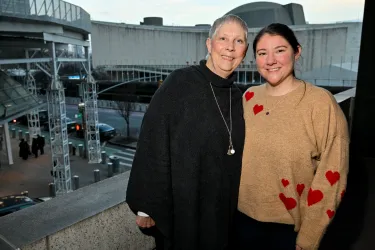
Image Punky Dahl, left, and daughter Haley attended events during the 70th session of the Commission on the Status of Women. (Photo by Rich ...
-
Betsy Shirley , the editor in chief of Sojourners , recently told the hosts of “A Matter of Faith: A Presby Podcast” that resilience in diff...
-
Image Photo by Sincerely Media via Unsplash The Rev. Dr. Jermaine McKinley, the co-chair of the Self-Development of People Ministry Team for...
-
For their sixth episode, podcast hosts reach out to a sage and seasoned pair of Presbyterian pastors July 1, 2024 Photo by Benarelexander vi...


