Showing posts with label Presbyterians for Earth Care webinar. Show all posts

Saturday, November 16, 2024

Today in the Mission Yearbook - Presbyterians for Earth Care webinar touts urban tree canopies and edible landscapes

Two experts share their experiences and helpful suggestions for churches during an hour-long online event

November 16, 2024

A webinar offered Wednesday by Presbyterians for 

Earth Care stressed the benefits churches can 

provide through community gardens. (Photo courtesy 

of Arkansas Interfaith Power & Light)

If establishing edible landscapes and climate resilient communities is the goal, Presbyterians for Earth Care recently provided at least some of the answers during an informative webinar. Watch the hourlong broadcast here.

PEC invited Scharmel Roussel, executive director of Arkansas Interfaith Power & Light, and the Rev. Dr. Shelly Barrick Parsons, executive director of Richmond, Virginia-based Capital Trees, to talk about work toward those goals in their regions — and how faith communities and individuals can do their part.

Arkansas Interfaith Power & Light has been awarded several environmental justice grants related to regenerative agriculture from federal agencies including the Environmental Protection Agency, the U.S. Department of Agriculture and the Natural Resources Conversation Service. A current “Grow More Food Where People Live” grant supports community gardens producing fruits and vegetables that go to food distribution efforts in low-wealth areas. The three-year grant has trained dozens of urban farmers, student interns and volunteers on the benefits of Earth-friendly agriculture methods that conserve water and protect soil health.

“We envision resilient communities that gather around locally sustainable food systems,” Roussel said. “We intend to demonstrate we can do healthy feeding outreach to those in need while at the same time reducing our carbon footprint.”

The USDA estimates that agriculture contributes 9% of greenhouse gases, while the EPA says it’s 10%, Roussel noted. Both agencies “partner to advance sustainability in growing food.”

Part of the problem is our diet, which for many Americans is meat-based. “Big agriculture is not feeding America. It’s feeding livestock,” Roussel said. The Washington Post has reported on University of California at Berkeley research that uses gene editing to eliminate cattle methane emissions.

At Bethlehem House in Conway, Arkansas, a student’s capstone project was to install garden beds so residents could grow, harvest and cook their food. “Regenerative” and “genesis” come from the same root word, Roussel pointed out. “It has to do with new life.”

Helpful steps people can take include reducing lawn sizes and installing pollinator gardens instead, Roussel said. Churches can build a community garden with a compost system. They can also add a Little Free Pantry.

City of Hope Outreach in Conway has impacted nearly 16,000 neighbors, Roussel said. Its community garden has helped divert nearly 30,000 pounds of produce from the landfill to food pantries and compost systems. Nearly 60 interns have been involved.

“The fruit of justice will be peace,” the prophet Isaiah writes. Roussel added that food justice is related to environmental justice, social justice and peace.

Barrick Parsons said it’s Capital Trees’ vision “to build a greener, more livable Richmond.”

In addition to the better-known benefits trees provide in an urban landscape — including reducing the impacts of heat islands, improving air quality, supporting wildlife, reducing erosion, improving soil quality and mitigating the impacts of floodwaters —trees also improve mental and physical health, she said. One study indicated that as little as 30 minutes in a greenspace once a week improves our well-being.

Capital Trees has also shown that illegal practices, including redlining, have resulted in diminished tree canopies in neighborhoods of color. Redlined neighborhoods have up to 30% less tree canopy, which inhibits not only the availability of shade but the evapotranspiration process, which has a cooling impact on urban neighborhoods.

“Trees are a scalable and affordable solution,” she said. Churches can help by partnering with organizations that give trees away and by learning, meeting, listening, engaging and partnering with neighbors who are impacted by having fewer trees. “Take time to get to know the community with less tree canopy percentage,” she suggested, and “advocate and prioritize retaining trees and tree canopy before, during and after” new development occurs.

“Churches can be places for people to gather and work on community health and well-being,” she said. “It’s a way to raise awareness and it draws people into conversations about larger initiatives.”

Mike Ferguson, Editor, Presbyterian News Service

Today’s Focus: Presbyterians for Earth Care webinar

Let us join in prayer for:

PC(USA) Agencies’ Staff
Angela Wyatt, 1001 Apprentice, 1001 New Worshiping Communities, Presbyterian Mission Agency 
Yun Kyoung Yang, Editorial Assistant, Korean, Presbyterian Publishing Corporation 

Let us pray

Loving God, thank you for courage, creativity and perseverance. Give us health and strength in difficult circumstances. Shine your face upon all of us so your love will light our path. Amen.

Wednesday, June 5, 2024

Today in the Mission Yearbook - Presbyterians for Earth Care webinar looks at real faith in a sinful world

Susan Krehbiel of Presbyterian Disaster Assistance is a guest on the ‘Between 2 Pulpits’ podcast

June 5, 2024

Photo by Dustan Woodhouse via Unsplash

During a recent webinar offered by Presbyterians for Earth Care (PEC), available here, Avery Davis Lamb introduced participants to Plastic Jesus.

Lamb is co-executive director of a partner of the Presbyterian Church (U.S.A.), Creation Justice Ministries, which developed “Plastic Jesus: Real Faith in a Sinful World,” a prayer, education and worship resource that churches can use. He called his recent talk “From Plastic Pollution to Environmental Justice.”

After explaining the dangers posed by too much plastic and the inadequacy of even dedicated recycling, Lamb turned to what all of this means for the church. “We’re going to think theologically about plastics for a minute,” he said. “Let’s talk about sin. Some of my communities [Creation Justice Ministries counts 39 denominational partners] get a little uncomfortable when we talk about sin. But with plastics, we can talk about sin on an individual and systemic level, and their interplay.”

Avery Davis Lamb

Sin is individual, Lamb noted, but “it’s also the harm that communities and societies and economies do to other communities and society, and harm that is produced within an economy or because of an economy, and it affects the vulnerable and the ecosystems around us.”

He encouraged everyone to think about and act on their own plastic consumption, but at the same time to remember that “we swim in the water of plastic pollution.”

Think of the sin of idolatry, Lamb suggested. Many people see plastic as “a solution to our problems, or we idolize technology as the solution to our plastics crisis,” he said. Rather than believing that’ll get us out of this problem, it’s more helpful to look inward “or toward our economies and the ways we have structured society and make the change there.”

Plastic Jesus (Courtesty of Creation Justice Ministries)

Paul’s revelation in Philippians 4:11–13 about being content with little or plenty is “a superhuman skill Paul has developed that he’s sharing with us here. That’s something we can learn,” Lamb said, “to practice contentment, to get away from idolatry and the accumulation of stuff and be content with what we have — and certainly be content in our lives without single-use plastics.”

The free “Plastic Jesus” resource includes sermon starters and “helpful bits of scriptural wisdom” for use in Bible study or sermons, Lamb said. The look at Exodus 32:1–6 is called “The New Golden Calf.”

“Pushing Our Limits” in “Plastic Jesus” is based on the Tower of Babel account found in Genesis 11:3–4. Lamb wondered: “Are we making a tower of plastics and trying to save ourselves?”

“Plastic Jesus” also features three original songs with sheet music: “Plastic Jesus,” “Creation is Waiting for Us” and “Fall in Love with the Earth.”

“Plastic Jesus” also has possible action steps, including support for the proposed REDUCE Act, for Rewarding Efforts to Decrease Unrecycled Contaminants in Ecosystems Act.

“Plastic Jesus: Real Faith in a Sinful World” can be downloaded for free at creationjustice.org. (Image courtesy of Creation Justice Ministries)

Other possible actions include organizing community cleanups, donating to support communities impacted by pollution, advocating for divestment from fossil fuel and petroleum companies, and engaging local and state governments to seek a ban on plastic bags.

Lamb credited Jessica Maudlin, associate for Sustainable Living and Earth Care Concerns in the Presbyterian Hunger Program, for playing “a crucial role for bringing this resource to life.”

Maudlin called it “a joy and an honor” to work with Creation Justice Ministries staff “to bring this to life and to learn myself about some of the plastic pollution issues I wasn’t aware of.”

The Rev. Bruce Gillette, PEC’s moderator, introduced Dr. C. Mark Eakin, who discussed Overture 14, “On Becoming Free from Plastic Pollution,” for consideration this summer by the 226th General Assembly. The overture, supported by PEC and sponsored by the Presbytery of Susquehanna Valley, reflects action taken “by our sisters and brothers in the United Church of Christ last year,” Eakin said. “This is a real act of solidarity.”

It’s “not a mandate, but there are things we should be doing,” Eakin said, and they’re included in the overture. Among them is educating congregations and mid councils, moving away from single-use plastic, “going to paper as much as we can, and advocating for actions at the state and federal levels,” Eakin said.

Mike Ferguson, Editor, Presbyterian News Service

Today’s Focus: Presbyterians for Earth Care webinar

Let us join in prayer for:

PC(USA) Agencies’ Staff
Sandy Johnson, Financial/Budget Analyst, Budgets & Forecasting, Administrative Services Group (A Corp)  
Emma Johnston, Mission Specialist, Office of the Middle East & Europe, Presbyterian Mission Agency  

Let us pray

Lord, grant us the wisdom to care for the earth and till it. Help us to act now for the good of future generations and all your creatures. Help us to become instruments of a new creation, founded on the covenant of your love. Amen.

Wednesday, April 10, 2024

Today in the Mission Yearbook - Presbyterians for Earth Care webinar explores what it will take to slow the devastating effects of climate change

Dr. Colin Evans of the Northeast Regional Climate Center makes a return appearance to deliver a sober assessment

April 10, 2024

Photo by Mika Baumeister via Unsplash

Dr. Colin Evans helped the 70 or so participants attending a recent Presbyterians for Earth Care webinar to connect the dots between the extreme global weather patterns that make headlines and the world’s worsening climate crisis. Watch the 64-minute webinar here.

Evans, a postdoctoral research associate with the Northeast Regional Climate Center at Cornell University, began by going back to basics: Weather is not climate. Weather is short-term, and climate has a 30-year window.

Divide one day by the 10,957 days contained in 30 years and you come up with 0.009%. “You can’t make conclusions about climate on such a small sample,” Evans said.

Last year, the average Major League Baseball game took 2 hours and 25 minutes. Multiply that by 0.009% and you have 0.783 seconds. Determining climate by the weather outside right now is like predicting the outcome of a baseball game by watching it for less than a second.

Here’s a real-life example: Many in the audience remembered the polar vortex that froze the upper Midwest in January 2019. “It was beyond frigid, and it was like that for several days,” Evans said. But despite those record-breaking days, the average temperature for the month was right at the climate normal because the rest of the month was warmer than normal.

Climate change is making the polar vortex unstable, bifurcating it into a pair of rings. Now the Arctic is warming faster than anywhere else on Earth, nearly four times faster than the globe has since 1979. But how do we know the climate is changing?

One indication is that multiple meteorological agencies around the world “have all come across the same information. These are independent observations,” Evans said.

We’ve known about global warming “for a really long time,” he said. The greenhouse gas effect first entered the scientific literature in 1863. Carbon in the atmosphere and its effect on temperatures appeared in 1896. “We have watched it happen in real time,” Evans said, and energy companies began their own internal research back in the 1970s.

Dr. Colin Evans

Last year was the hottest year on record, but if you’d asked climate scientists last May if that would be the case, “we would have said no,” Evans said. But beginning in June and lasting through December, record hot months piled up, one after the other.

Sea ice continues to decline, and we may see an ice-free Arctic summer in the next two decades, he said. The cause of it all is the greenhouse effect, with carbon dioxide concentrations sharply up over the past five years. “The rate of change is incredibly unprecedented and entirely unnatural,” Evans said. Methane is 25 times stronger than C02, and nitrous oxide 250 times stronger than carbon dioxide. More and more billion-dollar climate disasters “hit us every year.”

So, what do we do?

Awareness of our carbon footprints and efforts to recycle are good starts, but “we need to fully understand the problem, and it comes down to energy use,” Evans said. “Fundamental, systemic change must happen through legislation.” He offered up four imperatives:

  • All cars sold must be hybrid or electric or meet stringent miles-per-gallon standards.
  • An “immense” investment in public and commercial transportation, especially in railroads. “We need an alternative to flying,” Evans said. “We fly way too much.”
  • All consumer plastics must come from recycled plastics.
  • A “massive investment” in retrofitting for increased energy efficiency in our buildings.

Our individual action “means something to Generation Z, the climate activists working hard for a livable planet,” Evans said. “We owe it to every young person to right the ship.”

But “it’s going to be tough,” he said. Last year, 62,000 people died from record-breaking heat in Europe. “This will continue, and it will get worse, but we have to do it because there’s no alternative,” he said.

Then he displayed a slide comparing the 66-year span between the first flight by the Wright brothers and the first walk on the moon by astronauts Neil Armstrong and Buzz Aldrin.

“That’s a short time for technological achievement,” Evans said. “We need the will and the investment, and the leaders to step up and do it.”

Mike Ferguson, Editor, Presbyterian News Service

Today’s Focus: Presbyterians for Earth Care webinar

Let us join in prayer for:

PC(USA) Agencies’ Staff
Mari Evans, Digital and Marketing Manager, Communications, Office of the General Assembly 
Michael Fallon, Executive Vice President & Chief Financial Officer & Treasurer, Board of Pensions  

Let us pray

Gracious God, pour out your Spirit on all your servants, that as we reach out in your name with love and justice you will deepen our understanding of your holy purpose and strengthen our commitment to one another and to you. Amen.

Thursday, April 27, 2023

Today in the Mission Yearbook - PC(USA) pastor and professor describes ways to read the Bible from the Earth’s perspective

The Rev. Dr. Paul Galbreath offers up a thoughtful biblical approach during a Presbyterians for Earth Care webinar

April 27, 2023

The Rev. Dr. Paul Galbreath

Speaking to a Presbyterians for Earth Care audience during a recent webinar, the Rev. Dr. Paul Galbreath was able to help viewers read biblical texts from the perspective of the Earth.

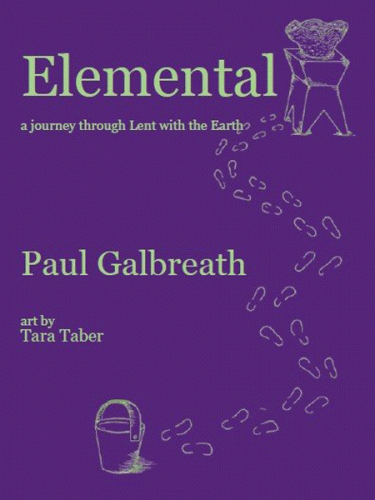
Galbreath, Professor of Theology at Union Presbyterian Seminary’s Charlotte campus, wrote the 2022 book “Elemental: A Journey through Lent with the Earth.” His hourlong talk to PEC can be viewed here.

Most of the Bible, as anyone who has ever read The Green Bible can attest, has something to say about the Earth, according to Galbreath. “It’s a radical jolt to remind us of the central place of Creation through the sacred texts that we hold at the center of our assemblies,” Galbreath said. Because the Christian faith is incarnational, “to do the work of theology is to take seriously the role of Creation in all that we do.” The problem is that we quickly encounter the gulf between materiality and spirituality. It’s our job, Galbreath said, “to find ways that reconnect spirituality and materiality.”

To do this means returning often to Scripture, “asking ourselves questions about what people in biblical times saw,” Galbreath said.

“I’m not trying to read 21st-century perspectives back into biblical texts. The world has changed,” Galbreath said. “But I am trying to be sensitive of the ways people in biblical texts related to Creation and the Earth around them. It’s clear to me that people in biblical times carried with them a great deal of awareness of the Earth, more than we cultivate in our lives. They were aware they were at the mercy of the elements in nature. What you had to eat was dependent on what was in the market, not what was flown in from Peru.”

As a result, religious celebrations in ancient Judaism and early Christianity were usually associated with harvest festivals, “something we don’t think about often,” Galbreath said. “My point here is to note the importance of Earth and sky to ancient people who attended closely to these. It informed the way they lived and worshiped.”

In the book, Galbreath associates certain elements with different days of Holy Week. For Maundy Thursday, it’s water, remembering Jesus washing the disciples’ feet. On Good Friday, it’s trees to remember the cross of Jesus.

This is the associative way of reading the Bible, “looking at a text for the role of Creation in hopes that it prompts us to see the presence of God in the world around us in a different way,” Galbreath said.

On Palm Sunday, it’s the response of the crowds. Preachers can talk about the role trees play providing parade-watchers with palm fronds to spread ahead of Jesus. “It makes the case that the Earth as a participant is a teacher of us in terms of what it means to praise God,” Galbreath said. “Scripture offers models of ways Creation anticipates and is already involved in giving thanks to God for the gift of life.”

But in many churches, Palm Sunday is punctuated with “sword fights between third-grade boys who have been handed palm fronds and are going to battle it out before, during and after the service,” Galbreath said. “It’s one of the few Sundays we bring something from outside into the sanctuary for worship. Our attempts to involve ourselves in this praising have not always been the most beneficial to the Earth.” He wondered out loud: “Might we learn something different by using local foliage?”

Turning to the passion reading for Palm Sunday, “it’s important to note the arrest of Jesus happens in a garden. … What does it mean in a text about Jesus’ arrest and pending death that it happens in a garden, a place of life?” The 30 pieces of silver Judas is paid to betray Jesus goes to purchase a field in which to bury those from a foreign land. “What does it mean for us to read that text today?” Galbreath asked. “For those of us finally paying attention to the Doctrine of Discovery … what does it mean to read a text that pays attention to the role of the purchase of land by the betrayal of Jesus as a place to bury foreigners?”

Mike Ferguson, Editor, Presbyterian News Service

Let us join in prayer for:

PC(USA) Agencies’ Staff
Michele Blum, Managing Director of Editorial, Presbyterian Publishing Corporation
Jacqueline Boersema, Director Financial Education, Board of Pensions

Let us pray

Dear Lord, we give thanks that you have gifted each of us for your purpose. May our hearts be open to your leading that we may use those gifts to your glory. We give thanks that we are part of a great family. May we always encourage and support one another in your work in your world. Amen.

Mission Yearbook: Free guide is a primer on Congregation-Based Community Organizing

Churches interested in grassroots organizing as a way to help their communities and boost congregational vitality have a new downloadable re...