The Board of Pensions’ Vice President for Ministry Innovation concludes the Policy, Benefits and Mission Conference with a prophetic sermon
December 11, 2023

The Rev. Dr. Jerry Cannon, vice ;resident for Ministry Innovation
with the Board of Pensions, preached during closing worship at
the Policy, Benefits and Mission Conference. Photo by Randy
Hobson.
It was up to the Rev. Dr. Jerry Cannon to wrap up the Polity, Benefits and Mission conference with preaching laced with both insight and inspiration, and Cannon did plenty of both during closing worship.
Cannon, Vice President for Ministry Innovation at the Board of Pensions, preached as others had during the conference on Ephesians 3:20–21. In addition to accomplishing abundantly far more than all we can ask or imagine, what else does Scripture say God has done? That long list, Cannon noted includes rescuing God’s people from a fiery furnace and from a lion’s mouth, restoring sight to the blind, keeping many from stumbling “and making every grace overflow to you. God can work exceedingly abundantly beyond our wildest dream,” Cannon said.
There is a “but,” however: Those works are “according to the power that works within us — the believer’s strength, the believer’s capacity, the power to believe … God is doing things that blow your imagination, if you will let God be God,” he said.
In the letter to the church at Ephesus ascribed to Paul, the audience can include preachers and teachers and executive presbyters and denominational leaders “warning that the diligent will face trial after trial, but don’t give up,” Cannon said. “God is still able. Not the church, not our intellect or finance, but God is still able. Not our social network and definitely not our politics, but God is still able.”
Cannon shared portions of the Rev. Dr. Martin Luther King Jr.’s “Letter from Birmingham Jail,” published April 16, 1963. The “most pertinent” epiphany from that famous letter is this, according to Cannon: “There was a time when the church was very powerful — in the time when the early Christians rejoiced at being deemed worthy to suffer for what they believed. In those days the church was not merely a thermometer that recorded the ideas and principles of popular opinion; it was a thermostat that transformed the mores of society.”
King “replied in a disarming, conciliatory tone” in response to white clergy who questioned the timing and the tactics of civil rights leaders, Cannon said, “and he was throwing shade while he was doing it.”
A thermometer reflects the temperature, but a thermostat determines the temperature, Cannon noted. “The thermostat allows you to set the temperature to what you need it to be,” he said. “Once it reaches the desired temperature, the thermostat still works.”
“I believe the writer of Ephesians would say that we still need to be a thermostat,” he said. “Don’t let public opinion determine how you think. Be a thermostat. Don’t let circumstances dictate how you feel. Be a thermostat.”
Imagine what a better life we might have if the Presbyterian Church (U.S.A.) functioned as a thermostat, Cannon said. “I have a sneaking suspicion there are some thermostats sitting in the audience this morning. Somebody is going to turn up the heat in a cold church. I just have a sneaking suspicion and a Holy Ghost inclination that you are serving a God who has a future you have never seen, but a God who’s prepared you for right now.”
“God is able to accomplish more in our lives than we can ever imagine,” Cannon reminded those in worship. “May our shared plans become shared actions. … May we march toward the promise of a better tomorrow, knowing that the path becomes wider and we never march alone. … On our way, let us become the thermostat that changes the world for the glory of God.”
Mike Ferguson, Editor, Presbyterian News Service
Today’s Focus: Rev. Dr. Jerry Cannon preaching at the Polity, Benefits and Mission Conference
Let us join in prayer for:
PC(USA) Agencies’ Staff
Barbara Soete, Ministry Specialist for Special Offerings, Ministry Engagement & Support, Administrative Services Group (A Corp)
Samuel Son, Manager, Diversity & Reconciliation Associate, Advocacy, Presbyterian Mission Agency
Let us pray
Gracious God, fill us with power to proclaim your name boldly at every age, until all come to the knowledge and love of your Son, Jesus Christ our Lord. Amen.

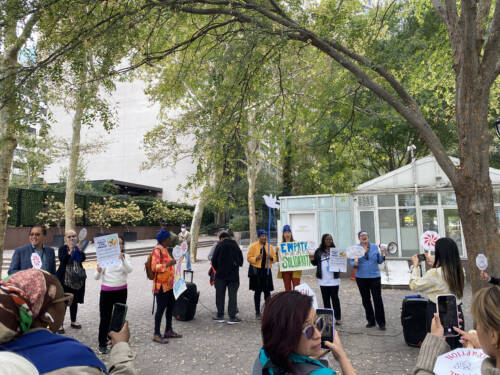 Human rights violations are far too common in our world today. These violations come in the form of exploitation, discrimination, violence and many other horrors. These rights are God-given by our nature of being human and being God’s children. However, they have been simultaneously named by society and have been declared human rights by documents such as the Universal Declaration of Human Rights and countless examples of legal repercussions for those who have violated the rights of others. As Deuteronomy says, all people shall receive equal judgment and equal respect, regardless of identity, citizenship or political standing. The text also mentions that any question that is too tough for us to tackle as mortal beings should be brought unto God. It seems that the aspirations that we have for human rights and human rights law are in line with the aspirations that are set out for us in Deuteronomy. So, it is our duty as Christians to work toward the respect of human rights for all people, all the time. As we see brutal violence all over the world, in Israel and Palestine, in Ukraine, in Sudan and all over the world, we are called to speak for those who have been silenced by oppressive and exploitative forces. Listen to the voices of those oppressed in the same manner that we would listen to those in positions of power. When we feel overwhelmed by the horrors of human rights violations around the world, God calls us to bring these burdens before God. For all our human shortcomings, God sees no difference between the big and the small, the rich and the poor, the powerful and the powerless. We continue to strive to make our human rights laws reflective of the way God calls us to treat each other, while always knowing God is there to listen when we struggle with the ways that we have failed others.


 Oct. 12, 1792, was the first observance in the United States of America of what we now know as “Columbus Day.” The Columbian Order of New York, better known as Tammany Hall, held a commemoration of the 300th anniversary of his historic arrival in the “New World.”
 For those and many other reasons, many states and communities have forgone what is seen as the devastating consequences of “Discovery” from 1492 and decided to officially observe Indigenous Peoples’ Day instead, to recognize the Native populations who were summarily pushed aside by the coming of European culture to their territories, which archeological evidence has shown Native people had occupied for thousands of years.