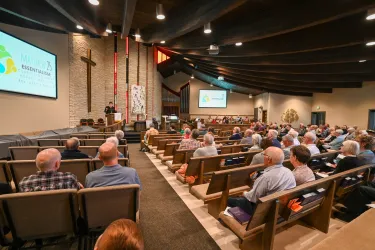
The Synod of the Covenant recently offered a webinar on remaining faithful in the face of Christian nationalism. The Rev. Dr. Tony Tian-Ren Lin, a Presbyterian pastor who is trained as a cultural sociologist and is the director of research and the associate director at the Center for Public Theology and Public Policy at Yale Divinity School, led the 105-minute workshop, which can be viewed here.
Lin was born in Taiwan and grew up in Argentina. He has served congregations in New Jersey, Virginia and New York, including his current position as interim pastor at Iglesia Presbiteriana El Buen Vecino in New York.
“We are living in a time most of us thought we’d never be in,” he said. “That’s probably why many of you have taken the time to be here today.”

Lin said he prefers the term “religious nationalism” over “Christian nationalism.” If he were to define the latter, it would be “when religious identity is fused and blended with national identity.”
That’s not always a bad thing, Lin pointed out. “For a long time, to be Mexican was to be Catholic, and that was not a bad thing.” Similarly, being Italian and Catholic “were intertwined as well. It’s not bad. It can be empowering.”
“On the other hand, most of us can think of the horrible things that religious nationalism has done,” he said, including the Crusades.
“At the end of the day, we have to recognize that nations need an idea to hold them together, an idea that makes us a nation,” Lin said. In this nation, for many years that idea was the American Dream, that “people who came here or were brought here had some commitment to meritocracy — if you work hard and follow the rules, you can get ahead.”
For a long time, the idea was the U.S. Constitution, which “was supposed to hold us together, but in the last few decades that also has fallen away,” he said. A Yale colleague made the case it was the idea of the “endless frontier that kept us together.” But when that myth collapsed, “we started building walls and went into protectionism,” Lin said.
“Today we are still looking for the ideology that keeps us together as a nation,” Lin said. “That’s why people grasp for something to hold onto, and that’s why religious nationalism works. It works because we don’t have to dig deeper into ideas like freedom.” While we may grant freedom to certain groups, “we have created oppression for others,” Lin said. “That’s something we don’t like to wrestle with.”
A workshop participant said members of her congregation “are searching for faithful words they can use.”
“I think we [the church] have answers to the questions the world is asking,” Lin said. “We need to be more unapologetically Christian.” Most of our problem with religious nationalism is that “certain groups are taking their theological convictions and making it the law of the land for everybody.”
“Some of the greatest progress for justice in this country came from strong and unapologetic Christian convictions,” he said. The speeches written and delivered by the Rev. Dr. Martin Luther King Jr. “were deeply political and thoughtful,” Lin said. During the years before the Civil War, abolitionists “said it was against God’s will to enslave people who were made in the image of God.”
If King’s vision were made into law, “would people be OK with that?” Lin asked. “If Mister Rogers’ version of Christianity were made into public policy, would you support that or would you fight it?”
“Whatever theological conviction you’re fighting for, you should fight for all people” is a notion that describes King’s position, Lin said. “If you believe in a living wage or housing or healthcare or education, you should fight for it all around the world.”
Love and evangelism are the way to go, he said, although the latter can be difficult.
“It’s making disciples, which is very hard. Even the ones Jesus made were messed up,” Lin said. Still, “many of us are here because the love of God transformed us. If you have an inclusive vision of Christianity, you will believe the love of God can transform people.”
Mike Ferguson, Editor, Presbyterian News Service (Click here to read original PNS Story)
Let us join in prayer for:
Kristen Gaydos, Multimedia Producer, Story Ministry, Interpretation & Communications, Presbyterian Life & Witness
Mark Thomson, Manager, Media & Publishing, Interpretation & Communications, Presbyterian Life & Witness
Let us pray:
Dear Lord, help us to look to you for guidance on how best to serve your people. Help us to be courageous as we respond, change and grow. Help us to be faithful as you always are faithful! We thank you in advance for all that you will do in and through us this day. Amen.



No comments:
Post a Comment