Tuesday, March 15, 2022

Today in the Mission Yearbook - Land use in Latin America and systemic poverty

Asking good questions moves us to solidarity

March 15, 2022

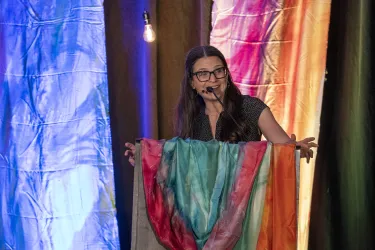
Erlinda Quesada (right), an activist from an area in Costa Rica with large transnational farms of pineapple production, shares about her community’s struggles for environmental justice at Chapel in the Pines Presbyterian Church in Chapel Hill, North Carolina. Mission co-worker Karla Ann Koll is translating. (Photo courtesy of Chapel in the Pines Presbyterian Church)

To end systemic poverty, we first must understand its root causes by asking good questions. In Latin America and the Caribbean, two good questions to ask are, “How is the land used?” and “How are the people who live on that land treated?” 

In Nicaragua, Indigenous groups who live along the coast and extensive rivers in the eastern half of the country struggle to control their land, despite laws passed in 1987 and 2007 that recognized their land rights. But policies and attitudes of the government encourage encroachment on traditional lands as well as outright confiscation of land for mining, lumber and cattle ranching. At the same time, global warming led to two hurricanes in fall 2020, Eta and Iota. These historically powerful hurricanes devastated many of these same communities. National and international aid to help these remote communities recover has been minimal.

In Haiti, the 2010 earthquake set the stage for massive international investment in a Free Trade Zone along the northern coast. It’s the same coast where many small communities have traditionally used state land for irrigated crop production, and their proximity to the ocean for fishing. To create the large tracts of land to build factories, international investors moved the families away from the coast into poorly constructed housing surrounded by semi-arid soils. In the end, the complex provided a small fraction of the employment that had been promised, leaving many families with almost no means of support. 

In the Dominican Republic, sugar cane production has long been an important product for export. But standard sugar cane techniques require large expanses of fertile land and an abundant supply of cheap labor. In the Dominican Republic, this labor is typically provided by Haitian immigrants. These essential workers often are in danger of deportation. Sugar cane companies commonly use glyphosate, a cancer-causing product used to control weeds that has also been implicated in a deadly epidemic of kidney disease among workers.  

In northeastern Costa Rica, Del Monte produces pineapples using toxic chemicals that contaminate the groundwater, making it unsafe for people in surrounding communities to consume. Waste products from pineapple harvesting have also been implicated in breeding flies that affect local farmers’ livestock, so farmers sell their land to the companies and move into dilapidated urban centers. 

Understanding root causes moves us beyond pity and compassion to indignation and solidarity. Mission co-workers throughout Latin America and the Caribbean are witnesses to these situations and many others. More importantly, we accompany local networks denouncing injustices and fighting for environmental and social justice for their families, their communities and for all of God’s Creation.  

Would you care to join us, and them?

Mark Hare, mission co-worker promoting environmental sustainability with the Latin American Biblical University, an ecumenical seminary on the eastern edge of San Jose, Costa Rica.

 Mission co-workers Jenny Bent (Costa Rica), Cindy Corell (Haiti) and the Rev. Dr. Karla Ann Koll (Costa Rica) also contributed to this article.

Let us join in prayer for:

PC(USA) Agencies’ Staff
Victor and Sara Makari, Mission co-workers serving in Israel & Palestine, Presbyterian Mission Agency
Troy Marables, Vice President, Director of Human Resources, Presbyterian Foundation

Let us pray

Father, thank you for your love that enables us to love others. Help us to reflect the free gift of your grace to all who cross our path. Amen.

Sunday, March 13, 2022

Minute for Mission: Self-Development of People

March 13, 2022

Nick building fence (provided)

Be imitators of me, as I am of Christ. Now I commend you because you remember me in everything and maintain the tradition even as I delivered them to you. — 1 Corinthians 11:1–2

The Ekvn-Yefolecv project located in the Birmingham, Alabama, rural area is a recipient of a Self-Development of People grant. This project is creating an ecovillage community that provides the opportunity for individuals and kin to efficaciously revitalize the Maskoke language, traditions and worldview while embodying a collective commitment to environmental sustainability, and to serve as a replicable archetype for other Indigenous communities to manifest similar models. The ecovillage has a trifold focus: language and cultural preservation, ecological living, and sustainable economic development.

Ekvn-Yefolecv Indigenous Maskoke Ecovillage will offer a variety of programs and research projects relative to issues affecting Indigenous peoples within the framework of environmental, cultural and economic sustainability. Programs will focus on education, training and deep holistic health. The major and dire impetus for the establishment of Ekvn-Yefolecv is preservation of the Maskoke language, which is classified as “definitely endangered” by the United Nations Educational, Scientific and Cultural Organization (UNESCO), and which is intrinsically connected to traditional culture, medicine and ceremony.

Twenty Maskoke community leaders have progressively deepened their relationship with each other and their commitment to Ekvn-Yefolecv through inclusive and comprehensive visioning processes, which have included cultural strong-talks and ceremonies; land exploration, including finance options; and feasibility assessment and strategic planning.  The project is owned and controlled by the founding Indigenous Maskoke members of Ekvn-Yefolecv. The primary beneficiaries of Ekvn-Yefolecv are the project members — the ecovillage residents — who will be able to practice their culture in a living, working village environment.

The project seeks real long-term change by:
1. Empowering the current language, immersing students in a new learning space more conducive to Maskoke language acquisition and equipping them with fluency in the language to reverse the currently projected road to language extinction.

2. Transitioning residents to healthy diets based on foods organically grown within the ecovillage while simultaneously improving the overall mental, physical and spiritual health of all residents.

3. Empowering women through the reclamation of women’s agricultural roles in farming and spirituality, especially through plant propagation and equipping young girls, as well as older women (who did not have the opportunity to learn women’s knowledge as young girls), with knowledge of plants and traditional holistic healing practices.

4. Conducting traditional ceremonies to support language and culture preservation and spiritual healing.

5. Reintroducing Lake Sturgeon into the Coosa watershed.

All members of the founding committee range from ages 18–75 and volunteer with the project on a monthly basis, and the committee makes all decisions by consensus to advance the project.

It was an honor to visit with this group and to support their work by awarding a grant to their project.

Rev. Gail Porter Nelson, Member, Presbyterian Committee on the Self-Development of People


Let us join in prayer for:

PC(USA) Agencies’ Staff
Teresa Mader, Project Manager, Direct Response, Special Offerings/Appeals, Presbyterian Mission Agency
Monica Maeyer, Director, Communications, Board of Pensions

Let us pray

Lord God, we are so thankful for the various gifts you have bestowed upon us. These gifts  that are intended to uplift, sustain and be a help to your people wherever they may be and whatever the need. Self Development of People (SDOP) is that community of faith that honors your desire that your people strive, open the hearts of those who call you their God to join with us through their giving to continue the good works you have blessed. This we pray in the powerful name of Christ Jesus, Amen.

Saturday, March 12, 2022

Today in the Mission Yearbook - Empowering girls through education

Addressing menstrual health and hygiene issues reduces school dropouts, improves livelihoods

March 12, 2022

Cecilia Shawa teaches girls at Mphamba Primary School in Lundazi District, Zambia, about feminine hygiene and reproductive health.
(Photo by Melissa Johnson)

An African proverb says: “If you educate a man, you educate an individual, but if you educate a woman, you educate a nation.”

One of the United Nations Sustainable Development Goals is to “ensure inclusive and equitable quality education and promote lifelong learning opportunities for all” because “education enables upward socioeconomic mobility and is a key to escaping poverty.”

Matthew 25 calls us to eradicate systems and structures that keep people and communities poor.  Just as there is overwhelming data that educating girls empowers a nation, there is also clear evidence that girls often leave school due to cultural and personal issues related to menstruation.

Growing awareness of this concern has prompted some ministry partners in Africa to make menstrual health and hygiene (MHH) a priority to help girls stay in school.

Cecilia Shawa, a feminine hygiene educator with the Church of Central Africa Presbyterian (CCAP) Synod of Zambia’s Health Department, interviewed girls and young women about how menstruation affects their lives. While she knew that menstrual health management in Zambia was a challenge, she was saddened by the story of one young girl, Loveness, who was surprised and scared by beginning her period at school. Because she was unprepared, her school uniform was soiled. Her classmates, including the boys, shamed her. Lacking a facility where she could clean herself, Loveness ran home. She was so embarrassed she went to live with her grandmother in Malawi. Loveness didn’t return for a year and a half, and she didn’t attend school during this time. When she did return, she was still so traumatized by her experience that she changed schools. Loveness’ story is not unique. In areas where water and facilities are lacking, the onset of menses increases girls’ vulnerability to dropping out of school.

Improving access to safe and healthy menstrual hygiene education, materials and facilities helps reduce poverty. A child whose mother can read is 50% more likely to survive past the age of 5. Each extra year of a mother’s schooling reduces the probability of an infant dying by 5% to10%. The risk of maternal death is 2.7 times higher among women with little or no education. Countless studies have shown that every year a girl stays in school, her income can increase by 15% to 25%. An educated woman will invest 90% of her income into her family and is more likely to send her children to school, continuing the legacy of education and helping break the cycle of poverty.

Cecilia and the CCAP Zambia Health Department are working to educate girls, women and men about MHH and reproductive health to help keep girls in school by reducing the stigma that surrounds menstruation. They also are sustainably producing washable, reusable feminine hygiene kits and making them available and affordable for women in communities across Zambia.

By addressing MHH in schools, mission partners are supporting girls’ education and confronting systems that keep people living in poverty.

Melissa Johnson serves as health education program facilitator with the Church of Central Africa Presbyterian Synod of Zambia Health Department.

 Jim McGill serves with the Evangelical Church in the Republic of Niger and the Presbyterian Church of South Sudan to ensure sustainability for clean water and sanitation at the community and user levels.

Let us join in prayer for:

PC(USA) Agencies’ Staff
Janeen Lush, Accountant 1, Accounts Payable Office, Administrative Services Group (A Corp)
Catherine Lynch, East Coast Regional Representative Presbyterian Investment & Loan Program

Let us pray

Generous God, as you have given so freely to us, we give you thanks that, as possible, we are able to freely give to others. May your Spirit sustain the many helping hands, and may your blessings bound for those being served. Through Christ we pray. Amen.

Friday, March 11, 2022

Today in the Mission Yearbook - Stony Point Center becoming a place of connection for nonprofits in community

Partnership gets food to immigrants; others looking to join residential nonprofit hub on campus

March 11, 2022

Volunteers from Proyecto Faro (the Lighthouse Project) get ready to give out excess food from Stony Point Center to immigrant families. (Photo by Ingerlene Frick)

Thanks to a new partnership at Stony Point Center (SPC), food that might have been thrown away or composted ended up in the hands of immigrants in the community who needed it.

In a small example of how SPC can partner its resources with nonprofit needs, the center found itself with leftover food after a guest group ate significantly less than was brought in to serve them. After Stony Point made a quick call to its new resident nonprofit partner, the food was picked up and taken to a distribution center that Proyecto Faro (Lighthouse Project) had already set up in the community.  At SPC, Proyecto Faro plans to use its space at the to gather and distribute food and clothing — and also provide legal representation and other services — for immigrants in the surrounding community.

At SPC, Proyecto Faro plans to use its space on campus to gather and distribute food and clothing — and also provide legal representation and other services — for immigrants in the surrounding community.

Looking to the future, Brian Frick, the interim executive director at Stony Point Center, sees nonprofits building their capacity through connections made at the PC(USA) Center.  Imagine, he said, linking Proyecto Faro’s needs with the Big Brothers Big Sisters of Rockland County, which is also exploring leasing space on the SPC campus.

“These are the kind of intersections we can do to seed benefits beyond our usual sphere of influence,” Frick said.

Debra Thomas, executive director for the Workforce Development Board of Rockland County in Stony Point, New York, is collaborating with SPC and the Rockland Community Foundation on a grant for nonprofits to participate a residential “innovation hub” that SPC is working on.  The hub will be in a space on campus where local and regional nonprofits — whose work aligns with the PC(USA) Matthew 25 invitation — can gather to do their work.

“The grant money will allow us to do on-the-job training and possibly internships onsite,” Thomas said. “We can redeploy those whose jobs were impacted by COVID into priority sector jobs in industries like hospitality, tourism and health care.”

For Frick, the innovation hub will provide SPC with a way to better utilize their space — and to bring innovation and new thinking to the campus. And it moves one of the Matthew 25 foci on eradicating systemic poverty into action, he said.

SPC is also building an “innovation studio” where leaders can gather around a Matthew 25 or related topic and broadcast part of that gathering to churches around the country, including to smaller congregations.

“The pandemic taught us that we can gather in new ways and still be a faithful church,” he said. “We need to stay open to moving of the Spirit. For conference centers, gone are the days of ‘y’all come here’ gatherings. We need to be where people are now and where they can best engage.”

And once the innovation hub and studio take place, Thomas said Stony Point Center will no longer be a hidden gem.

“Using these tools, we will be able to share the gem of SPC with the rest of the country,” Thomas said.

According to Frick, Stony Point Center has always been a space of experimentation and learning for the PC(USA), from hosting missionaries for conversations in the early 20th century to experiencing a lived community focused on interfaith sharing and communal action in the early part of the 21st century.

SPC also has a rich history of spawning ministry organizations on its campus like the Center & Library for the Bible and Social Justice. At the library, CLBS hosts at Stony Point opportunities to learn what the Bible says about active social justice. Stony Point has also provided space to other nonprofits, like the Fellowship of Reconciliation USA. FOR moved to Stony Point Center several years ago, in part to be close to a space that aligns with their values and is capable of hosting larger national gatherings they envision.

And Proyecto Faro formed as self-help group, in a primarily immigrant community in 2012, which was welcomed to stay  at Stony Point Center temporarily after being flooded out of their homes by Hurricane Sandy.

 Paul Seebeck, Communications Strategist, Presbyterian Mission Agency

Let us join in prayer for: 

PC(USA) Agencies’ Staff
Samantha Lund, Legal Office Administrator, Administrative Services Group (A Corp)
Erika Lundbom-Krift, Electronic Resources Associate, Presbyterian Publishing Corporation

Let us pray

Lord, thank you for experiences that open our eyes to more clearly see you, and our ears to more clearly hear you. Expose in us those things that keep us from coming to you. Open our hearts and make us unafraid to be vulnerable. May we have encounters that will change us forever and move us in the direction where you are leading. Amen.

Thursday, March 10, 2022

Today in the Mission Yearbook - Breaking the chains of poverty

Mission makes a difference in Southeast Asia

March 10, 2022

The sound of Filipino schoolchildren’s voices breaks through the overwhelming feeling of despair. (Photo by Cobbie Palm)

Roland is now in high school and is among a group of student panelists presenting on the topic “Social Economic Reforms for Sustainability,” organized by the National Christian Youth Fellowship. The invitation to be a panelist is merited by outstanding academic achievement and each of the panelists performed exceptionally on this day.

But it was Roland who caught my attention. Roland passionately and sincerely spoke about rice and hunger during the COVID-19 pandemic. The pandemic, Roland argued, “has been threatening and taking lives, but just as severe a threat and as violent a killer is the Rice Tariffication Law, which took effect March 5, 2019.” At that point, he went on to connect the dots. “Hunger in the Philippines today has reached an unprecedented high of 30.7% of all households in the country. The reason is not only the loss of employment caused by the pandemic, but also the high cost of rice. Farmers in the Philippines can no longer afford to compete with foreign rice imports.”

Roland concluded, “Then came the pandemic, and our main sources of rice — Thailand and Vietnam — suffered tighter supplies and less exports, and with less imports came higher prices. Our dependency led to increased poverty for everyone because our 10 pesos worth of rice is now costing 20 pesos at the present market price.”

After all the panelists had spoken, I sent a generic congratulations to everyone in the chat. In a short while, I received a personal message from Roland saying, “Mr. Palm, you came to our school and taught us a song, thank you. I hope you remember me.” I sent back a message, “I am sorry, you have grown up; I do not recognize you now.” He replied, “I was a tutor at the Sunbeam Day Care Center, where I once was a student.”

The Sunbeam Day Care Center was a visit I made with the Young Adult Volunteer (YAV) program during their orientation to the realities of the Philippines. I remember it was a difficult day for all of us. As we entered this district of Manila neighboring the port, observing this community through the windows of our vehicle, we were guided from the road, where we had parked our vehicle, into a narrow alley of abject poverty. The light of day grew into dark gloom as we walked over slabs of wood, elevating our steps from muddy wastewater below. To each side of us were walls of repurposed wood, then a doorway or a window that revealed a room to the left, then to the right. Each room was a whole home.

Soon there was the sound of children’s voices counting in unison. The narrow dark alleyway led us to a larger room that was set with children’s chairs and tables as a small mess hall. Voices were coming from another room. It was a classroom of children ages 5 to 8 — all learning together. This was the Sunbeam Day Care Center, a program of our PC(USA) mission partner the United Church of Christ in the Philippines, led by Tondo Evangelical Church. This congregation, believing that a mission endeavor can have significant impact, refused to lose hope.

Walking away from our short visit, I am ashamed to confess that the friends at the Tondo Evangelical Church had more hope and faith than I did. It was difficult for me to see a way out for children living amid overwhelming poverty, hunger and adverse conditions.

In unexpected times, God seems to be saying through these moments, “I am not done with you yet!” A personal message from Roland caught me by surprise. What I could not see then, God wanted me to see now. God connected the dots between a mission endeavor reaching into overwhelming poverty — nurturing a child with a new song — and witnessing that student using a well-deserved scholarship to access the tools to discern the structures in our society that perpetuate poverty.

God’s amazing work reminds me that mission works. Mission into poverty can lift hands, strengthen voices and warm bodies, reenergizing people who then can see clearly where policies and laws must be changed — Matthew 25 people willing to work together to make it happen.

Carlton J. “Cobbie” Palm, Mission Co-Worker and Director of Spiritual Formation at Silliman University Divinity School
Dessa Palm, YAV Site Coordinator in the Philippines, Artistic Director for Youth Advocates Through Theater Arts

Let us join in prayer for:

PC(USA) Agencies’ Staff
Kathy Lueckert, President, Administrative Services Group (A Corp)
Victor Min, Translator, Global Language Resources, Administrative Services Group (A Corp)

Let us pray

Dear God, your blessings are always evident and give us the good pleasure of enjoying your presence. Continue to abide with us as we love and serve those in need. In Christ’s service. Amen.

Wednesday, March 9, 2022

Today in the Mission Yearbook - Five Wisconsin churches join to feed their hungry neighbors

The Presbytery of Milwaukee congregations have reaped a harvest of cooperation

March 9, 2022

Each of the five participating churches has something to offer for the Food for the Journey program. (Photo by Cathy Manthei)

Five congregations in the Presbytery of Milwaukee joined together on an initiative inspired by the Matthew 25 invitation to feed the hungry. It led to unexpected, broad collaboration.

As congregations join this week with the Presbyterian Hunger Program to celebrate Food Week of Action, the five Wisconsin churches are living into their Matthew 25 calling to feed the hungry. This summer they built a community garden and now are harvesting the produce, distributing it to people who are experiencing hunger.

Food for the Journey is a project of Apostle Presbyterian Church in West Allis, Calvary Presbyterian Church in Milwaukee, Delafield Presbyterian Church in Delafield, Jerusalem Presbyterian Church in Wales and Kettle Moraine Presbyterian Church in Hartland.

Each church had something to share. “Food for the Journey started out as a project that none of our congregations could have pulled off on their own,” said the Rev. Nikki Blanks, pastor at Delafield. “The beauty of this is that either we were going to work collaboratively, or we weren’t going to be able to do it all.

“With each other,” Blanks said, “we have everything we need.”

The Kettle Moraine church had excess land, perfect for the 40-foot-by-24-foot raised-bed garden built for the project, and the Delafield church contributed financially. Several churches, especially the Jerusalem church, brought Master Gardeners into the planning. The Calvary and Apostle churches act as distribution sites, sharing the bounty with urban residents of Milwaukee and Waukesha counties. Volunteers from all churches help with the garden.

It’s been transformative. At the Delafield church, “One hundred percent of our newest members are involved in this garden; they see what the Spirit is doing, and they want in on it,” Blanks said.

JP Kastner, a lead organizer, sees the same at his church. “Folks are stepping up into leadership positions because they’re interested in involvement with the produce marketplace at Calvary,” Kastner said.

To the surprise of many participants, the collaboration has gone beyond the project.

When the Kettle Moraine church had a problem with its church sign, a church member from the Calvary church came out to fix it. The Delafield church collected books for Jerusalem’s Book Drive, and Jerusalem contributed to Delafield’s rummage sale.

In these newfound relationships, Blanks says, “the people have had so much fun, there’s talk of building more gardens next year.”

Presbytery of Milwaukee, Special to Presbyterian News Service

Let us join in prayer for:

PC(USA) Agencies’ Staff
Lisa Love, Counsel, Legal Services, Presbyterian Foundation
Sandy Lucas, Receptionist, Presbyterian Foundation

Let us pray

Gracious God, you call us to be Christ incarnate. We are to be the compassionate heart and hands of Christ. We are the loaves and the fish that will give hope and life during these challenging times. Amen.

Tuesday, March 8, 2022

Minute for Mission: International Women’s Day

March 8, 2022

All who call this planet home are impacted by a warming climate. But our most vulnerable, particularly women and girls, are disproportionately affected. And although women may carry the burden of weathering storms (and tsunamis and droughts and all events that result from a warming planet), they are also the first to embrace earth-friendly policies and practices as they (and their families and communities) are literally on the front lines. Seeing our way forward to a sustainable future can only be realized when the leadership of women and girls is encouraged and valued.
International Women’s Day is a day set aside each year to address challenges that are unique to women and girls. For 2022, the United Nations Entity for Gender Equality and the Empowerment of Women, or U.N. Women, has chosen the theme “Gender equality today for a sustainable tomorrow” in recognition of “the contribution of women and girls around the world, who are leading the charge on climate change adaptation, mitigation, and response, to build a more sustainable future for all.”

International Women’s Day reminds us to reflect on our responsibility to make this world a just world. As people of faith called by God to care for God’s Creation, let us encourage, value and support our sisters and neighbors who bear the greatest consequences of climate change.

Carissa Herold is marketing associate for Presbyterian Women in the Presbyterian Church (U.S.A.) Inc.

Let us join in prayer for:

PC(USA) Agencies’ Staff

Ivy Lopedito, Mission Specialist, Presbyterian Ministry at the United Nations, Presbyterian Mission Agency

Let us pray

Loving Creator, a warming planet affects us all, but our poorest neighbors bear the greatest burdens of climate change. On this International Women’s Day, and all days, let us strive toward gender equality so your daughters, as well as your sons, are empowered to find solutions for a sustainable future. Amen.

Mission Yearbook: Rabbi calls connection, vulnerability keys to supporting communities of faith

Rabbi Sharon Brous, senior and founding rabbi of IKAR in Los Angeles, urged church leaders to resist isolation, embrace vulnerability and d...