Showing posts with label environmental justice. Show all posts

Saturday, November 9, 2024

Today in the Mission Yearbook - Environmental justice workshop offers advice for activists

Participants urged to build trust with communities

November 2, 2024

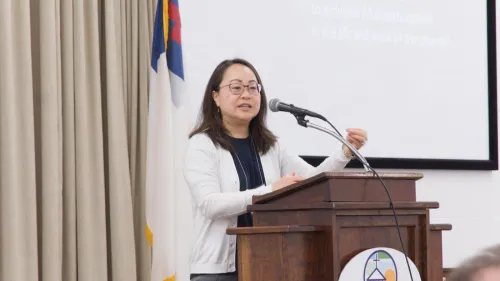
Dr. Monica Unseld, left, of Until Justice Data Partners and Coming 

Clean spoke during a panel discussion that also included Tyler 

Offerman, center, of the Kentucky Equal Justice Center and Bonifacio 

Aleman of Kentuckians for the Commonwealth. (Photo by Rich 

Copley)

A workshop with a focus on environmental justice offered strategies for people who are interested in doing the work of organizing and movement building.

The Sept. 13 workshop, “Organizing for Change,” was part of the People’s Summit on Food Systems and Urban Agriculture, hosted by Food in Neighborhoods, a coalition that works to improve food and farm systems in Louisville. The Presbyterian Hunger Program was one of the summit’s sponsors.

The workshop’s three main panelists were Dr. Monica Unseld, a scientist who’s the founder of Until Justice Data Partners, which seeks to demystify and normalize the use of research and data in social justice work and daily life; Bonifacio Aleman, a lead organizer with Kentuckians for the Commonwealth; and Tyler Offerman, who works on food, feeding and farm justice policy with the Kentucky Equal Justice Center, a nonprofit law firm and public interest advocacy organization. The panel was moderated by Nia Rivers of Community Farm Alliance and Emily Smith of the Greater Louisville Food Council.

The panel was directed at those interested in environmental justice, which relates to the right to live, work and play in healthy environments and the need to push back against environmental racism, which leads to people of color and low-income people being disproportionately exposed to health hazards, such as contaminated drinking water and polluted air.

It’s a topic that’s highlighted in the Presbyterian Church (U.S.A.) document “Investing in a Green Future: A Vision for a Renewed Creation” (2022). It states that “we believe that God is calling the church to the trifold work of environmental justice, racial justice and economic justice” and describes a vision that includes “an environment renewed, better health outcomes, living wage jobs, clean air and water, wilderness preserved for its own sake, access to healthy food and the reparation of broken relationships.”

Tyler Offerman listens as Bonifacio Aleman answers a question 

during Friday’s workshop. (Photo by Rich Copley)

For those who are interested in doing work in the environmental justice arena or movements that intersect with it, the panelists suggested these and other tips:

  • Listen to people on the margins and lift up their stories:People on the margins are often overlooked and forgotten about, said Aleman, who spoke of the need to challenge the assumption that “communities most impacted by issues are not equipped enough to save themselves.”
  • Adhere to environmental justice principles:“When you abide by these principles, you completely abandon any of your own authority and you give these disproportionately impacted communities full right to self-determination and full right to self-representation,” said Unseld, who also does environmental justice work through Coming Clean, a nonprofit environmental health collaborative. “So, when I go in, my first thing is to build a relationship with trust. I don’t go in and start interviewing them or start presenting them with plans. I go and hang out and hear about their grandpa, just to form these relationships, ’cause it has to be long-term. You can’t bring in college students for a semester and then bounce. You have to share data.”
  • Be ready to take action:“I often think about movement moments,” Offerman said. “It’s like there’s a thing that happens, and if we were positioned as a movement, we could capitalize on it. But if we are not positioned, then the moment passes us.”
  • Don’t be afraid to make waves: Be willing to go into spaces, such as community meetings, and push back, Unseld said. “Sometimes our job is to go in and to just be the first one to get angry, to let everyone know that it’s safe to piss somebody off.”
  • Be crafty:“Find ways to jujitsu the system,” Offerman said. For example, “find ways to get money and use it against capitalism. Find ways to get lawyers and use it against the legal system. … We just have to build trust with communities, so that way, we can use the tools at our disposal to broaden the movement.”

The Presbyterian Hunger Program is one of the Compassion, Peace & Justice ministries of the Presbyterian Mission Agency.

Darla Carter, Communications Strategist, Presbyterian Church (U.S.A.)

Today’s Focus: Organizing for Change, an environmental justice workshop

Let us join in prayer for:

PC(USA) Agencies’ Staff

Michael Wade, Production Supervisor, Hubbard Press 
Teresa Waggener, Manager, Immigration, Legal Resources, Office of the General Assembly 

Let us pray

Gracious God, help us to continually look for you in all of Creation and help us always to be a blessing in your sight. Amen.

Tuesday, October 15, 2024

Today in the Mission Yearbook - Presbyterian Hunger Program associate reports on White House conference for faith leaders

Jessica Maudlin was among faith leaders convening on climate, clean energy and environmental justice

October 15, 2024

Jessica Maudlin of the Presbyterian Hunger Program 

attended the White House faith Leaders Convening on 

Climate, Clean Energy and Environmental Justice. 

(Contributed photo)

The White House Council on Environmental Quality (CEQ) recently held a White House Faith Leaders Convening on Climate, Clean Energy and Environmental Justice.

The event, attended by Jessica Maudlin, associate for Sustainability and Earth Care Concerns in the Presbyterian Hunger Program, along with other board members and staff of Creation Justice Ministries, gathered faith leaders and representatives of faith-based organizations from across the country, with the goal of discussing opportunities to benefit from and further engage their communities on President Biden’s climate, clean energy and environmental justice agenda.

That agenda includes Direct Pay, a novel provision provided through the Inflation Reduction Act that enables tax-exempt entities, including houses of worship, to benefit from federal clean energy tax incentives. Participants at the 226th General Assembly learned more about Direct Pay during the Environmental Justice Committee’s presentation when Ronald Newman addressed the Assembly and during a recent Presbyterians for Earth Care webinar.

The event recognized faith leaders for their unique ability to connect their communities with the information, resources, and support needed to create a more equitable and just clean energy future.

“It was truly an honor to be gathered together at the White House with so many people of faith,” said Maudlin. “I get to do this work with Presbyterians, day in and day out, but to be reminded again that we are not alone in our commitment to care for Creation and to see the ways in which policy and federal funding can support those commitments was so encouraging. People of faith truly bring something special to this shared vocation of ours.”

White House National Climate Advisor Ali Zaidi pointed out that post-pandemic, houses of worship have been faced with what he called powerful head winds, citing less giving, being asked to do more with less, increased prices of energy costs and unprecedented heat waves requiring more use of energy. And despite all of that, Zaidi said, people of faith are asking themselves, “Are we powerful enough to deliver the services our most vulnerable need? Do we have the ability to be the light that is still on while the storm is raging?”

Board members for Creation Justice Ministries, including 

Jessica Maudlin, second from right, pose for a group photo. 

(Contributed photo)

Participants also heard from several church and nonprofit leaders as they shared success stories and best practices for leveraging Direct Pay and other federal investments.

RE-volv Executive Director Andreas Karelas was one such leader. As he started to share, he pointed out a wall sculpture hanging in the ornate gathering room. An angel holding a gear, keys and a toolbelt graced the sculpture. Karelas drew the comparison between the artwork and the work of faith leaders in the room having all the tools and keys to creating a just and equitable transition. Solar panels are just one of the ways houses of worship can be part of the transition to clean energy. He went on to share data from a Berkeley Lab study that indicates that the result of one house of worship installing solar panels could translate to as many as 80 residential installations over the next five years.

The Rev. Betty Holley, a presiding elder in the African Methodist Episcopal Church in the Ohio Conference, a professor of environmental ethics at Payne Theological Seminary and another member of CJM’s board who also attended the meeting, shared that she was struck by another example of Direct Pay utilization: battery storage updates, which allow houses of worship to retain energy even when power grids are hit.

“One group talked about how they became a resilient community church. People could come to them to get their phones recharged, to get their medication stored in a battery-operated refrigerated machine, both of which were one of the church’s projects through this IRA initiative,” Holley said.

Holley believes that religious leaders should be a “beacon” for their communities in the environmental movement.

“We’re looking toward sustainability. How can we sustain ourselves on Earth?” she said. “You know, we all have but one home and one future.”

Jessica Maudlin, Associate for Sustainable Living and Earth Care Concerns, Presbyterian Hunger Program

Today’s Focus: Jessica Maudlin was among faith leaders convening on climate, clean energy and environmental justice

Let us join in prayer for:

PC(USA) Agencies’ Staff
Keren Strothman, Mission Specialist II, Theology, Formation & Evangelism, Presbyterian Mission Agency 
Shawnda Styles, Client Services Specialists, Presbyterian Foundation 

Let us pray

Dear Creator, help us make every day one of celebration of and protection for your creation. For all the wonders of Creation, we give thanks. Help us remember members of Creation, human and non-human, who are threatened. Give us strength to stand up for the most vulnerable, who are the most affected by environmental degradation.

World Communion Offering — Free Resources for All Ages

Lesson Plans and Activities for All Ages Looking for ways to involve children or your whole congregation in the World Communion Offering thi...