Scarce water for thirsty Palestinians sustains life, while sea water destroys
March 22, 2024
 The Bible has a surprisingly large number of references to water. One concordance had 300 water references. From Noah’s Ark and the destructive flood to Isaiah’s well-watered garden and an ever-flowing spring, the role of water is myriad. Water as everlasting life and water as the bringer of death, the Bible has it all!
Which is the first verse that comes to your mind when you think about water?
On another winter day when it is hard for me to think about anything but the mounting death and destruction in Gaza, I found a verse from Zechariah that I don’t recall ever reading:
On that day living waters shall flow out from Jerusalem, half of them to the eastern sea and half of them to the western sea; it shall continue in summer as in winter. Zechariah 14:8
The geographical reference is striking. Jerusalem is right between Gaza and the Mediterranean Sea to the east and the Dead Sea to the west. Yet, the water Israel is pouring into the tunnels of Gaza is seawater, which will contaminate wells and aquifers for decades or centuries.
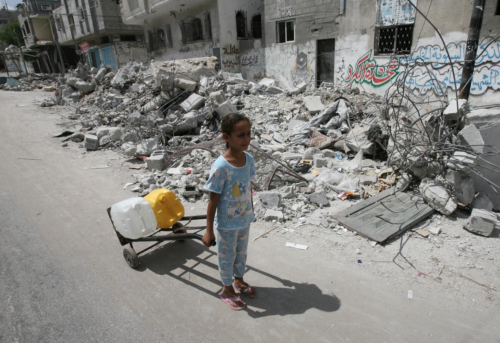 The water situation is dire and life-threatening. The World Food Program has reported that there are only 1.5 to 1.8 liters of water available per person per day for drinking and all uses in Gaza, far below the “emergency threshold” of 15 liters per day for “war or famine-like conditions” or the “survival threshold” of 3 liters per day.
The water crisis was decades in the making, and the Gazan water infrastructure has further deteriorated. Gazans are dependent on desalinated water plants run by electricity, and since the main power plant was bombed, the plants have shut down throughout Gaza.
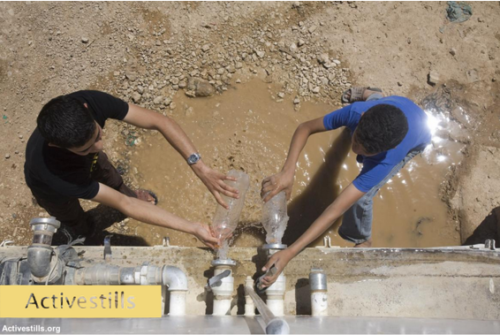
Meanwhile, nearly two million Palestinians in Gaza are being forced to drink brackish, untreated water. Women are taking pills to delay their menstruation due to lack of water and sanitary pads.
 With the shortages of food and water, experts are now predicting that more Palestinians in Gaza will die from starvation, thirst and disease than from airstrikes. As of Feb. 12, 28,730 Palestinians, overwhelmingly women and children, have been killed. The mass murder and extensive destruction throughout Gaza has been called collective punishment, a policy that the Presbyterian Church (U.S.A.) has repeatedly condemned. Our most recent General Assembly overture on Israel-Palestine speaks directly about the humanitarian toll of the siege on and occupation of Gaza since 2007.
In 2022 the Presbyterian Church (U.S.A.) called on the U.S. government to “exhort the government of Israel to end the siege of Gaza that restricts its access to adequate water and electricity and the entrance of food, medicine, and fuel to Palestinians in Gaza so as to alleviate and end the humanitarian and environmental crises caused by the siege and provide the material resources necessary for economic prosperity, human health and safety, and environmental protection.” (PC[USA] General Assembly Resolution)
The water crisis is further compounded by Israel’s efforts to pump seawater into the tunnels below the ground in Gaza, which may endanger hostages and pollute the freshwater aquifer, an action deemed illegal under international laws.
Flooding of tunnels
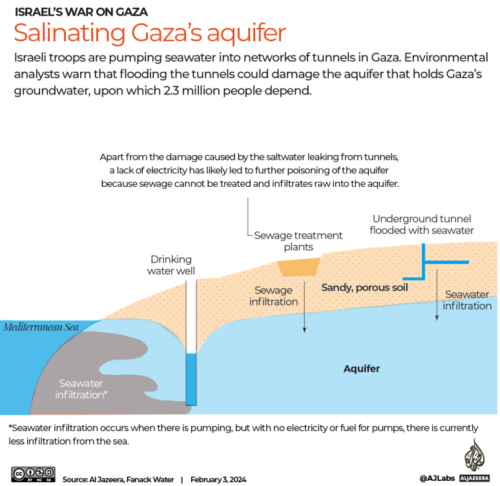 Some water researchers are warning that flooding tunnels with seawater could have a devastating effect on Gaza’s already scarce freshwater supplies and might destabilize buildings. The biggest concern is that the seawater will contaminate a critical coastal aquifer lying between Gaza, Egypt and Israel. This aquifer supplies nearly 80% of Gaza’s water.
“If you put salty water into a freshwater source, it’s polluting, it’s contaminating, it’s poisoning,” said Mark Zeitoun, a water engineer and director-general of the Geneva Water Hub in Switzerland.
Geographer Ahmed Ra’fat Ghodieh, from the An-Najah National University in Nablus in the West Bank, agrees that the aquifer is likely to become irreparably contaminated with salt water.
“If they flood these tunnels, then the seawater will penetrate the geological strata, towards the aquifer,” says Ghodieh. “Such action will have severe consequences on all aspects of life in Gaza — on agriculture, on soil, on infrastructure.” Ghodieh adds that the seawater could create sinkholes that destabilize the foundations of buildings. (Scientific American)
Polluting the aquifer with seawater adds to the numerous toxins the attacks on Gaza have brought. “Tens of thousands of unrecovered bodies are decomposing under rubble,” said Amali Tower, director of nonprofit Climate Refugees. “Thousands of explosives from the current and previous wars have polluted the air and ground, including highly incendiary white phosphorus, leaving another toxic layer of chemicals in Gaza’s air and soil.”
Waterborne diseases, too, are skyrocketing. The number of Palestinians in Gaza suffering from dysentery multiplied 25 times between mid-October and December, with more than 100,000 cases recorded, according to the World Health Organization (WHO). Children make up half of the cases since toddlers are more susceptible to a disease that causes extreme dehydration and, possibly, death.
The situation in Gaza is so extreme and horrific, words can feel empty and powerless. But let us vow to not turn our attention away when those in pain are calling for our care, our solidarity, and our action.
So we begin with prayer, gaining strength and hope from the prophets.
For I will pour water on the thirsty land, and streams on the dry ground; I will pour my spirit upon your descendants, and my blessing on your offspring. (Isaiah 44:3)
The Lord will guide you continually, giving you water when you are dry and restoring your strength. You will be like a well-watered garden, like an ever-flowing spring. (Isaiah 58:11, NLT)
Now, let us recommit to do all we can to stop the bloodshed and call for peace!
Andrew Kang Bartlett, Associate for National Hunger Concerns, Presbyterian Hunger Program
Today’s Focus: World Water Day
Let us join in prayer for:
PC(USA) Agencies’ Staff
Allison Davis, Digitization Coordinator, Presbyterian Historical Society
Samantha Davis, Coordinator for Gender & Racial Justice, Racial Equity & Women’s Intercultural Ministries, Presbyterian Mission Agency
Let us pray
God, O God, there is so much fear, pain, and harm all around us. Help us remember all the beauty, love, and goodness in the mix and yes, even to be grateful. Give us strength and give us vision. And give us the gumption to act for peace, justice, and the coming of your kin-dom, one devoid of earthly kings and dictators. Remind us daily of our own watery baptism as we pray and seek to behave like midwives of a new world. Amen.


