Tuesday, January 24, 2023

Today in the Mission Yearbook - The Rev. Dr. Luke Powery tells a Synod of the Covenant gathering that dealing with death is central to preaching that’s alive

Ezekiel’s vision of the Valley of Dry Bones has been ‘a gift’ to a scholar and preacher ‘expanding my own homiletical imagination’

January 24, 2023

The Rev. Dr. Luke Powery (Photo courtesy of Duke Divinity School)

The Rev. Dr. Luke Powery, Dean at the Chapel at Duke University and an associate professor at the Duke Divinity School, recently used the account of the Valley of Dry Bones found in Ezekiel 37:1–14  to remind preachers that sermons about resurrection must first encounter death in a real way.

Powery, whose new book, “Becoming Human: The Holy Spirit and the Rhetoric of Race” was published by Westminster John Knox Press, was the guest of the Synod of the Covenant’s monthly Equipping Preachers series. Listen to Powery’s talk, “Preaching in the Valley of Dry Bones,” by going here. The Rev. Dr. Chip Hardwick, the synod executive, hosted the installment.

Ezekiel 37 “has been a gift to me in thinking about and expanding my own homiletical imagination,” Powery said. “Ezekiel 37 is what I think of as death’s domain.”

When Jerusalem fell to King Nebuchadnezzar, Israel’s “dreams were dashed by Babylonian brutality,” Powery said. “Ezekiel, a priest and prophet, is called upon to prophesy to these bones. Chapter 37 is part of the restoration discourses which reveal, as the spiritual says, ‘This trouble don’t last always.’”

“It’s interesting it’s the Spirit of the Lord that brings [Ezekiel] to the Valley of the Dry Bones,” Powery said, since “it was believed one could be contaminated by coming into contact with the dead.” The Spirit of the Lord “leads him into a preach-off with death,” Powery said. “Israel is indeed dried up and dead, and if we are honest, many of us are preaching in a Valley of Dry Bones,” where “death is the context for all of preaching. To experience life, resurrection or hope, one must go through death, not around it.”

The Spirit “leads preachers to the context of death every Sunday in order to proclaim a word of life that ultimately breathes hope into the lives of people,” Powery said. “If a preacher avoids dealing with death, he or she will not be able to preach Christian hope in any meaningful way.”

In many churches, though, “preachers do that very thing — avoid death because they are at a loss about what to say about it and don’t realize its vital connection to the substance of Christian hope,” Powery said. “Because of this denial of death in general,” many churches are left with sermons “that are fundamentally hopeless.”

Ezekiel reports the Spirit of the Lord “sat me down in the middle of a valley” that was “full of bones.” “When I think about preaching, I often begin with the pain of unjust historical subjugation,” which Powery called “the spiritual roots of preaching.” Then he began singing the great spiritual “Trouble of the World.”

“Suffering is not limited to African Americans. It’s universal,” Powery said, adding that his students used to call him “Dr. Death” for delivering talks like he did last week. “I smell death whenever I preach,” Powery said. “I think the blood of martyrs fertilizes the soil of our preaching.”

Pain and suffering “keep our worship connected to reality — not that we consciously perpetuate it, but we acknowledge it,” Powery said. “For me, worship and death are intertwined.” But often “our preaching is so neat and orderly that even the Spirit doesn’t seem to surprise us anymore.”

“You can’t truly celebrate,” Powery told preachers, “until you learn how to lament.”

Fortunately, “it’s not your preaching that brings salvation. Man, that should free us!” Powery said. “It’s the Spirit working through your preaching that brings salvation.”

It was the great preacher James Forbes who called preaching “a ministry of raising the dead,” Powery pointed out. That suggests “our pews perhaps are full of dying people in need. Or do we imagine preaching to be a hospice ministry, where we help people to die with dignity rather than raising them to new life in Christ? As preachers in the Spirit, we are in the resurrection business. … By engaging contamination and death, we demonstrate our hope for resurrection.”

Facing death head-on “reveals a deep trust in the Spirit,” Powery said. “It’s not possible to explore the Spirit of life without facing head-on the reality of death.”

Mike Ferguson, Editor, Presbyterian News Service

Let us join in prayer for:

PC(USA) Agencies’ Staff
Maria Perry, Manager, Synod of Boriquen (PR), Plan Operations, Board of Pensions
Lisa Pesavento, Human Resources Coordinator, Presbyterian Foundation

Let us pray

God of hope, we thank you for the evidence of your love and care that is all around us. We ask your continued blessings. In Jesus’ name. Amen.

Virtual AME Church Growth and Development Seminar Registration is still open!

Virtual AME Church Growth and Development Seminar Registration is still open!

Not on our list?
Join Here
The News Digest contains selected articles from the newspaper.  Click below to get full access!
Buy Here
ShareShare
TweetTweet
ForwardForward
YouTube
Facebook
Website
Twitter
Email
The Christian Recorder is the official newspaper of the African Methodist Episcopal Church and the oldest continuously produced publication by persons of African descent.  

Bishop David R. Daniels, Jr., Chair of the General Board Commission on Publications

Rev. Dr. Roderick D. Belin, President/Publisher of the AME Sunday School Union
Dr. John Thomas III, Editor of The Christian Recorder


Copyright © 2023 The Christian Recorder, All rights reserved.

Monday, January 23, 2023

Today in the Mission Yearbook - A Pennsylvania church serves as a case study during a PC(USA) Stewardship Kaleidoscope workshop

The message from its pastor is straightforward: Honesty is the best financial policy

January 23, 2023

The Rev. Tom Moore (Photo by Gregg Brekke)

“Tell the story of Center Church honestly: the good, the bad and the ugly.”

This guiding principle framed the Rev. Tom Moore’s workshop at Stewardship Kaleidoscope 2022. Moore told participants the story of Center Presbyterian Church in McMurray, Pennsylvania, showing the importance of honesty and transparency when it comes to the church and its finances.

Located in an affluent community south of Pittsburgh since the 19th century, Center operated with the “Field of Dreams” mentality: “If you build it, they will come.”

The congregation thought, when it undertook a $1.2 million renovation around 2008, “it will pay for itself over time.”

That was just before the Great Recession of 2008.

At that critical time, Center was unaware of resources provided by ministry partners like the Presbyterian Foundation and the Presbyterian Investment and Loan Program, so they financed the renovation through a conventional community bank loan.

The church did not believe it needed outside help, so it began building before the campaign started. This led to a follow-up capital campaign a year later to alleviate mortgage debt. But with the building project completed, no one had an incentive to give.

And then the pastor received a new call two years after the project was completed.

Together, this collection of assumptions and missteps snowballed. Anxiety peaked. Key members and financial supporters left. By 2018, things looked bleak.

Fortunately, membership had stabilized by that time. The church hired Moore as a quarter-time pastor that summer. He was also working as a camp director then, but he lived close to the church and felt a call to journey with the congregation.

Through a series of “bold moves” that Moore outlined in the workshop, Center was able to overcome its crisis. These bold moves included:

Name reality. The church had to accept that it did not get to a crisis point overnight. Neither would it emerge from it overnight. Members had to be honest with themselves about the situation.

Ask for help. The church felt ashamed of its financial position yet was too proud to publicly admit the problem. Members had to set pride aside and ask for help.

Listen to advice. Center contacted the Presbyterian Foundation and met with Paul Grier, Vice President of Project Regeneration, who reviewed their financial predicament. The preschool and church mortgage were not included in the church’s operating budget. Combined with the school’s annual operating loss, the church realized it was losing more than $81,000 a year. As much as the church loved hosting a preschool, Moore spoke the words everyone was thinking: “This model of ministry was unsustainable.”

Living into painful changes. In such a precarious financial state, Center had to be honest with members and staff. Constant, transparent communication included naming the problems and listening to possible solutions from everyone. This led to difficult but necessary decisions such as saying goodbye to longtime staff, closing the preschool and selling two manses on the church campus.

Living into hope. Even though they tightened the purse strings, Center had to change its mindset. Members had to believe that God had a purpose for the church, even if they did not know what it was. Instead of asking “How do we survive?” they asked, “What is God doing with us?”

Faith in Action. Before the pandemic, Center was on the verge of being in the black (revenue equal to or exceeding expenses) for the first time in a long time. Center still managed to be in the black in 2020, despite the pandemic, and it has maintained that status. Covid tested the church’s faith, but the church continued to emphasize giving to local mission causes, since those ministries were hurting, too. This cultivation of generosity started with leadership, and their modeling inspired the congregation.

Center’s story may be unique in the details. But its spiral of denial and pride is a common reason churches face financial struggle. The church’s willingness to share what it learned the hard way can serve as both a warning and an inspiration to churches that hesitate to speak boldly not only to the world but to themselves.

The Rev. Jody Mask for the Presbyterian Foundation

The Rev. Jody Mask is a member-at-large of Central Florida Presbytery. He is a native and current resident of Orlando, Florida. He loves distance running and nature hiking as ways to be generous to his health. Send comments on this story to robyn.sekula@presbyterianfoundation.org

Let us join in prayer for:

PC(USA) Agencies’ Staff
Charlene Peacock, Reference Archivist, Presbyterian Historical Society
Derrick Perkins, Mail & Print Supervisor, Administrative Services Group (A Corp)

Let us pray

Creator God, thank you for speaking to your servants through the lives of others. Bless those whose prayers and actions sustain the men and women you call to the ministry of your church. Amen.

Sunday, January 22, 2023

Today in the Mission Yearbook - During a PC(USA) webinar, Bible scholars reimagine evangelism as equity, inclusion and flourishing

‘Evangelism must be redefined’ says Dr. Donghyun Jeong of Austin Seminary

January 22, 2023

Dr. William Brown

“Evangelism means sharing the good news in relationally flourishing ways,” said Dr. William P. Brown, Professor of Old Testament at Columbia Theological Seminary in Decatur, Georgia, recently.

In the Scattered Church webinar sponsored by Theology, Formation and Evangelism ministry area of the Presbyterian Mission Agency, Brown admitted that he was challenged by the invitation to speak about evangelism within the Hebrew Bible, particularly the psalms. However, once he looked at the texts from this angle, he was inspired by the holistic way that “good news” is both given and received and tied to the concept of shalom. “Shalom is not just peace but also justice,” said Brown, who pointed to Isaiah 52:7–8, where God’s messenger brings the good news of shalom to the impoverished, the captives, the impaired and the oppressed. The good news is, “they shall be free.”

“The result of justice is praise,” Brown said as he cited Psalms 8298146 and 148 as evangelism-defining texts of the Hebrew Bible before crossing over to the New Testament to support this fuller picture of evangelism with Colossians 1:21–23. “Evangelism is for all of Creation,” said Brown, who did not bow to stereotypes of converting nonbelievers and saving souls but instead described how the sharing of good news is done “on behalf of Creation and for those who are hungry.”

“Evangelism must be redefined,” agreed Dr. Donghyun Jeong, assistant professor of New Testament at Austin Presbyterian Theological Seminary. Jeong shared a slide from the 8 Habits of Evangelism produced under the leadership of the Rev. Dr. Ray Jones III, director of Theology, Formation & Evangelism, and quoted its opening line: “Evangelism is not a tool to gain new members for our churches … nor an instrument to help people gain access to heaven.”

Dr. Donghyun Jeong

Through close readings of Galatians 2 and James 2, Jeong revealed how evangelism is about the cyclical relationship among us, God and others. Jeong’s reading of Galatians 2 focused on how the good news manifests itself through inclusion and equity. Evangelism in the book of James comes in the form of action. Faith is not inward facing but declared outwardly. Jeong challenged traditional assumptions about the role of faith and works in Christian faith and practice by parsing out an analogy James employs: “Works animate faith like the spirit animates the body.”

Webinar attendees commented on the theme of integration and inclusion that ran throughout. The Rev. Dr. David Gambrell, Associate for Worship in TFE, thanked Jeong for reconciling Paul and James, two biblical writers who are more often contrasted than compared. Brown thanked Jeong for illustrating how “inclusion is a sign of embodiment of the gospel” and drew parallels to the fullness of evangelism aimed at the flourishing of all Creation, remarking, “Good news is embodied by the community.”

Beth Waltemath, Communications Associate, Presbyterian Mission Agency

Let us join in prayer for:

PC(USA) Agencies’ Staff
Sean Payne, Research Analyst II, Administrative Services Group (A Corp)
Tabatha Peach, Trust Administrative Assistant, Presbyterian Foundation

Let us pray

God of new life, we ask that our hearts and minds might be open to new revelations of how we are called to serve you. May your Spirit inspire us with new resurrection possibilities in Christ Jesus. Amen.

Friday, January 20, 2023

Today in the Mission Yearbook - A Princeton Theological Seminary webinar tells a captivating story of how one inmate gained freedom and now serves his community

Billy Taing and the Rev. Diane Ujiiye of API Rise are guests of the Center for Asian American Christianity

January 21, 2023

Billy Taing is co-director of API Rise. (Contributed photo)

It was Billy Taing’s candor that made for a memorable and moving webinar recently hosted by Princeton Theological Seminary’s Center for Asian American Christianity. Taing joined his fellow co-director with the organization API Rise, the Rev. Diane Ujiiye, for a discussion titled “Freedom? A Conversation About Incarceration and Being Asian in the U.S.” Dr. David Chao, director of the Center for Asian American Christianity, was the host. Listen to their conversation here.

Formerly incarcerated in the California state prison system for more than two decades for kidnapping and robbing people aboard a tour bus, Taing petitioned for and received a full and unconditional pardon. After leaving prison, he also left a union apprenticeship as an electrician to serve his siblings in the Asian American and Pacific Islander community in API Rise. Taing co-founded the Black and API Solidarity Group.

Taing was born in Cambodia in 1974, a year before the Khmer Rouge began one of the most brutal genocidal campaigns in human history. When he was about 18 months old, the Khmer Rouge “barged into our home, accused my father of speaking Chinese and beat him up in front of us. They dragged him away and we never saw him again,” Taing said.

He, his older brother and their mother were sent to a labor camp. By 1979, they’d made their way to the border with Thailand, where they were taken in by American soldiers. The next year the family made it to Atlanta, then San Diego and Monterey Park, California.

His brother joined a gang when he was 12. “I wanted to be embraced by people and naturally I gravitated there,” Taing said. “I started committing crimes and hanging out with people in that lifestyle. I felt a sense of belonging.”

At age 19, Taing laid plans to rob a bus going to Las Vegas. “My intention,” he said, “was not to harm anybody.” Police charged him with kidnapping and robbery, and Taing was incarcerated in the Los Angeles County Jail. Following his trial, the judge told Taing he was “showing mercy” by sentencing Taing to two life sentences.

When the doors closed at the maximum-security prison he was sent to, “there was a sense of despair. I thought, what am I going to do for the rest of my life?” Taing said.

The Rev. Diane Ujiiye is co-director of API Rise.

Three years later, Taing was sent to a lower security prison that offered educational and other programs. A sociology course “opened my eyes to a world bigger than the one I grew up in,” he said. “I started to learn about the impact of my crimes. No one got hurt physically, but I traumatized people and robbed them of their emotional security. That realization allowed me to take a path of transformation, learning about the ripple effects of my actions.”

By the time Taing appeared before the parole commission, “I was deep into my transformation. I understood what led me to be that 19-year-old boy who committed the crime that day. Trauma plays a huge role in that. I had felt weak and abandoned, and the trauma has impacted me throughout my whole life.”

While Taing was found suitable for parole, he next had to face immigration officers because he’d never sought U.S. citizenship. He served more than four months in a detention facility, then gained his release. A support organization introduced him to API Rise, “where I saw guys who were formerly incarcerated and lawyers and students who are really supportive and didn’t care about my past.”

During a question-and-answer session, Chao told Taing he was struck by how calm Taing was even while relating all the twists and turns he has endured.

Taing said he owes his calm to meditation. “For a long time, they didn’t allow Buddhist monks into prisons,” Taing said, explaining that he learned he could meditate up to 30 minutes in a prison dorm setting “without worrying I would be attacked. I have found inner peace and inner freedom. My experience defines who I am today,” someone who’s “not cuffed by the mistakes I have made.”

“I share now with a mind to allow people to learn from my experience,” he said, “and I think that really helps me.”

Mike Ferguson, Editor, Presbyterian News Service

Let us join in prayer for:

PC(USA) Agencies’ Staff
Brent Paschal, Help Desk Technician, Presbyterian Foundation
Stephanie Patterson, Multimedia Associate/Designer, Presbyterian Women

Let us pray

Heavenly Father, as you have sent your Son Jesus Christ, so send your children today to be instruments of reconciliation. Amen.

Ministry Matters - Faith & the scientific senses: observation | Purpose & Reductionism

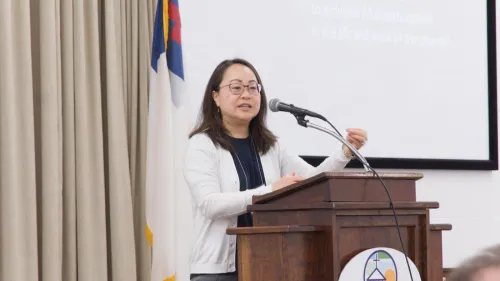
Mission Yearbook: Oh challenges Presbyterians to move from diversity to true inclusion

The Rev. Jihyun Oh addresses participants from all five presbyteries in Georgia. (Photo by Kira Waters) More than just welcoming new faces t...