Friday, February 18, 2022

Today in the Mission Yearbook - The jig’s up

An Illinois pastor doesn’t mind a little humiliation while helping to teach youth a lesson on generosity

February 18, 2022

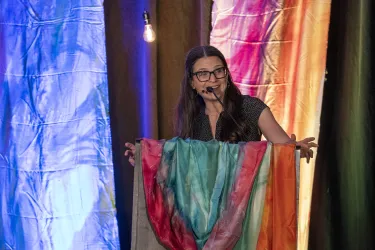
The Rev. Amanda H. Joria

For really good ideas on how to serve the faithful at Park Ridge Presbyterian Church in suburban Chicago, the Rev. Amanda H. Joria often relies on her mother.

On St. Patrick’s Day, that idea involved Joria dressing up in the Irish step dancing costume — complete with a bouncy, curly wig — that she’d last worn at age 15. With an eye toward downsizing the house, her mother had brought the costume and wig by Joria’s house. To Joria’s surprise — she’d given birth a few months earlier — the costume still fit. “I put it on and I decided people need to see this,” she said during a recent Between Two Pulpits Facebook Live broadcast hosted by Bryce Wiebe and Lauren Rogers of Special Offerings. “If I’m going to put it on the internet,” having done exactly that, “we should get something out of this,” Joria reasoned.

Her St. Patrick’s Day online plea came with a promise to don her costume — complete with the wig — and dance a jig if the congregation gave $100 to One Great Hour of Sharing by the end of the day. For $500, she’d get the church’s senior pastor, the Rev. Josh Erickson, to dance a jig too, once she taught him how.

“He’s a great sport,” Joria told Wiebe and Rogers. “We raised well over $500 for One Great Hour of Sharing. It was the most online traffic we had ever done. It was proof that it could work even when we are separated.”

“That,” Wiebe responded, “is why I like talking with leaders who work with young people.” Since 2018, Joria has been Park Ridge Presbyterian Church’s associate pastor for children, youth, missions and outreach ministries.

Joria said it’s been social media that has allowed the church to connect with Park Ridge residents around generosity outside the church community. “They may not care about our worship services or our community life, but there is a longing for people to connect around serving, and it’s contagious,” she said. “Being part of a faith community is not important to everybody, but responding to hunger is.”

Lessons about kindness “just make sense to young people,” she said. “If we can make generosity make sense to them early on, the next generation will be unstoppable.”

The church has a gumball machine and gives away the quarters spent on gum. “Having fun and a gimmick is not a bad thing when you are trying to cultivate generosity,” Joria said. “You can put on a wig and dance and that’s OK, too.”

Wiebe suggested the church take the gumball ministry a step further during an upcoming children’s time: give each child two quarters to have a gumball and a quarter left over. Call it “something to chew on,” suggested Wiebe, the former Special Offerings director.

“I may steal that idea,” Joria said.

If she were to preach on this week’s lectionary, Joria would focus on James 3:1–12, especially verse 8: “but no one can tame the tongue — a restless evil, full of deadly poison.”

“We’ve got to try to control our tongues or our tongues will control us,” Joria said. “Words can have powerful impact. Kids can say really kind things out of nowhere, but we forget how to if we don’t practice it often.”

“I’ve also learned from our younger leaders about how we think and talk to ourselves, and how we make incorrect conclusions about how we think God talks to us,” Joria said. “We can learn new loving ways in which we hear God speaking to us.”

Joria said she sat down recently with some of the church’s high school seniors to record a podcast. It proved to be a great opportunity to talk about mental health, “which came up quite a bit,” Joria said. Later via Instagram she found herself telling the story of her friend in the eighth grade who died by suicide.

“Why don’t I tell that story much anymore? The ways kids express themselves on social media now gives us a lot of opportunity to see what they were struggling with behind the scenes,” Joria said. “I wanted them to be sure to see a word on Instagram that they are not alone.”

Michael Ferguson, Editor, Presbyterian News Service

Let us join in prayer for:

PC(USA) Agencies’ Staff
Jed and Jenny Koball, Mission co-workers serving in Peru, Presbyterian Mission Agency
Karla Ann Koll, Mission co-worker serving in Costa Rica, Presbyterian Mission Agency

Let us pray

Lord, bless us with renewal. We pray our community would be blessed with one mind and spirit in feeding your flock. By your Holy Spirit, inspire and enable foolish moves leading to the flourishing you have promised. Jesus, you call us to feed, by the power of your Holy Spirit. May we answer. Amen.

WCC NEWS: European churches grapple with challenges of secularization

European churches are wrestling with the consequences of a secularized society for their life and witness, according to participants from Europe attending the central committee of the World Council of Churches which is meeting via videoconference from 9-15 February.
A glimpse of downtown in Karlsruhe, Germany. Photo: Marcelo Schneider/WCC
16 February 2022

At a meeting of the WCC’s Europe region, participants reflected on the changing religious context of their continent, as the WCC prepares to hold its 11th Assembly later this year in Karlsruhe, Germany - the first such WCC gathering in Europe since 1968.

“We’re looking at a Europe characterized by increasingly secularized societies. This is our context,” said Dr Jørgen Skov Sørensen, general secretary of the Conference of European Churches, which is holding a European Regional Pre-assembly for the WCC gathering from 25-26 February.

“Authorities are questioned nowadays and one of the authorities is the voice of the church,” said Sørensen. “And this leaves churches with a new challenge – how to be a voice among voices in the public square. How do we maintain our constructive voice in building European societies?”

Metropolitan Nifon of Targoviste from the Romanian Orthodox Church highlighted the consequences of secularization for the missiological task of the churches.

Other issues highlighted by participants at the meeting chaired by the WCC president for Europe, Archbishop Emeritus Dr Anders Wejryd, included the importance of interreligious dialogue in Europe, which is increasingly a multifaith society, as well as the migration, climate change, and ecology.

The Rev. Karin van den Broeke from the Protestant Church in the Netherlands, said it was important to discover the “spirit of God” in secularization, “so that it is not only a problem for us but also a chance, and a chance to rethink how ecumenism, diakonia, mission, and being church are related to each other.”

Summing up the discussion, Wejryd said that Europe is undergoing great changes and these will change the role played by churches.

“Secularization can be devastating and can also create new openings for churches,” he said.

“Many of the issues that confront churches in Europe are also issues that will confront churches in other parts of the world,” according the archbishop. “And many questions we thought pertinent to Africa, Asia, and Latin America are coming to the surface in Europe.”
 

WCC central committee meeting 2022

Learn more about the WCC 11th Assembly

See more
The World Council of Churches on Facebook
The World Council of Churches on Twitter
The World Council of Churches on Instagram
The World Council of Churches on YouTube
World Council of Churches on SoundCloud
The World Council of Churches' website
The World Council of Churches promotes Christian unity in faith, witness and service for a just and peaceful world. An ecumenical fellowship of churches founded in 1948, today the WCC brings together 349 Protestant, Orthodox, Anglican and other churches representing more than 550 million Christians in over 120 countries, and works cooperatively with the Roman Catholic Church. The WCC acting general secretary is Rev. Prof. Dr Ioan Sauca, from the Orthodox Church in Romania.

Media contact: +41 79 507 6363; www.oikoumene.org/press
Our visiting address is:
World Council of Churches
150 route de Ferney
Geneve 2 1211
Switzerland

WCC NEWS: Communication critical in our digital age, WCC central committee emphasizes

The World Council of Churches (WCC) central committee has underscored the vital importance of churches addressing critical issues related to social justice raised by digital transformation.
Photo: Albin Hillert/WCC
16 February 2022

The WCC governing body on 14 February received “A New Communications Paper for the 21st Century: A vision of digital justice,” a text created in preparation for the WCC’s 11th Assembly later in 2022 that takes into account the results of a symposium on “Communication for Social Justice in a Digital Age” held in September 2021.

According to the paper, the digital transformation of society raises profound issues that the ecumenical fellowship has wrestled with for many decades: power, justice, equity, participation, promoting sustainable communities, care for creation, how voices from the margins are heard, as well as human dignity, and what it means to be human, made in the image of God.

The paper states that “digital technologies can be powerful tools for living in relation with others, for inclusion, education, encounter, imagination, creativity, and understanding.”

However, digital communication platforms are also “used to spread disinformation and hate, exploit individuals and communities, increase surveillance, and contribute to growing gaps in access, power, and wealth.”

To bring about digital justice, the paper urges “a transformative movement led by civil society and communities of faith.”

The WCC central committee also received the report “Pilgrims on the Path of Peace – The Journey of the WCC from Busan to Karlsruhe,” which recounts the journey of the WCC since its last assembly in 2013. It is the story of a fellowship of churches committed to moving together on a Pilgrimage of Justice and Peace, and will be the report of the central committee to the assembly.

The WCC central committee is meeting via videoconference 9-15 February to prepare for the WCC’s 11th Assembly, address business matters, and strengthen the WCC fellowship through sharing and prayer.
 

A New Communications Paper for the 21st Century: A vision of digital justice

WCC central committee meeting 2022

Symposium on Communication for Social Justice in a Digital Age

Learn more about the WCC 11th Assembly

See more
The World Council of Churches on Facebook
The World Council of Churches on Twitter
The World Council of Churches on Instagram
The World Council of Churches on YouTube
World Council of Churches on SoundCloud
The World Council of Churches' website
The World Council of Churches promotes Christian unity in faith, witness and service for a just and peaceful world. An ecumenical fellowship of churches founded in 1948, today the WCC brings together 349 Protestant, Orthodox, Anglican and other churches representing more than 550 million Christians in over 120 countries, and works cooperatively with the Roman Catholic Church. The WCC acting general secretary is Rev. Prof. Dr Ioan Sauca, from the Orthodox Church in Romania.

Media contact: +41 79 507 6363; www.oikoumene.org/press
Our visiting address is:
World Council of Churches
150 route de Ferney
Geneve 2 1211
Switzerland

Thursday, February 17, 2022

Today in the Mission Yearbook - Trail magic

Ministry to thru-hikers helps revitalize oldest Protestant church on the western slope of Colorado Rockies

February 17, 2022

From left to right are hikers Marco Santarsiere and Don and Heather Berneir. (Photo by Paul Seebeck)

One month after the Rev. Dr. Jason Brian Santos became pastor of Community Presbyterian Church in Lake City, Colorado, the small mountain town of 400 officially became a “gateway” trail town for hikers on the Continental Divide. It was already well known as one of the better towns to stop for those hiking the Colorado Trail, which runs from Denver to Durango.

Months before the thru-hiking season began, Santos began pondering how his congregation might minister to trail hikers. Earlier in his career, as an associate pastor in New Wilmington, Pennsylvania, he partnered with the Presbyterian church in Duncannon, Pennsylvania, a town on the Appalachian Trail. For two years, he and his youth group refurbished the historic hiker center that sits adjacent to the church. Through that effort, Santos became more aware of the needs of thru-hikers.

So, when Lake City became an official gateway trail community, Santos had an idea about how the small church he served might service these weary travelers: by providing them with a free Sunday night hiker meal — and genuine hospitality — in the busy summer months of July and August.

At first, people at the church were a little uncertain, but by springtime the church session approved the hiker ministry. And at the next community pastoral meeting with the Baptist, Episcopalian, Catholic and nondenominational churches in Lake City, Santos invited them to join in the trail hiker meal.

Each church took turns hosting meals at Community Presbyterian Church and helping with the shuttle to Spring Creek Pass on Sunday to pick up hikers coming for the meal. During the eight weeks, the churches served some 200 hikers and provided refuge to more than 20 who couldn’t find accommodations in town.

Word on the Colorado Trail quickly spread about the hospitality Lake City was offering via testimonies on the Guthook app, in Facebook posts and through word of mouth. Hikers Marco Santarsiere, Dodge Aistad, Anna Howell and Eric Sallenberger came to Lake City on the last Friday in August. “We all agreed we had to stay for the final meal,” Santarsiere said. “It’s been wonderful. You make lifelong friends on the trail and now here in Lake City.”

Based what they’d heard, Howell and Sallenberger also felt like they couldn’t pass up the meal. People on the trail kept telling them that they had to come to Lake City, a place where people were kind and helpful to hikers. Howell said seeing people helping, for no reason except to provide her and other hikers with a meal, restores one’s faith in humanity. Added Sallenberger: “It was so nice. We now call them trail magicians,” a tip of the hat to the phrase “trail magic,” which refers to unique acts of kindness hikers encounter on their journeys.

Jim Ferguson, a member of First Baptist Church in Lake City, has been to every meal. “Seeing church people accept others for who they are has restored my faith,” he said. “Our communities of faith are working together planting seeds.” For one retired summertime resident, Presbyterian Donna Lowry, the hiker meals, which she refers to as “Sunday night socials,” have been not only been good for the hikers, “but also for us,” she said, “just to love on people.”

Hiker meals throughout the summer had themes, including German, Mexican, Italian fests — along with an all-American meal with hot dogs, and both a ham dinner and a ham brunch.

The final meal, prepared by Santos, was Greek night. With homemade pitas, shaved gyro meat and a dollop of tzatziki, the meal participants feasted on Mediterranean fare.

For Santos, who previously was director of Christian Formation for Presbyterian Mission Agency, the best thing about providing meals for hikers is that faith communities joined together for the common purpose of mission and ministry. It’s been a thrill for him to see how it’s taken off.

“In the middle of the week, people are telling me they’ve picked up a hiker and taken them to the pass,” he said. “Like they’ve done something really good. It’s rewarding, good to see and hear. It’s what the hikers call ‘trail magic’ — holy moments that are heart of humanity.”

Paul Seebeck, Communications Strategist, Presbyterian Mission Agency

Let us join in prayer for:

PC(USA) Agencies’ Staff
Mike Kirk, Director & General Counsel, Legal Services, Administrative Services Group (A Corp)
Mark Koenig, Internal Communications, Human Resources, Administrative Services Group (A Corp)

Let us pray

Redeeming and restoring God, we give thanks for the varied ministries of the church. Help us to make good use of the skills and talents as we share in the building and rebuilding of Christ’s church. Amen.

Wednesday, February 16, 2022

Today in the Mission Yearbook - Berries and nuts are among signs of God’s enduring love for Creation

Current headlines may be more than we can bear, but the deep cycles of life carry on

February 16, 2022

Bur oak (photo by Ken Rummer)

Along the High Trestle Trail, berries settle on.

Elderberries hang purple from red branches, dressed like Red Hat ladies out on the town. Honeysuckle opts for Christmas colors, setting red balls among still-green leaves. And the clustered white berries of the local dogwood carry dark center spots that make them look like manic eyeballs.

Seeing the berries cheers me up.

The news may be more than I can bear to watch, but a man on a three-wheel bicycle is gathering elderberries for a batch of wine or a few pints of jelly.

The battle against the virus may be losing some ground, but the honeysuckle managed to turn yellow-white flowers into tiny red spheres again.

Wildfires may be getting wilder, and hurricanes may be getting stronger, but the cardinals that nest in the dogwood thicket have their pantry well-stocked once again.

Despite disaster and disruption, some of the deep cycles of life continue.

In Genesis, at the end of the great flood, Noah offers sacrifices to God. The ancient storyteller gives us God’s response with some internal dialogue that concludes with an assurance.

As long as the earth endures,
     seedtime and harvest, cold and heat,
summer and winter, day and night,
  
  shall not cease. — Genesis 8:22

Deep cycles, life and season, continuing on. That’s what I see in the berries along the trail.

I find comfort in the regularity, even if it feels increasingly fragile. When the migrating insect that feeds on a particular flower arrives at the usual stop to find that the flower bloomed two weeks early due to a warming climate and no flower juice remains, the deep and regular cycles begin to lose their grip.

I hear the seedtime verse in Genesis as God’s intention, but not as a guarantee that God will overrule the effects of climate change. Still, checking on the berries, witnessing circles of life beyond my own, I feel less anxious.

The trees are getting in on the act, too. The bur oak near the entrance to the creek trail is going nuts. It’s showing off new acorns already wearing their distinctive caps. Red buds dangle their browning bundles in preparation for the great seed drop. And near the creek, a broken locust branch still nurtures the spiral seed pods children love to shake like maracas.

That locust branch inspires me. It was a major part of the tree, perhaps twisted beyond its strength by the derecho wind a year ago, broken off mid-tree but not cleanly, still connected by living layers of bark. There it is, broken beyond repair, but still bringing seeds to maturity and dropping life into the future.

In a season of much brokenness, I hear an invitation to embrace the steadiness of bushes and the courage of trees. There is still time to offer our best gifts, our acorns and berries, to the world, and to the future.

The Rev. Ken Rummer writes about life and faith from the middle of Iowa by the High Trestle Trail.

Let us join in prayer for:

PC(USA) Agencies’ Staff
Oweeda Kinnaird, Trust Associate, Presbyterian Foundation
Jim Kirk, Associate, Disaster Response USA, Presbyterian Disaster Assistance, Presbyterian Mission Agency

Let us pray

Loving God, we are mindful that you have called your people to sit together in the kingdom of God. We are thankful for new ministries within our midst that give witness to that calling. Amen.

Tuesday, February 15, 2022

Today in the Mission Yearbook - Arab and Israeli women use creativity to work toward a just peace

Sindyanna of Galilee bridges cultural divides with Fair Trade products

February 15, 2022

Sindyanna children were asked to illustrate ideas of optimism, togetherness and hope. Speaking two different languages, the children created instant bridges between the two cultures. (Photo by Yoram Ron)

Working for a just peace in Israel-Palestine can’t be left only to the governments, or even the diplomats. Sindyanna of Galilee, a Presbyterian Mission Agency global partner and grassroots group of Arab and Jewish women, is working together to share its vision of peaceful co-existence in the region.

“Here at Sindyanna we still believe that hope and collaboration defeat racism and hatred,” said Hadas Lahav, Sindyanna’s CEO. “This is why, now more than ever, we are promoting our story of a Fair Trade, women-led organization where Arabs and Jews work together towards economic justice and a better future.”

Created in 1996, Sindyanna of Galilee is the only certified Fair Trade olive oil producer in Israel that operates among the country’s Arab population, providing both functional expertise and a practical approach to build capabilities and deliver impact. The work is focused on bridging cultural divides, encouraging sustainable agriculture and supporting organic farming.

The group’s list of fair-trade products includes organic and extra virgin olive oils, spice mixes, carob syrup, almonds, honey, olive oil soaps and various traditional handicrafts. Za’atar is a mixture of dried za’atar leaves, sesame seeds, sumac, olive oil and sea salt used for seasoning.

The products create economic opportunities for Arab women and assist local growers and producers.

The female-led nonprofit actively promotes the concepts of “business for peace” and Fair Trade in Israel. They do this by selling Arab producers’ olive oil and other premium products in the international and local marketplace according to Fair Trade principles, and then channeling all of the profits into education for Arab women.

“We’re driven by our strong sense of values every step of the way,” said Lahav. “We strive to proudly execute five pillar principles that are embedded in our culture and form the backbone of our values, our mission and our business approach.

In cooperation with other local organizations, Sindyanna reclaimed abandoned or neglected parcels of land and transformed them into Israel’s first flourishing Jewish-Arab organic and regular olive groves. By combining sustainable cultivation with modern techniques, they produce award-winning olive oils.

But they believe the fruits of the groves is much greater than just good-tasting olive oil. “They are a passion for the environment, and invaluable, trust-building cooperation between local Arabs and Jews,” the group says on its website.

Why olive oil?

“Locally grown, cultivated and cold pressed, the extra-virgin olive oil marketed by Sindyanna of Galilee is part of a time-honored Mediterranean legacy intrinsically linked to the land of Canaan, later known as Israel and Palestine. Olives are the fruits of a land that is sacred to Jews, Christians, and Muslims — the Holy Land (Latin: Terra Sancta; Hebrew: ארץ הקודש Eretz HaQodesh, Arabic: الأرض المقدسة Al-Arḍ Al-Muqaddasah). As such, they are imbued with a unique significance appreciated by millions of people around the world,” the website says.

Sindyanna explains that olives were one of the biblical seven species and a key agricultural product of the land of Israel in ancient days.

“Olive oil has played a pivotal role in people’s daily lives. Its uses range from lighting (feeding clay lamps as well as the Menorah, the seven-branched candelabrum, which illuminated the Temple) to preparing, cooking and baking food; from hygiene (olive oil soaps and beauty care) to healing and medicine; and from religious and sacrificial rituals to anointing kings and priests. The latter is illustrated by the word ‘messiah’ that stems from the Hebrew word ‘mashiakh,’ which literally means a person anointed with oil,” according to Sindyanna.

The group says that the olive tree also symbolizes revival, renewal and new generations, as in Psalm 128: “Happy is everyone who fears the Lord, who walks in his ways … your children will be like olive shoots around your table.”

Sindyanna exports its fair-trade olive oil and other products from its warehouse and factory in Kfar Kana (Cana), about 3.1 miles northeast of Nazareth on the road to the Sea of Galilee. The village of Cana is recognized by Christians worldwide as the biblical Cana of Galilee, where according to the Fourth Gospel, Jesus performed his first public miracle — the turning of water into wine at a wedding feast (John 2:1–11), the first among seven miraculous signs.

Kathy Melvin, Director of Mission Communications, Presbyterian Mission Agency

Let us join in prayer for:

PC(USA) Agencies’ Staff
Regina Kimbrough,  Trust Officer, Presbyterian Foundation
Tracey King-Ortega, Mission co-worker serving in Nicaragua, Presbyterian Mission Agency

Let us pray

Eternal and loving God, in the midst of a world of relentless change, grant us a deep and abiding sense of your sovereign power and abiding presence in our lives. May we walk the way you have set before us in confidence, in hope and in faithfulness to our calling in Christ Jesus our Lord. Amen.

Monday, February 14, 2022

Today in the Mission Yearbook - A Valentine’s card for all

When you love more, you get more

February 14, 2022

For God so loved the world that he gave his only Son, so that everyone who believes in him may not perish but may have eternal life. — John 3:16

Valentine’s Day is one of those commercialized holidays that boost the bottom lines of candy companies — and florists. But when I was a little girl, Feb. 14 wasn’t about flowers or even the chocolates in the heart-shaped box that my mother would put on top of my cereal bowl in the morning. (It was always a beautiful sight to see that loving gesture brightening what would have been just another ordinary wintry day for my brother, sister and me. I tried my best not to get into the candy before heading to school, emphasis on “tried.”)
As much as I appreciated the chocolates, what I looked forward to the most was handing out Valentine’s Day cards to my classmates. With money in my pocket from my allowance, I would go to the local Woolworth’s with my grandmother and pore over the variety of boxed cards. There were cards featuring cuddly animals. Cards with Peanuts characters. Cards with flowers and rainbows. It wasn’t easy choosing, but no matter what I finally purchased, I knew this: There would have to be enough cards for ALL my classmates. That’s right. All. My mother made sure of that, reminding me that even the kid who pulled my pigtails should not be left out and receive a card.

Sadly, what I often remember of Valentine’s Days past were my friends who didn’t get such advice from their parents, which meant there were children who would go home that day with few messages of “You are loved.”

William Shakespeare famously penned about love that the “more I give, the more I have.” He was right. Love is like that, and every time I have found myself building walls around my heart or withholding a loving word or choosing to dislike someone all because (insert any foolish reason we give to not like someone), I remember those boxed Valentine’s Day cards of my childhood. I remember the joy of writing cards to those who were my best friends. I remember the struggle to write a card to the child who was mean to me. I remember the sadness writing a card to the child who always sat alone during lunch. What I remember the most, though, was the day I placed my Valentine’s Day card on the desk of that child. It was the only one she had received — and she gave me the most beautiful smile. A simple little heart-shaped card made all the difference to her — and to me.

When you risk loving all, more love does enter your life. Perhaps that is what Jesus was trying to tell us when he gave us the mandate to love one another. Love, even if it is hard at times. Love. Because when we choose to love, goodness and grace increase and hate decreases. This Valentine’s Day, imagine what your small gesture of love can do to heal the brokenhearted, the lonely, the misunderstood and the neglected. For God so loved the world, God gave us Jesus — a love letter addressed to you, to me, to the stranger, to our enemies, to all.

Donna Frischknecht Jackson is the editor of Presbyterians Today. She is also the author of the 2022 Lenten devotional, “Lord, When Did We See You?” — a weekly Matthew 25 journey to Easter. The online devotional is available at pcusa.org/2022Lent.

Let us join in prayer for:

PC(USA) Agencies’ Staff
John Kim, Senior Translator, Global Language Resources, Administrative Services Group (A Corp)
Lydia Kim, Coordinator, Mission Personnel Team, World Mission, Presbyterian Mission Agency

Let us pray

Loving God, in a world where hate seems to be the norm and where we are too quick to draw divisive lines in the sand, come and open our hearts. Help us on this day to move past the sentimentality of hearts and roses. May we embrace this day as one to challenge ourselves to love as your Son wanted us to love. May we look at our box of Valentine’s Day cards and see that there are enough love notes for all in our lives. In Jesus’ name, we pray. Amen.

Mission Yearbook: Rabbi calls connection, vulnerability keys to supporting communities of faith

Rabbi Sharon Brous, senior and founding rabbi of IKAR in Los Angeles, urged church leaders to resist isolation, embrace vulnerability and d...