Monday, May 15, 2023

Minute for Mission: May 15 Palestinian Nakba Remembrance Day

My reflection to the Presbyterian Church

May 15, 2023

Zoughbi

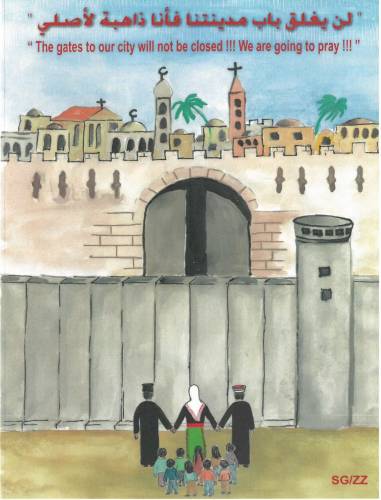
Mahmoud Darkish once said, “Whenever they find the reality that doesn’t suit them, they alter it with a bulldozer.” It is the reality of the Palestinians facing the Nakba (catastrophe) of 1948. You know, the Nabka didn’t happen only in 1948; it has been happening since 1948, as the leveling of villages is still occurring. House demolitions are on the rise, confiscation of lands is still ongoing, children, young adults, and others continue to be imprisoned, ethnic cleansing still occurs and unemployment is skyrocketing. It was a shocking war of 1948, a war which led to “independence for Israel” but a Nakba for the Palestinian Arabs in which 750,000 at least were forced to leave their country, and where 600 villages were destroyed.

The whole story started with the Zionist idea that Jews are people without land and Palestine was a land without people — so why not have the people without a land settle in Palestine, a country without a people? In 1948, the dreams of Palestinians were shattered; their land was divided — 77.3% became Israel, and 22.7% became the West Bank, despite the populations reflecting the inverse. Jerusalem was under Jordan’s rules and Gaza Strip under Egyptian rule until 1967. In 1967, Israel occupied the remnant of Palestine, and all of the historical land came under Israel’s occupation. Palestinians were scattered into five groups. Those inside Israel have an Israeli Passport, those in the West Bank have Palestinian travel documents, those in Gaza have Egyptian travel documents, East Jerusalem Palestinians have Israeli laissez passes, and Palestinians in the diaspora have different Arab and foreign passports. The land is divided, and the people are scattered, but their dream is to be united despite their diversity in living situation. Half of Palestinians are refugees. They are scattered, too, and live in 60 refugee camps around the Middle East, including the motherland.

Zoughbi

“They divided my garments among them, and for my vesture they cast lots” John 19:24.

Let me draw some lessons from the catastrophe:

The Palestinians will not disappear. There is a big difference between wishful thinking and reality; Israel would like to control all the land, and there is a demographic war between Israel and Palestine. The number of Palestinians is almost equal to the Israeli population. No one will disappear.

Israel will continue with its expansionism and ethnic cleansing of Palestinians. In fact, Israel wants more geography and less Palestinian demography, but this will not work. (Another way of saying this is, “While Israel wants the land of the Palestinians, it refuses to accept the people who come with the land.”) Let us learn from the example of South Africa, Northern Ireland and the Civil Rights movement in the States. “No injustice will last forever.”
Stories are stronger than their devious scheme: “I will tell you something about stories,” Leslie Marmon Silko once said. “They are not just entertainment. Do not be fooled. They are all we have, you see, all we have fight off illness and death. You do not have anything if you do not have stories. Their evil is mighty, but it cannot stand up to our stories. So, they try to destroy the stories. Let the stories be confused or forgotten. They would like that. They would be happy. Because we would be defenseless then.”

Let us pray together for the steadfastness and the unity of our people, and for the integrity of the land, despite all the challenges, difficulties and hardships that we face. No doubt, we will celebrate life with the resurrected Savior. “We are troubled on every side, yet not distressed; we are perplexed, but not in despair; persecuted, but not forsaken; cast down, but not destroyed; always bearing about in the body the dying of the Lord Jesus that the life also of Jesus might be made manifest in our body.”

Indeed, it is not the epoch of demise of the nation, but it is the rebirth of people’s dreams and hopes.

Zoughbi for Douglas Dicks, Associate for Ecumenical Partnerships — St. Andrew’s Scots Memorial Church, Jerusalem, Facilitator for Education for Peace and Justice in Israel and Palestine — Presbyterian Church (U.S.A.)

Let us join in prayer for:

PC(USA) Agencies’ Staff
Devan Caton, Operations Business Analyst, Presbyterian Foundation
Stephanie Caudill, Mission Associate for Resources & Promotion, World Mission, Presbyterian Mission Agency

Sunday, May 14, 2023

Today in the Mission Yearbook - Mother’s Day

Later we will understand

May 14, 2023

Mother’s Day, the second Sunday in May, dates to the late 1850s as a day to learn to cook better and clean house to protect the family from disease. Mothering is not limited to moms, though. Children need many positive role models in life’s journey.

I keep thinking about the mother of the disciples James and John, you know her as the wife of Zebedee.

Her name was Salome, which means peace. She may have been the sister of Jesus’ mother, which would have made her Jesus’ aunt, and James and John, Jesus’ cousins. Jesus gave them the name Boanerges, which means “Sons of Thunder” (Mark 3:17, Luke 9:54).

Salome was present at the crucifixion of Jesus and the empty tomb after Jesus’ resurrection. She is the mother who knelt before Jesus to ask if her two sons could sit next to Jesus in his kingdom, one on his right and the other on his left (Matthew 20:20–28).

I’d like to know if this was her idea or if her sons convinced her to ask Jesus for these places of honor. One thing is certain: It wasn’t their father Zebedee’s idea, since Salome refers to James and John as “these two sons of mine.”

Do you think Salome thought Jesus would say something like, “That’s a great idea, Salome, should James be on my right and John on my left, or vice versa?”

Instead, Jesus basically said she didn’t really know what she was asking him to do. Turning his attention to James and John, Jesus asked them, “Are you able to drink the cup that I am about to drink?”

They answered, “We are able.”

At this point in the story, I bet they got a little ahead of themselves. I bet they all three thought, ‘OK, we’ve got this.’

Then Jesus tells them they will indeed drink from the same cup, however, “to sit at my right hand and at my left, this is not mine to grant, but it is for those for whom it has been prepared by my Father.”

Parents typically want the very best for their children. Yet, Salome had not one son — but two — called by Jesus himself. Why wasn’t this enough for her? For them? Why did they want more greatness than that?

Jesus told his disciples that he came to serve, not to be served. He came to give his life “as a ransom for many.” Greatness in the world is different than greatness in the kingdom.

What do you think James and John were thinking later, as Jesus knelt down to wash their feet? (John 13:1–17)

Tammy Warren, Former Communications Associate, Presbyterian Mission Agency

Let us join in prayer for:

PC(USA) Agencies’ Staff
Sharon Castillo, Director, Delivery & Administration, Benefits, Board of Pensions
Lee Catoe, Managing Editor, Unbound & Associate for Young Adult Social Witness, Presbyterian Mission Agency

Let us pray

Lord, so often we don’t think our ideas through. Please forgive us. Thank you for giving us life and opportunities to serve one another where you have called us to be in this moment. Bless all who mother others, those who have given birth and those who have given love. Amen.

Saturday, May 13, 2023

Minute for Mission: Fair Trade Day

Prayer for Fair Trade 2023

May 13, 2023

Fair Trade is a partnership that observes the human rights of all involved, paying fairly for goods and services that have been sustainably sourced and also engaging in supporting the fight against economic crisis, poverty, gender inequality and climate change. The PC(USA) encourages fair trade purchases, including Eco-Palms and the Presbyterian Coffee Project, whenever possible. Photo courtesy of the University of Minnesota CINRAM

Jesus fed the hungry and told his disciples to do the same. Yet, we know that hunger is an extremely complex phenomenon with economic, political and social causes. The Presbyterian Hunger Program does root cause work that addresses the underlying questions of why people are hungry in order to reduce ongoing hunger. That work includes accompanying Presbyterians in questioning our economic lives as we move beyond what our dollars do in the offering plate, to considering what our dollars do in the marketplace.

Fair Trade is an economic model that ensures we are practicing our values through our money. Fair Trade provides access to needed resources, allows workers to provide for their families while having control in their lives that allow them to live with increased dignity and tell their own stories.

World Fair Trade Day takes place on May 13, 2023. Organized by the World Fair Trade Organization, the aim of the day is to celebrate Fair Trade and encourage the public to, where possible, choose Fair Trade goods, becoming fair and ethical consumers.

How to Observe Fair Trade Day:

Buy
Next time you need to make a purchase at your local supermarket, purchase fair trade certified products. If your local stores don’t carry fair trade products, encourage them to do so, and explain the movement’s benefits. Use Fair Trade coffee, tea, cocoa and other products during fellowship hour and anywhere coffee is served at church. Visit the Presbyterian Coffee Project page for congregations for ideas on how to get started and keep momentum going.

Pray
Incorporate prayers for Fair Trade farmers and artisans all over the world into your own prayers and into the prayers of your congregation.

Learn
Educate members of the congregation and community using Educational Materials from PC(USA) and Fair Trade partner organizations. Learn more about Fair Trade Day.

Jessica Maudlin, Associate for Sustainable Living and Earth Care Concerns, Presbyterian Hunger Program

Let us join in prayer for:

PC(USA) Agencies’ Staff
Laura Caruthers, Client Specialist II, Presbyterian Foundation
Jennifer Cash, Copy Editor, Communications Ministry, Presbyterian Mission Agency

Let us pray

God of Justice, we ask that you transform the rules and practices of trade. We pray for those suffering because of unfair trade, for those developing new ways of trading and for those making choices about what they sell or buy.

We remember your wisdom from Proverbs and confess our part in the disparity that exists so that in the fields of the poor even when abundant fruits ripen, injustice sweeps them away, leaving families to hunger.

We ask, Oh God, that you help us to share the fruits of your bounty so that all Your family may benefit from Your gracious gifts.

Friday, May 12, 2023

Today in the Mission Yearbook - Remember, Presbyterians: God can bear our pain and anger

We need one another to process and heal

May 12, 2023

Originally published July/August 2019

Adele Crawford

As I write, there are reports of yet another school shooting. The refrain “I never thought this would happen here” has become a mantra on the evening news. The circle of those experiencing trauma — or knowing someone who has — widens daily. In her book “Spirit and Trauma: A Theology of Remaining,” Dr. Shelly Rambo recalls standing in the backyard of Julius Lee, a retired member of the United States Air Force. It was after Hurricane Katrina and all that was left of his house were remnants of a washed-out foundation. As they stood there, Lee said, “The storm is gone, but the ‘after the storm’ is always here.”

Whether the trauma was caused by a human being or nature, what kind of faith do we need for “after the storm?”

First, God does not will for bad things to happen. Scripture tells us that God loves us deeply and wants the best for us. God even conquered death for us. God does not need for evil to exist simply to show off God’s own goodness. Still, bad things happen, and when they do, I believe that God is first on the scene and weeps alongside us. As 20th century preacher the Rev. Dr. William Sloane Coffin said, “God’s heart is always the first to break.”

Second, even out of utter devastation, God can bring good. God simply refuses for evil and death to have the last word. This is not to say that God glosses over the bad to make it less ugly. Rather, from the dust and ash of our pain, God can and does create beautiful things.

The challenge comes in letting our own lives be part of that dust and ash. Perhaps the greatest sin we could commit in the face of tragedy is to refuse to be changed by it, to prohibit God from working on and in us.

In much of American culture, we have very little tolerance for grief and pain — our own or other people’s. Our discomfort is revealed in phrases like “Everything happens for a reason” or “God just needed another angel,” which are neither true nor helpful to people who are suffering. We expect people to fix it or just get over it. But that isn’t how it works.

God models how we can be present to one another by simply holding space for suffering. Traumatic injuries need a witness; healing begins when the wound is treated, not hidden. We want to know what to say, but silence is welcome here. A simple “I’m so sorry” is enough. Sit and wait. Offer to pray with someone — not just for them. Grant them the grace to be who they really are in that moment. When you serve as a compassionate witness to someone else’s wounds, the ground becomes hallowed. Just by being present, we show others they are not alone. We tangibly exhibit some of God’s love by allowing God to work through us.

Remember, too, that God can bear all of our pain and anger. Among the most beautiful poetry in all of literature are the Psalms, filled with ancient words for joy and praise and also some of the deepest grief and harshest anger. “My God, my God, why have you forsaken me?” (Psalm 22:1) are words Jesus prays on the cross. Or, “O daughter Babylon, you devastator! … Happy shall they be who take your little ones and dash them against the rock!” (Psalm 137:8–9). These texts show us that we, too, can pray in this way, knowing God will hold all of the ugliest, most desperate and broken parts of us.

Finally, when we catch our breath, we might ask: What does this all mean for me/us? We need community for this work. Church is meant to be a place where we wrestle together with our theology, define and refine it, and help each other see signs of transformation and even resurrection.

There is trauma all around us, whether we see it or not, which is why we need to learn to be a humble, vulnerable, broken church and eschew the shiny, polished, always happy one. We simply cannot do this without God and one another.

Adele Crawford for Presbyterians Today, Special to Presbyterian News Service

Let us join in prayer for:

PC(USA) Agencies’ Staff
Jackie Carter, Project Manager, Media & Publishing, Communications Ministry, Presbyterian Mission Agency
Katie Carter, Mission Associate II, Faith Based Investing, Presbyterian Mission Agency

Let us pray

Good and gracious God, thank you for the gift of life. Grant us the freedom to embrace the new thing that you are doing in our midst and employ our influence for the good of those who have none. Amen.

Thursday, May 11, 2023

Today in the Mission Yearbook - Presbytery welcomes transgender teens

Presbytery of New Covenant seeks to be ‘as inclusive as possible for all God’s children’

May 11, 2023

Originally published May/June 2021

Becky Ardell Downs

Presbytery of New Covenant in southeast Texas has had a strong youth ministry for decades. A highlight has been its Youth Conclaves weekend retreats that are led by the youth themselves. These retreats are a time to meet other Presbyterian youth and a time to grow as disciples. Our presbytery also recognizes that youth is a time of exploration and identity formation — including gender or sexual orientation. This became apparent in February 2020 when a request was received regarding a young person who was hesitant to attend a retreat weekend because of who she is. Katrina is transgender. She had attended the previous year when she hadn’t fully come out, and she stayed in the boys’ cabin. While she knew she didn’t want to stay there, she wasn’t sure she would be able to stay with the girls. The presbytery’s General Council made a quick decision, with a hastily written policy, that Katrina could attend and stay with the girls. We felt that, at the very least, she could feel comfortable, and we were covered legally. We knew, though, that inclusion of transgender youth in church events had to be addressed because there were more teens like Katrina among us.

A 2019 Centers for Disease Control and Prevention report found that 2% of high school students identify as transgender. Thirty-five percent of transgender youth attempt suicide and 27% admit to feeling unsafe going to school. That’s why we included the following words in the final transgender youth policy: “In our work as a presbytery, our love for one another — especially those who are often excluded — is how we are known.”

We brought the transgender youth policy to our March 2020 presbytery meeting for a first reading. There were no comments. Before the second reading, General Council contacted pastors or clerks of session from every congregation in the presbytery to receive feedback. Most was positive, but two primary objections to the policy emerged. The first had to do with parental notification. Originally, the presbytery policy stated that if a youth comes out to their sponsor or the Youth Council leaders as transgender, the parents would not be notified. The reason for this is that instances of transgender youth being met with violence in their homes is simply too high. Instead, it was decided that the Youth Council leaders would work with the youth to find a way to talk to their parents. In addition, parents wouldn’t be notified ahead of time that their child would be in a cabin with a transgender youth. There were parents, youth sponsors and other adults who felt that parents should always be notified, no matter what.

The second objection had to do with inclusion of youth who aren’t comfortable rooming with transgender peers. The original policy included statements that some saw as discounting the genuine feelings of unease, disapproval and fear that some youth may have in the rather intimate situation of sharing a cabin and bathroom with a transgender peer. They didn’t want these youth to feel excluded or criticized because of their beliefs or feelings.

After a major revision, the policy was presented and approved in January 2021. In the final transgender youth policy, wording was changed to assure folks that all youth would be welcome, even if they were uncomfortable with their transgender peers. Brief explanations were added around the issue of parental notification, which included that parents would be informed that their children may be staying with a transgender youth. Perhaps, though, the most important part of the policy is near the end. It states a reminder for us all: “It is difficult to imagine all of the situations where what we have always done is limiting or exclusionary. This document is intended to be a map towards inclusion. As a presbytery we continue to strive to find ways to be as inclusive as possible for all God’s children.”

Becky Ardell Downs for Presbyterians Today, Special to Presbyterian News Service

Let us join in prayer for:

PC(USA) Agencies’ Staff
Olanda Carr, Senior Ministry Relations Officer, Presbyterian Foundation
Darla Carter, Mission Communications Strategist, Communications Ministry, Presbyterian Mission Agency

Let us pray

Dear Lord, you offer peace to those who come from afar. May the church hear your voice calling us to build community among all people, so that in Jesus Christ we are no longer strangers but members of the household of God. In Jesus’ name. Amen.

Wednesday, May 10, 2023

Today in the Mission Yearbook - Presbyterians Today columnist suggests we open our eyes to the poor

Helping others begins with identifying with them

May 10, 2023

Originally published January/February 2020

Rev. Dr. Chip Hardwick

Which Harry Potter character are you? Which famous clown are you? Which “Friends” character are you?

Quizzes like this abound on the internet, claiming to tell us who we identify with most in pop culture. And they’re not just on the internet. I remember a rogue questionnaire — “Which Princeton Theological Seminary professor are you?” — that a couple of seniors with too much time on their hands wrote.

While I’m not sure how my preferring glazed doughnuts contributes to being most like Ronald McDonald, the fact is that we often connect with some characters better than others. Whether it’s our life circumstances, physical appearance or the personality to which we aspire, some shoes just fit more comfortably.

It happens when we read Scripture, too. Think about it: Is it easier for you to identify with the father, younger brother or older son in the story of the prodigal son?

Where we see ourselves in the story often reveals what we understand God’s call to be. Yet when we are willing to put ourselves in someone else’s shoes, we will see a different way to join Christ’s mission.

Psalm 40:1–11 gives us the opportunity to place ourselves in a couple of different places to understand how God might be calling us to respond to eradicating poverty. This psalm seems to be a full-throated, joyous song of praise, with the author filled with gratitude for God’s work. There are incomparable wondrous deeds that have been multiplied and glad news of deliverance to be proclaimed.

Now let’s place ourselves in the first two verses as a family who had been stuck in systemic poverty. The psalmist describes our gratitude because God has heard our cry. The Lord has drawn us up from the desolate pit, out of the miry bog, and made our steps secure. The psalm gives no hints how God accomplished this rescue, but let’s imagine. Could it be that people mired in a bog of poverty might have their steps in life made more secure via access to better education, job training and mentoring, and legislation confronting systemic racism?

Now let’s return to our own place in life, rather than that of the family in “desolate” (verse 2) poverty. While those of us reading this article come from many financial backgrounds, it is safe to say that most of us are not impoverished. That means when we identify with the psalmist who says, “I delight to do your will, O my God; your law is within my heart” in verse 8, we can imagine the Holy Spirit working through us, nudging us to follow God’s law by addressing poverty in our communities. By joining Jesus’ work to free others from the pain of poverty, we can join the psalmist as he tells God that we “have not concealed your steadfast love and your faithfulness.”

We don’t need internet quizzes to tell us who we are. We are children of God, and as such we need to look beyond who we think we are or want to be and insert ourselves into the story of poverty that’s growing in our nation.

Pray that the Holy Spirit will inspire a unique ministry for you, your family or your church, so that the impoverished in your community can experience God using you to answer the closing prayer of the psalmist: Do not, O Lord, withhold your mercy from me; let your steadfast love and your faithfulness keep me safe forever.

As you share steadfast love and faithfulness, perhaps you’ll realize that the One with whom you’re identifying the most in this passage is our God, who puts a new song in our mouths.

Chip Hardwick for Presbyterians Today

Let us join in prayer for:

PC(USA) Agencies’ Staff
Tim Cargal, Associate Director for Ministry Leadership Development, Office of the General Assembly
César Carhuachîn, Mission co-worker serving in Colombia, World Mission, Presbyterian Mission Agency

Let us pray

Lord, in a world where we are often so busy with our own lives and needs, help us to remember that it only takes small acts of kindness to remind others of your love. Let us take the time to share those small acts of love and kindness wherever we may be. Amen.

WCC NEWS: WCC to convene high-level roundtable with specialized ministries

The World Council of Churches (WCC) will convene a high-level roundtable with heads of specialized ministries partners on 16 May. The leaders will advise the WCC general secretary and provide input to the strategic direction of the WCC.
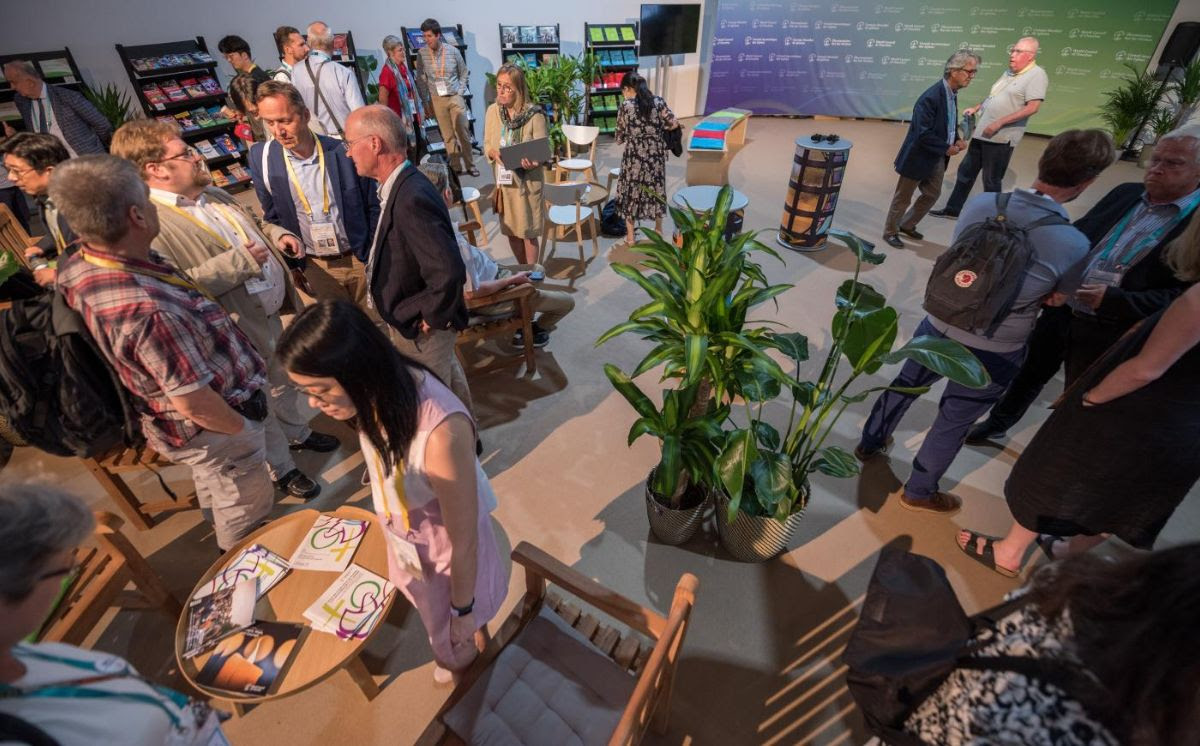
4 September 2022, Karlsruhe, Germany: Networking Zone of the WCC 11th Assembly. The 11th Assembly of the World Council of Churches is held in Karlsruhe, Germany from 31 August to 8 September, under the theme "Christ's Love Moves the World to Reconciliation and Unity." Photo: Albin Hillert/WCC
 
10 May 2023

The previous roundtable produced the specialized ministries pre-assembly message, which substantially influenced the WCC 11th Assembly message, “A call to act together.”

This year’s roundtable will contribute in substantive ways to the WCC strategic direction and plans, building on the assembly’s mandate to be on a pilgrimage of justice, reconciliation, and unity. Discussions at the roundtable will help prepare for the June 2023 WCC central committee meeting.

“Together, we will discern the signs of our times, emphasize the importance of working together in a fragile world, and reflect on the mission and vision of the ecumenical movement,” said WCC general secretary Rev. Prof. Dr Jerry Pillay. “Input from our partners in specialized ministries is valued and needed as we share potential points of collaboration to strengthen our common work and witness.”

“Specialized ministries are church-related agencies and organizations active in humanitarian, development and disaster response work. They are key collaborators for the WCC, and I would argue an essential part of global conciliar ecumenism,” said Rev. Nathan Day Wilson, WCC liaison to specialized ministries.

In June 2023, the WCC central committee will develop the strategic direction and programmatic responses to the assembly as a Pilgrimage of Justice, Reconciliation, and Unity. It will approve the WCC Strategic Plan 2023-2030, guiding the work of the WCC until the next WCC assembly in 2030.

 Link to the WCC 11th Assembly Message

“Working Together” hones collaboration to address the needs of the world

See more
The World Council of Churches on Facebook
The World Council of Churches on Twitter
The World Council of Churches on Instagram
The World Council of Churches on YouTube
World Council of Churches on SoundCloud
The World Council of Churches' website
The World Council of Churches promotes Christian unity in faith, witness and service for a just and peaceful world. An ecumenical fellowship of churches founded in 1948, today the WCC brings together 352 Protestant, Orthodox, Anglican and other churches representing more than 580 million Christians in over 120 countries, and works cooperatively with the Roman Catholic Church. The WCC general secretary is Rev. Prof. Dr Jerry Pillay from the Uniting Presbyterian Church in Southern Africa.

Media contact: +41 79 507 6363; www.oikoumene.org/press
Our visiting address is:
World Council of Churches
150 route de Ferney
Geneve 2 1211
Switzerland

Mission Yearbook: Miami organizer builds community and fights for housing justice

Adrian Alberto Madriz will never forget the smell of burning mattresses. After Hurricane Andrew — a violent, 1992 Category 5 storm that left...