|
|

|
|

|
|
|
|
|
|

|
|
|

|
|
|

|
|
|

|
|
|
|
|
|
|
|
|
|
|
|
|
|
|
|
|
|
|
|
|
|
|
|
|
|
|
March 30, 2022

Missy Buchanan
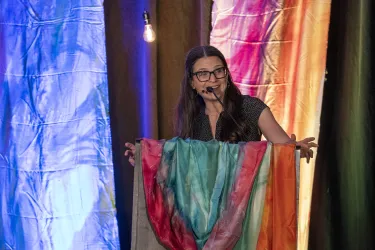
To illustrate how older adults can build bridges to young people through intergenerational ministry, author and speaker Missy Buchanan selected an illustration that was brand new when many of her listeners were youngsters — the Golden Gate Bridge.
“Seize the Season: Using Your Late Years to Build a Bridge to Younger Generations” was the talk that Buchanan delivered during the opening day of the Presbyterian Older Adult Ministries Network national conference, which more than 100 people signed up to attend. A resident of Rockwell, Texas, Buchanan is both speaker and writer. Her most recent book is “From Dry Bones to Living Hope: Embracing God’s Faithfulness in Late Life.”
With a daughter and her family living in the area, Buchanan loves to traverse the iconic bridge connecting San Francisco with Marin County in California, especially as a pedestrian. On the day it opened for pedestrians only in 1937, officials expected 50,000 to walk across. Instead, 200,000 people showed up, some wearing roller skates.
“Bridge building is risky business. Is it worth it?” Buchanan asked, adding that “building bridges between generations is also risky business. Is it worth it?”
While the Golden Gate Bridge was under consideration during the depths of the Great Depression, many people thought its price tag was too high, that construction would prove too difficult, and that there were already ferries to take people from one side to the other.
Some people bring up similar concerns about intergenerational ministry, Buchanan said: it’s too difficult, we have more important things to worry about or we already have multiple generations in worship.
“What difference might it make,” she asked, “if older adults became intentional bridge builders?”
Buchanan asked conference attendees if adults 60 and older at their church knew the names of up to a dozen children and youth, both first and last names. Do they regularly initiate conversation with them?
And how about those children and youth? Could they name up to a dozen adults at the church who are older than their parents? Answering those questions “should tell you whether you have an intergenerational focus going in your church,” Buchanan said.
She said intergenerational ministry goes beyond “just seeing one another at church. Proximity does not equal relationship.” We may giggle at what young people say during the children’s sermon, applaud them when they receive their children’s Bible and buy tickets to their spaghetti supper to support a youth choir trip. But “do we know that the tall boy is being raised by a single mother recently diagnosed with breast cancer?” Buchanan asked. “Or that little girl who struggles with dyslexia?”
In Sunday school, children may make cards for nursing home residents who once faithfully attended worship services. Do the children know about the lives of those people receiving the cards?
“At church potlucks, we fill our plates and then we sit with our own tribes,” Buchanan said.
After examining the numerous challenges, much of it around loneliness, faced by members of Gen Z, who were born between 1997 and 2012, Buchanan offered up this quote from Professor William Willimon of the Duke Divinity School: “Growing up is too tough without some help from those with gray hair.”
“We can either complain about culture or we can impact culture by how we use our late years,” Buchanan said. “Let’s use our late years to build bridges. Our legacy must be what we invest in our young people.”
When you find yourself about to criticize youth and modern culture, “think about the uncertainty and fears you faced as a young person,” Buchanan suggested. “A humble spirit builds bridges between the generations … Sometimes a humble spirit means zipping it up and just listening.”
Or, as author Bob Goff put it, “Most people need love and acceptance a lot more than they need advice.”
Buchanan urged listeners to “think beyond our own grandchildren. They are a great place to start, and we pour our lives, time and resources into them. But we should never forget there are a lot of children and youth who have no older adults in their lives, or they aren’t a good influence. We must widen our circle to include more than our grandchildren.”
Mike Ferguson, Editor, Presbyterian News Service
Let us join in prayer for:
PC(USA) Agencies’ Staff
Terri Milburn, Accounts Payable Manager, Administrative Services Group (A Corp)
Carla Miller, Customer Service Consultant, Communications Ministry, Presbyterian Mission Agency
O Lord, you have called us to be witnesses to your love, grace and mercy to the ends of the earth. Thank you for your Holy Spirit, who gives us the courage and the means to do so. Amen.
March 29, 2022

Korean Maryland Presbyterian Church members Courtesy of Korean Maryland Presbyterian Church
In Deuteronomy, the people are urged never to forget God’s laws. Remember them. Teach them to future generations. “Bind them as a sign on your hand, fix them as an emblem on your forehead, and write them on the doorposts of your house and on your gates” (Deuteronomy 6:8–9).
While an ancient edict, there are still Jewish households today that seek to remember by mounting what is called a mezuzah onto their doorpost. Inside the mezuzah, which is a small container, is a piece of parchment with the words from Deuteronomy. As members of the household go about their daily tasks, they pass the mezuzah coming and going, and they remember.
While the congregation of Korean Maryland Presbyterian Church doesn’t have mezuzahs in their homes, they do have something for their walls: a framed picture with the Matthew 25:40 verse that reads, “Truly, I tell you, just as you did it to one of the least of these who are members of my family, you did it to me.”
The frames were the idea of the Rev. Dr. Seung Yong Lee. Lee came to Korean Maryland Presbyterian from California in December 2019, just as COVID-19 was making its presence known. The virus might have thwarted the pastor from visiting his members, but it didn’t thwart his vision for the church to become an integral part of the community they were in. Korean Maryland Presbyterian is in the backyard of Washington, D.C., with the University of Maryland close by. It is an area ripe with ministry opportunities, Lee said.
In February 2021, having become one of the few Korean congregations to accept the PC(USA)’s invitation to become a Matthew 25 congregation, working to dismantle racism, eradicate poverty and revitalize congregations, Lee thought what better way to connect with his congregation than to visit (safely with masks) and talk more about what it means to do Matthew 25 work. According to Lee, “Most Korean American pastors visit the homes of members in early spring every year.” And so, after his official installation as Korean Maryland Presbyterian’s pastor in May, armed with framed verses, Lee began making the rounds. The pastor’s presence — and the frames — were both received warmly.
According to Lee, one of his deacons didn’t expect to get a frame. Both he and his wife were touched. Another deacon who lives in a nursing home enjoyed Lee’s visit and the gift of the frame. Lee hopes that the verse now hanging on his members’ walls in their homes helps them to “see Jesus” through those they encounter who are in need. “If a member encounters someone, he or she will recognize them as Jesus,” he said, adding that each frame he presented came with the heartfelt sentiment that it is “special for you.”
For Lee, the decision to have Korean Maryland Presbyterian become a Matthew 25 congregation was so that the mostly senior congregation — about 90% of members are seniors — can find a renewed sense of purpose.
“Matthew 25 challenges my church to be vital. We Korean Americans need to recognize the other ethnic groups near us. We need to reach out to the community,” said Lee.
Donna Frischknecht Jackson, Editor Presbyterians Today, Presbyterian Mission Agency
Let us join in prayer for:
PC(USA) Agencies’ Staff
Eliane Menezes, Mission co-worker serving in Guatemala, World Mission, Presbyterian Mission Agency
John Merten, Data Entry Representative, Relationship & Development Operations, Presbyterian Mission Agency
Good and gracious God, help us to be faithful with the good news that you have entrusted us to proclaim. Guide us. Inspire us to real and practical service to the least of Christ’s brothers and sisters, that we might minister to all according to their genuine needs. In Christ’s name. Amen.
| |||||||||||||||||||||||||||||||||||||
March 27, 2022

Vital Congregations Flower (provided)
John 20 gives us one of those timeless settings. The disciples had gathered in a house. Doors were locked. Questions were spiraling. The fear was palpable. Jesus had been crucified just a few days prior and the disciples still hadn’t really figured out what their next move should be. So, they sat. Confused. Doing nothing except worry about how the entire world had changed.
But then, all the sudden, Jesus shows up. Only for a moment. Only for a brief second. It was as if he said, “Peace be with you!” in one breath and then “Peace, I’m out!” in the next. It all seemed to happen so fast.
All the disciples were shocked. All the disciples except for one. Thomas. He had missed it. Thomas left for what was probably a small-time increment but was definitely a large faith experiential. The other disciples tried to explain what had happened, but Thomas wasn’t falling for it. He thought it was made up. He did not believe it to be true. He could not believe that their good news was for real. The other disciples tried to continue to try and convince him until he said: “unless I see the marks …” (John 20:25)
We live in a post-Christendom world in which the church is no longer the center of our society. Some people even say that we now live in a post-post-Christendom world in which the transition from Christendom to whatever was to come after has already taken place.
Simply put, the world in which we live in is a new world! And it is unlike any world the church has ever existed in before. We believe this is a good thing. We hope you do, too! Our prayer is for us to move forward as the people of God in this new world, not retreat from it into a fictional state of yesteryear. But, since we live in a new world, this also means that we need to be ready to answer a new set of questions.
The church has historically been such a fixture in our communities that a lot of what we did as the church in the past had always been assumed, but we cannot assume that our new world understands what we do anymore. Therefore, we cannot be offended when the new age doubting Thomas’ approach us with the timeless caveat:
This seems made up. This can’t be true. I don’t believe that this good news is for real. I don’t think I can buy into any of it “unless I see the marks.” (John 20:25)
For the past six years, the Office of Vital Congregations within the Presbyterian Mission Agency has been helping churches and presbyteries answer the question: “What does it mean for us to be vital today?” We have come up with a list of the “7 Marks of Vital Congregations” to help us engage all the people around us in the world who want to hear more and believe but simply can’t until they see the marks. For more information, please visit us here.
Rev. Dr. Brian Coulter for Vital Congregations, Presbyterian Mission Agency
Let us join in prayer for:
PC(USA) Agencies’ Staff
Jewel McRae, Coordinator, Women’s Leadership Development & Young Women’s Ministries, Women’s Leadership Development & Justice Ministries, Presbyterian Mission Agency
Rebecca Means, Customer Service Representative, Hubbard Press
Living Lord, by your Word and Spirit, show us your marks once again so that we may show them to this world! Breathe into our dry bones so that we may be a vital sign of the new life you offer to us all! In you, we live and move and pray. Amen.
Rabbi Sharon Brous, senior and founding rabbi of IKAR in Los Angeles, urged church leaders to resist isolation, embrace vulnerability and d...