Friday, March 11, 2022

Today in the Mission Yearbook - Stony Point Center becoming a place of connection for nonprofits in community

Partnership gets food to immigrants; others looking to join residential nonprofit hub on campus

March 11, 2022

Volunteers from Proyecto Faro (the Lighthouse Project) get ready to give out excess food from Stony Point Center to immigrant families. (Photo by Ingerlene Frick)

Thanks to a new partnership at Stony Point Center (SPC), food that might have been thrown away or composted ended up in the hands of immigrants in the community who needed it.

In a small example of how SPC can partner its resources with nonprofit needs, the center found itself with leftover food after a guest group ate significantly less than was brought in to serve them. After Stony Point made a quick call to its new resident nonprofit partner, the food was picked up and taken to a distribution center that Proyecto Faro (Lighthouse Project) had already set up in the community.  At SPC, Proyecto Faro plans to use its space at the to gather and distribute food and clothing — and also provide legal representation and other services — for immigrants in the surrounding community.

At SPC, Proyecto Faro plans to use its space on campus to gather and distribute food and clothing — and also provide legal representation and other services — for immigrants in the surrounding community.

Looking to the future, Brian Frick, the interim executive director at Stony Point Center, sees nonprofits building their capacity through connections made at the PC(USA) Center.  Imagine, he said, linking Proyecto Faro’s needs with the Big Brothers Big Sisters of Rockland County, which is also exploring leasing space on the SPC campus.

“These are the kind of intersections we can do to seed benefits beyond our usual sphere of influence,” Frick said.

Debra Thomas, executive director for the Workforce Development Board of Rockland County in Stony Point, New York, is collaborating with SPC and the Rockland Community Foundation on a grant for nonprofits to participate a residential “innovation hub” that SPC is working on.  The hub will be in a space on campus where local and regional nonprofits — whose work aligns with the PC(USA) Matthew 25 invitation — can gather to do their work.

“The grant money will allow us to do on-the-job training and possibly internships onsite,” Thomas said. “We can redeploy those whose jobs were impacted by COVID into priority sector jobs in industries like hospitality, tourism and health care.”

For Frick, the innovation hub will provide SPC with a way to better utilize their space — and to bring innovation and new thinking to the campus. And it moves one of the Matthew 25 foci on eradicating systemic poverty into action, he said.

SPC is also building an “innovation studio” where leaders can gather around a Matthew 25 or related topic and broadcast part of that gathering to churches around the country, including to smaller congregations.

“The pandemic taught us that we can gather in new ways and still be a faithful church,” he said. “We need to stay open to moving of the Spirit. For conference centers, gone are the days of ‘y’all come here’ gatherings. We need to be where people are now and where they can best engage.”

And once the innovation hub and studio take place, Thomas said Stony Point Center will no longer be a hidden gem.

“Using these tools, we will be able to share the gem of SPC with the rest of the country,” Thomas said.

According to Frick, Stony Point Center has always been a space of experimentation and learning for the PC(USA), from hosting missionaries for conversations in the early 20th century to experiencing a lived community focused on interfaith sharing and communal action in the early part of the 21st century.

SPC also has a rich history of spawning ministry organizations on its campus like the Center & Library for the Bible and Social Justice. At the library, CLBS hosts at Stony Point opportunities to learn what the Bible says about active social justice. Stony Point has also provided space to other nonprofits, like the Fellowship of Reconciliation USA. FOR moved to Stony Point Center several years ago, in part to be close to a space that aligns with their values and is capable of hosting larger national gatherings they envision.

And Proyecto Faro formed as self-help group, in a primarily immigrant community in 2012, which was welcomed to stay  at Stony Point Center temporarily after being flooded out of their homes by Hurricane Sandy.

 Paul Seebeck, Communications Strategist, Presbyterian Mission Agency

Let us join in prayer for: 

PC(USA) Agencies’ Staff
Samantha Lund, Legal Office Administrator, Administrative Services Group (A Corp)
Erika Lundbom-Krift, Electronic Resources Associate, Presbyterian Publishing Corporation

Let us pray

Lord, thank you for experiences that open our eyes to more clearly see you, and our ears to more clearly hear you. Expose in us those things that keep us from coming to you. Open our hearts and make us unafraid to be vulnerable. May we have encounters that will change us forever and move us in the direction where you are leading. Amen.

Thursday, March 10, 2022

Today in the Mission Yearbook - Breaking the chains of poverty

Mission makes a difference in Southeast Asia

March 10, 2022

The sound of Filipino schoolchildren’s voices breaks through the overwhelming feeling of despair. (Photo by Cobbie Palm)

Roland is now in high school and is among a group of student panelists presenting on the topic “Social Economic Reforms for Sustainability,” organized by the National Christian Youth Fellowship. The invitation to be a panelist is merited by outstanding academic achievement and each of the panelists performed exceptionally on this day.

But it was Roland who caught my attention. Roland passionately and sincerely spoke about rice and hunger during the COVID-19 pandemic. The pandemic, Roland argued, “has been threatening and taking lives, but just as severe a threat and as violent a killer is the Rice Tariffication Law, which took effect March 5, 2019.” At that point, he went on to connect the dots. “Hunger in the Philippines today has reached an unprecedented high of 30.7% of all households in the country. The reason is not only the loss of employment caused by the pandemic, but also the high cost of rice. Farmers in the Philippines can no longer afford to compete with foreign rice imports.”

Roland concluded, “Then came the pandemic, and our main sources of rice — Thailand and Vietnam — suffered tighter supplies and less exports, and with less imports came higher prices. Our dependency led to increased poverty for everyone because our 10 pesos worth of rice is now costing 20 pesos at the present market price.”

After all the panelists had spoken, I sent a generic congratulations to everyone in the chat. In a short while, I received a personal message from Roland saying, “Mr. Palm, you came to our school and taught us a song, thank you. I hope you remember me.” I sent back a message, “I am sorry, you have grown up; I do not recognize you now.” He replied, “I was a tutor at the Sunbeam Day Care Center, where I once was a student.”

The Sunbeam Day Care Center was a visit I made with the Young Adult Volunteer (YAV) program during their orientation to the realities of the Philippines. I remember it was a difficult day for all of us. As we entered this district of Manila neighboring the port, observing this community through the windows of our vehicle, we were guided from the road, where we had parked our vehicle, into a narrow alley of abject poverty. The light of day grew into dark gloom as we walked over slabs of wood, elevating our steps from muddy wastewater below. To each side of us were walls of repurposed wood, then a doorway or a window that revealed a room to the left, then to the right. Each room was a whole home.

Soon there was the sound of children’s voices counting in unison. The narrow dark alleyway led us to a larger room that was set with children’s chairs and tables as a small mess hall. Voices were coming from another room. It was a classroom of children ages 5 to 8 — all learning together. This was the Sunbeam Day Care Center, a program of our PC(USA) mission partner the United Church of Christ in the Philippines, led by Tondo Evangelical Church. This congregation, believing that a mission endeavor can have significant impact, refused to lose hope.

Walking away from our short visit, I am ashamed to confess that the friends at the Tondo Evangelical Church had more hope and faith than I did. It was difficult for me to see a way out for children living amid overwhelming poverty, hunger and adverse conditions.

In unexpected times, God seems to be saying through these moments, “I am not done with you yet!” A personal message from Roland caught me by surprise. What I could not see then, God wanted me to see now. God connected the dots between a mission endeavor reaching into overwhelming poverty — nurturing a child with a new song — and witnessing that student using a well-deserved scholarship to access the tools to discern the structures in our society that perpetuate poverty.

God’s amazing work reminds me that mission works. Mission into poverty can lift hands, strengthen voices and warm bodies, reenergizing people who then can see clearly where policies and laws must be changed — Matthew 25 people willing to work together to make it happen.

Carlton J. “Cobbie” Palm, Mission Co-Worker and Director of Spiritual Formation at Silliman University Divinity School
Dessa Palm, YAV Site Coordinator in the Philippines, Artistic Director for Youth Advocates Through Theater Arts

Let us join in prayer for:

PC(USA) Agencies’ Staff
Kathy Lueckert, President, Administrative Services Group (A Corp)
Victor Min, Translator, Global Language Resources, Administrative Services Group (A Corp)

Let us pray

Dear God, your blessings are always evident and give us the good pleasure of enjoying your presence. Continue to abide with us as we love and serve those in need. In Christ’s service. Amen.

Wednesday, March 9, 2022

Today in the Mission Yearbook - Five Wisconsin churches join to feed their hungry neighbors

The Presbytery of Milwaukee congregations have reaped a harvest of cooperation

March 9, 2022

Each of the five participating churches has something to offer for the Food for the Journey program. (Photo by Cathy Manthei)

Five congregations in the Presbytery of Milwaukee joined together on an initiative inspired by the Matthew 25 invitation to feed the hungry. It led to unexpected, broad collaboration.

As congregations join this week with the Presbyterian Hunger Program to celebrate Food Week of Action, the five Wisconsin churches are living into their Matthew 25 calling to feed the hungry. This summer they built a community garden and now are harvesting the produce, distributing it to people who are experiencing hunger.

Food for the Journey is a project of Apostle Presbyterian Church in West Allis, Calvary Presbyterian Church in Milwaukee, Delafield Presbyterian Church in Delafield, Jerusalem Presbyterian Church in Wales and Kettle Moraine Presbyterian Church in Hartland.

Each church had something to share. “Food for the Journey started out as a project that none of our congregations could have pulled off on their own,” said the Rev. Nikki Blanks, pastor at Delafield. “The beauty of this is that either we were going to work collaboratively, or we weren’t going to be able to do it all.

“With each other,” Blanks said, “we have everything we need.”

The Kettle Moraine church had excess land, perfect for the 40-foot-by-24-foot raised-bed garden built for the project, and the Delafield church contributed financially. Several churches, especially the Jerusalem church, brought Master Gardeners into the planning. The Calvary and Apostle churches act as distribution sites, sharing the bounty with urban residents of Milwaukee and Waukesha counties. Volunteers from all churches help with the garden.

It’s been transformative. At the Delafield church, “One hundred percent of our newest members are involved in this garden; they see what the Spirit is doing, and they want in on it,” Blanks said.

JP Kastner, a lead organizer, sees the same at his church. “Folks are stepping up into leadership positions because they’re interested in involvement with the produce marketplace at Calvary,” Kastner said.

To the surprise of many participants, the collaboration has gone beyond the project.

When the Kettle Moraine church had a problem with its church sign, a church member from the Calvary church came out to fix it. The Delafield church collected books for Jerusalem’s Book Drive, and Jerusalem contributed to Delafield’s rummage sale.

In these newfound relationships, Blanks says, “the people have had so much fun, there’s talk of building more gardens next year.”

Presbytery of Milwaukee, Special to Presbyterian News Service

Let us join in prayer for:

PC(USA) Agencies’ Staff
Lisa Love, Counsel, Legal Services, Presbyterian Foundation
Sandy Lucas, Receptionist, Presbyterian Foundation

Let us pray

Gracious God, you call us to be Christ incarnate. We are to be the compassionate heart and hands of Christ. We are the loaves and the fish that will give hope and life during these challenging times. Amen.

Tuesday, March 8, 2022

Minute for Mission: International Women’s Day

March 8, 2022

All who call this planet home are impacted by a warming climate. But our most vulnerable, particularly women and girls, are disproportionately affected. And although women may carry the burden of weathering storms (and tsunamis and droughts and all events that result from a warming planet), they are also the first to embrace earth-friendly policies and practices as they (and their families and communities) are literally on the front lines. Seeing our way forward to a sustainable future can only be realized when the leadership of women and girls is encouraged and valued.

International Women’s Day is a day set aside each year to address challenges that are unique to women and girls. For 2022, the United Nations Entity for Gender Equality and the Empowerment of Women, or U.N. Women, has chosen the theme “Gender equality today for a sustainable tomorrow” in recognition of “the contribution of women and girls around the world, who are leading the charge on climate change adaptation, mitigation, and response, to build a more sustainable future for all.”

International Women’s Day reminds us to reflect on our responsibility to make this world a just world. As people of faith called by God to care for God’s Creation, let us encourage, value and support our sisters and neighbors who bear the greatest consequences of climate change.

Carissa Herold is marketing associate for Presbyterian Women in the Presbyterian Church (U.S.A.) Inc.

Let us join in prayer for:

PC(USA) Agencies’ Staff

Ivy Lopedito, Mission Specialist, Presbyterian Ministry at the United Nations, Presbyterian Mission Agency

Let us pray

Loving Creator, a warming planet affects us all, but our poorest neighbors bear the greatest burdens of climate change. On this International Women’s Day, and all days, let us strive toward gender equality so your daughters, as well as your sons, are empowered to find solutions for a sustainable future. Amen.

Monday, March 7, 2022

Today in the Mission Yearbook - Hymns from the heart of the Black church

‘Delicate, heavy history’ informs the ‘pain’ heard in the swells, seen in the embodiment of those singing

March 7, 2022

The Rev. Carlton Johnson

Whenever the Rev. Carlton Johnson talks about hymns from the heart of the Black church, he feels a responsibility to carry on the tradition of his ancestors. For their hymns are, as W.E.B. Du Bois observed, “the most original and beautiful expression of human life and longing born on American soil.”

Formed in a Black Baptist congregation, Johnson sang his first solo when he was 5. A choir director by high school, he spent decades leading music ministry around the country. At a recent Presbyterian Association of Musicians Town Hall Forum, Johnson discussed an article he wrote for Call to Worship, a quarterly journal published by the Office of Theology and Worship in the Presbyterian Church (U.S.A.).

Johnson began the conversation on his article “Stretching Out: Hymn Interpretation in the Black Church,” with what he called “some delicate and heavy history.” In the late 1400s in Ghana, the Elmina Castle was originally built as a trading post and a house for missionaries. Johnson said there was a church in the castle compound that held Christian etchings, including a cross. In nearby adjacent buildings were enslaved and imprisoned African American people, where young boys and girls and older men and women were abused. Before or after the abuse, abusers would go to worship in the church.

“Such irony that both occurred in the same place,” Johnson said. “Keep in mind when we’re doing discipleship that today’s young people now know these two things were going on simultaneously in the compound.”

The coordinator for Vital Congregations in the PC(USA) said it was assumed the Africans had no knowledge. Even though they had Christianity (as well as the two other Abrahamic religions) long before their enslavement, their spiritual practices were considered pagan. Soon the singing, dancing and drumming by the enslaved became punishable offenses — and could actually get them killed.

But when they arrived in the U.S. to work the plantations in the South, they were told to sing their songs.

“My ancestors had to think, ‘How can we sing in such a strange land?’” Johnson said. “They were now being taught about Christianity in a way they didn’t understand. How could this be the high God?”

The enslaved Africans who were remembering their homeland compared their singing to Israelite songs in Babylon as they remembered Zion (Psalm 137). Because of this, Johnson said, there is more to the music in the Black church than just “jazzing it up” by adding beats and rhythms.

“What you really hear in the sounds and the ebbs and flows of the music [in the Black church] is pain,” he said. “Cries of desperation and pleas for help.”

Sometimes that pain is in the lyrics. But Johnson said you can really hear it the swells — and in the emphasis on particular parts of the song. You can also see it in the embodiment of those who are singing, or performing, for the Black congregation. Using the under-documented “old meter” form, the cadence of the hymn was slowed almost to a dirge.

Following the Great Awakening, the enslaved African people were taken to church to participate in worship services. But it is noteworthy, Johnson writes, that this invitation had nothing to do with the welfare of the enslaved. Citing Riggins R. Earl Jr.’s work “Dark Symbols, Obscure Signs: God, Self, and Community in the Slave World,” Johnson said slave owners were taught by the church to imagine these enslaved people as “bodiless souls.” It was acceptable to get as much work as possible out of their bodies, but it was their “Christian duty” to make their souls fit for heaven. But some would not even believe the soul of an African could abide in the same heaven as a white person. So, they built balconies in many of their churches to keep the enslaved as far away from the white people as possible. These balconies, Johnson said, became known as “N-Heaven.”

Paul Seebeck, Communications Strategist, Presbyterian Mission Agency

Let us join in prayer for:

PC(USA) Agencies’ Staff
Kim Long, Editor, Theology, Formation & Evangelism, Presbyterian Mission Agency
Patricia Longfellow, Senior Administrative Assistant, Presbyterian Women

Let us pray

Lord, you make no distinction between rich and poor, between those who give bread and those who receive it. You know that they all need you, your love, your presence. Thank you for reminding us that we are all your children. Amen.

Sunday, March 6, 2022

Minute for Mission: Celebrate the Gifts of Women Sunday

March 6, 2022

Photo Credit: Jenny Grant

As a young adult, I moved to New York City. I wanted to know what it was like to ride in a crowded subway right underneath another person’s armpit. I wanted to know what it was like to walk down a crowded Manhattan street and have to engage with some people who were well and some who were not so well, all coexisting together.

One of my jobs was in the Ratings Department at NBC. People called me regularly to get the ratings. I will never forget the day a famous news anchorwoman called, and I put her on hold! It was great working at Rockefeller Center. 

When I lived in New York, I experienced women who were dynamic and inspiring. Many of them worked in nontraditional roles. I became friends with wealthy women and poor women, entering homes, sharing vulnerabilities and championing causes.

Every day, I am thankful to live in an era where I could act on the call from God to become a minister of Word and Sacrament, and for many years serve as a director in the national church offices of the Presbyterian Church (U.S.A.). For some, this is a normative experience, but for many women, the road is rocky and filled with pitfalls. There are women, particularly women of color, who struggle, even today, to be ordained and installed as pastors in congregations, yet many of us don’t know this or know their experiences.

We celebrate the gifts of women because, let’s face it, there would be no church without women. And, “Nobody’s free, until everybody’s free,” as civil rights leader Fannie Lou Hamer once said. God has, indeed, created talented and prophetic women. I am grateful for these women who have nurtured me, befriended me, guided me and loved me. I am grateful, because when I look into their faces, I see the face of God.

Rev. Dr. Rhashell Hunter, Former Director of Racial Equity & Women’s Intercultural Ministries, Presbyterian Mission Agency

Let us join in prayer for:

PC(USA) Agencies’ Staff
David Loleng, Director, Financial Literacy & Leadership, Presbyterian Foundation
Christine Long, Church Consultant, Tacoma, Board of Pensions

Let us pray

God of grace, be present with us as we celebrate women who, with your help, have built communities that reflect your love. For women from different cultural backgrounds who do justice, love kindness and walk humbly with you, O God, we give you thanks and praise. Give us your peace, which surpasses our understanding, and watch over our hearts and our minds, as we rest in Christ Jesus. Amen.

Saturday, March 5, 2022

Today in the Mission Yearbook - One pastor and two churches are building congregational vitality

Cameron and Calvary Presbyterian churches in North Carolina exemplify a Matthew 25 focus

March 5, 2022

For Cameron Presbyterian Church and Calvary Presbyterian Church, both in Statesville, North Carolina, accepting the Matthew 25 invitation was not a difficult decision. When presented with information about the Presbyterian Church (U.S.A.)’s invitation by Salem Presbytery, the Rev. Timothy L. Bates, pastor of the two churches, says both congregations saw it as a great opportunity to join other Presbyterian churches in the endeavor.

“But the main reason we an accepted the invitation is that we wanted to answer the call and become more intentional in lining up with the Matthew 25 mission,” he said. “As a church we are focused on all three areas, but mainly the area of building congregation vitality. When COVID-19 hit, we looked for creative ways to become a more vital church, so we decided to become strategic with our outreach ministries.”

Bates says church members were challenged to be prayerful in asking God how they could become more involved. He says they challenged each other to discern how God was speaking to them during the pandemic.

“We asked, ‘What is God calling us to do in a crisis?’” he said. “We decided that this was an opportunity to joyfully serve God and community in a different way.”

Both Cameron and Calvary have about 70 members and both congregations exemplify the importance of congregational vitality.

The two churches work in collaboration with each other and both churches work in collaboration with a prayer and street ministry that Bates started called the “Nightcrawlers.” Additional local community partnerships include their work with Fifth Street Ministries, the Statesville Police Department, Iredell-Statesville Schools and the Summit retirement village.

According to Bates, since the pandemic the congregations have continued worship in an outdoor worship service. They call the service “park and praise.”

Bates says the churches have been renewed and uplifted through service and have started new ministries during this time.

The congregations formed an elder and deacon call list where elders and deacons make weekly calls and pray with members. They have started a preschool for four children of church members, and they have established a food pantry and clothes giveaway ministry that distributes items to the community. They offer food boxes on a weekly basis and during the Thanksgiving and Christmas holidays and they have started a ministry that shares water with all in need.

Excitement around the congregations’ newfound ministries is permeating beyond the membership. “Amens and the blowing of horns has caused the neighborhoods to join in with the praise from their homes,” said Bates. “New members have joined the church and membership has increased through social media platform. New relationships are being formed on the weekly prayer calls.”

“The spirit of both churches is at an all-time high,” Bates says. “Our choir participation has increased, the giving of tithes and offering has increased by members who didn’t give before, and more members are involved in serving communion as well as participating during the Sunday services. The members are excited to serve.”

The congregations are now providing school supplies and toiletries for children experiencing homelessness as well as teachers and other children within their communities. They provide financial assistance to families in need during the COVID crisis.

In addition to addressing the spiritual needs of their communities, Cameron’s and Calvary’s congregations are addressing justice and health needs through their advocacy efforts.

“We marched, prayed and sang in a neighborhood in which a 7-year-old was killed in a drive-by shooting,” said Bates. “We actively supply information on voting and assisting the community to get out and vote. Additionally, we share information on the importance of taking the COVID vaccine and have partnered with the North Carolina Minority Health Advisory Council to distribute information about the importance of the vaccine to underserve communities.”

In addressing the dismantling structural racism Matthew 25 focus, the congregations are participating in race relations forums and workshops to promote positive relationships.

“These are some of the ministries in which we are involved in to carry out our Matthew 25 responsibilities,” Bates said. “It is a great pleasure to be a part of the Matthew 25 community as we observe the great work that is taking place throughout our denomination.”

 Gail Strange, Director of Church and Mid Council Communications, Presbyterian Mission Agency

Let us join in prayer for:

PC(USA) Agencies’ Staff
Elizabeth Little, Church Consultant, Charlotte, Board of Pensions
Ann Logan, Payroll Specialist, Administrative Services Group (A Corp)

Let us pray

Dear Lord, we thank you for your church and its witness and ministry. Be with the ministers and servants who love you, carry their crosses and bear witness to your love for the world. Do not let them get discouraged in their ministry. In the name of Jesus Christ, the Lord of the church. Amen.

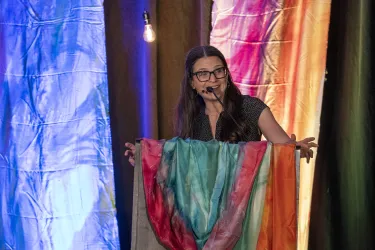
Mission Yearbook: Rabbi calls connection, vulnerability keys to supporting communities of faith

Rabbi Sharon Brous, senior and founding rabbi of IKAR in Los Angeles, urged church leaders to resist isolation, embrace vulnerability and d...