Showing posts with label Puerto Rico. Show all posts

Monday, October 5, 2026

Mission Yearbook: PDA director shows solidarity with Puerto Rican siblings

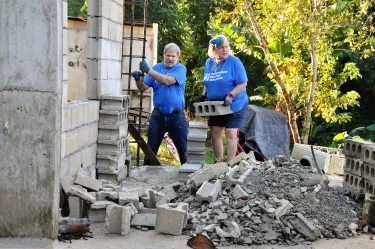
Image
Presbyterian Disaster Assistance volunteers at work in Puerto Rico in 2018. (Photo courtesy of PDA)

Speaking during a recent installment of the Presbyterian Hunger Program’s “Solidarity Hour,” the Rev. Edwin González-Castillo waxed eloquently and at times nostalgically on the topic of Puerto Rico, the Caribbean archipelago where he was born and raised. Watch his presentation here.

González-Castillo, the director of Presbyterian Disaster Assistance, hails from a San Juan neighborhood “where famous baseball players and salsa singers came from,” he said.

Webinar host Eileen Schuhmann, PHP’s Associate for Global Engagement and Resources, noted that the Solidarity Hour focused attention on Bad Bunny’s historic Super Bowl halftime performance. She asked González-Castillo: What’s key to understand about Puerto Rico’s history and current reality?

San Juan was founded in 1521, nearly a century before the founding of Jamestown, the first English settlement in North America, González-Castillo pointed out. Indigenous people lived there well before Europeans arrived. Because San Juan was “a doorway to trade routes,” it was for centuries “one of the most fortified cities in the Americas,” he said. “It was a treasure, a place that gave access to other places.”

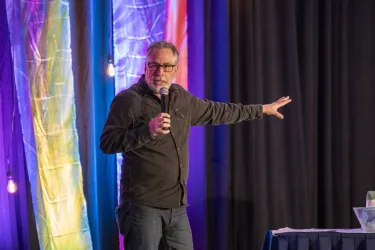
Image
Smiling man in a bowtie
The Rev. Edwin González-Castillo (Photo courtesy of PDA)

Puerto Rico became a U.S. colony in 1896, a result of the Spanish-American War. Since then, Puerto Ricans have served in the U.S. military during every major conflict since World War I, even though Puerto Ricans living on the island can’t vote during presidential elections — only in primaries. Puerto Ricans living on the U.S. mainland can vote. 

When the United Nations determined in 1946 that member nations could no longer have colonies, the United States started calling Puerto Rico a territory. “We have taxation without representation,” González-Castillo citing a line from the time of the Boston Tea Party. Still, Puerto Rico is “a small island in the Caribbean with a with a big impact all over the world.”

Just about anything one can purchase in Puerto Rico by law comes from the United States, “or at least a ship from the U.S.,” he said, thanks to the Jones Act of 1920. One effect of that law has been to drive up prices in Puerto Rico, González-Castillo said. When he and his wife shipped their car from Puerto Rico to their new home in Louisville a few years back, a vehicle registration clerk wanted to verify the taxes on the car they’d paid in Puerto Rico. When González-Castillo showed the statement to the officials, “they were surprised how high the taxes were,” he said. “They thought I was giving them the price of the car, not the taxes.”

Following a catastrophe such as Hurricane Maria, many Puerto Ricans had to wait for weeks for building materials and other goods to arrive. “We needed special permission from the U.S. to receive goods from other countries,” González-Castillo explained. On top of that impediment, since 2016, a U.S.-imposed oversight board, PROMESA, established by the Puerto Rico Oversight, Management and Economic Stability Act in a deal designed to reduce Puerto Rico’s crushing debt, makes all of Puerto Rico’s significant money decisions.

“Their interest is the people we owe money to,” González-Castillo said. “They are the ones who make decisions about budgets and how the money is spent.”

Schuhmann asked him: For U.S.-based Presbyterians, what might solidarity look like?

PDA received “a lot of volunteers” following Hurricane Maria, González-Castillo said. “People really wanted to help the people of Puerto Rico.” To help those who were helping others, PDA put together a training on decolonizing volunteerism.

“Everything comes down to the relationships we have,” he said. “That meaningful solidarity has to be less about charity and more about relationships and partnerships.”

“The people of Puerto Rico know how to help themselves and attend to their needs,” González-Castillo said. “We welcome expertise and knowledge, but we really value people who support local efforts.”

When Protestant denominations came to Puerto Rico to establish churches, they sliced the island “like a cake,” he said. Most of the 78 Presbyterian churches are on the western side. “The Presbyterian Church has a long-standing presence there — even before the missionaries arrived,” González-Castillo said. “Part of the relationship has to come with the recognition that we are here to learn and not come with the mentality that we are here to tell you how to do things.”

Mike Ferguson, Editor, Presbyterian News Service (Click here to read original PNS Story)

Let us join in prayer for:

Paula Tibbs, Administrative Support, Partners Beyond the PCUSA, Presbyterian Life & Witness
Jaymi Hendrix, 1001 NWC Apprentice, 1001 New Worshiping Communities, Presbyterian Life & Witness

Let us pray:

Dear God, thank you for giving us opportunities to serve — to be your hands and feet — and to share our time, talents and treasures with our neighbors in need. Amen.

Friday, June 13, 2025

Mission Yearbook: How Presbyterian Disaster Assistance supports communities in Puerto Rico

During its recent annual in-person meeting, the Committee on Mission Responsibility Through Investment (MRTI) of the Presbyterian Church (U.S.A.) met with community partners in San Juan, Puerto Rico.

Image
MRTI visits Puerto Rico
Estrella Santiago Pérez speaks to MRTI committee about Project ENLACE del Caño Martín Peña in San Juan, Puerto Rico. (Photo by Gregg Brekke)

The site visits allowed committee members to hear firsthand from people who have suffered from environmental disasters and people-made problems. MRTI staff and committee members listen and learn at these engagements and seek ways to advocate for communities as they work with companies on environmental and human rights issues.

Following its business session at the PC(USA) affiliated Seminario Evangélico de Puerto Rico, and presentations on the social, political, economic and theological environment by Emilio Pantojas, a sociology professor at the University of Puerto Rico, and Dr. Gonzalo Alers, a New Testament professor at the seminary, committee members met with two PC(USA)-supported community groups.

Beginning with Fideicomiso del Caño Martín Peña (Martín Peña Canal Land Trust) and Proyecto ENLACE, a Presbyterian Disaster Assistance partner project, committee members saw the effort that is restoring the canal connecting the harbor lagoons around San Juan. Environmental Affairs Manager Estrella Santiago Pérez described the dramatic turnaround that has happened because of the cleanup and restoration effort, and toured portions of the canal and surrounding communities with MRTI committee members.

“We have eight communities that are basically dissected by a T-channel called the Caño Martín Peña,” Santiago Pérez said of the area that has been home to San Juan’s working poor and had suffered a century of environmental neglect. “This project seeks to restore the environmental ecosystem of the Caño Martín Peña, which is also part of the San Juan based ecosystem through its dredging and channelization, but it also seeks to provide infrastructure housing and also promote socioeconomic development within the communities of the Caño Martín Peña.”

The project’s comprehensive development plan began in 2002 and encompasses infrastructure, sanitary, power, transportation, and stormwater improvements, as well as socioeconomic development and ecosystem restoration initiatives. Santiago Pérez says its goals are to restore the ecology of the Caño Martín Peña, reconnect the communities with the water, provide resilient and decent housing, and foster economic development opportunities for the residents.

Three primary project partners, including the “G8” governing boards from each of the affected communities, and 12 grassroot organizations expect the project to be completed by 2032.

“A beautiful element of this type of community planning tool is that it is a visualization of what the communities want for themselves,” Santiago Pérez said. “What these communities look like once the priorities are implemented will be a restored canal with mangroves surrounding it, similar to what it used to look like originally, because this is a wetland with recreation components. There are some proposed water plazas and recreation areas where the communities can enter the canal. Just imagine people taking a kayak from these communities all the way to San Juan or to Carolina.”

The land trust component of the project has purchased properties and resolved title issues that has allowed residents to remain in the community without fear of relocation. A surge in outside investment in response to a favorable tax shelter environment following Hurricane Maria has resulted in inflated land and housing prices. Through the land trust, residents individually own their houses and the right to use the plot of land where it is located. The trust also collectively owns 200 acres of land that was previously government property.

“The Presbyterian Church came at a very vulnerable time for the communities after Hurricane Maria. We were facing multiple challenges,” Santiago Pérez said. “We already had challenges before the hurricane, but definitely Maria exacerbated the vulnerability of the communities in terms of access to water and electricity.

“PDA came in when we needed them. … We deeply appreciate the commitment that PDA has shown the communities and that we know shows other communities throughout the U.S. and the world.”

MRTI was created in recognition of the PC(USA)'s unique opportunity to advance its mission faithfully and creatively through the financial resources entrusted it. MRTI implements the General Assembly’s policies on socially responsible investing — also called faith-based investing — by engaging corporations in which the church owns stock.

Gregg Brekke for the Presbyterian Foundation (Click here to read original PNS Story)
 

Let us join in prayer for:

Sunkyoo Park, Associate, Adult Curriculum, Korean Language, Presbyterian Publishing Corporation 
Brent Paschal, IS Specialist, Presbyterian Foundation 

Let us pray:

Lord of Creation, help us to live in Job’s words: “Ask the animals, and they will teach you … and the fish of the sea will declare to you. … In his hand is the life of every living thing and the breath of every human being” (12:7–8, 10). Amen.

Friday, June 16, 2023

Today in the Mission Yearbook - Church in Puerto Rico embraces Earth-friendly practices

Presbyterian Hunger Program highlights an Earth Care Congregation

June 16, 2023

The Presbyterian Church (U.S.A.) now has its first Earth Care Congregation in Puerto Rico.

Primera Iglesia Presbiteriana en Bayamón is in its first year as an official ECC, which are churches that demonstrate they are active stewards of the Earth by following, tracking and promoting environmentally friendly practices.

“Our interest in obtaining the certification was to motivate other congregations to follow the steps in broadening the Good News of Jesus through Creation care,” said Gloria D. Lozada-De Jesús, coordinator of the Earth care team for Primera Iglesia Presbiteriana.

Churches around the country take part in the program, which is led by the Presbyterian Hunger Program.

Participating churches show their commitment through worship and discipleship, educational efforts, facilities management and outreach activities. They also take the PC(USA)’s Earth Care Pledge.

Over the past few years, the congregation of Primera Iglesia Presbiteriana has taken part in various activities, including Bible studies (coordinated through the Ecological Ministry of the Presbytery of San Juan), and also has taken steps to reduce or eliminate the use of plastics in gatherings, said Lozada-De Jesús.

Primera Iglesia Presbiteriana en Bayamón in Puerto Rico has a facility equipped with solar panels to provide emergency power for people when the area is impacted by emergencies, such as natural disasters. (Contributed photo)

The church also does recycling and educates people about energy-saving practices.

“The challenge to Creation care is similar to other places in terms of you need to reach the conscience first for people to be willing to make a change, specially making the connection to acknowledge Creation care as a matter of faith,” Lozada-De Jesús said. “It’s like a conversion itself.”

The church hosts a community laundry facility to assist the community. (Contributed photo)

One of the church’s most significant efforts is a solar panel project, Lozada-De Jesús said. As part of the project, “Centro Autosustentable” (Self Sustainable Center), solar panels were installed at a property that people can turn to for emergency power, such as during times of disasters. It provides “solar power to charge portable devices and to power a refrigerator to store prescription medicines” and other important products, such as food for special diets.

The church also hosts a community laundry facility to help the community in emergencies and other times.

“At its inception, the Centro Autosustentable and the community laundry were two separate projects and were in two separate premises,” Lozada-De Jesús said. “We are in the process of consolidating both projects in one premise, so the community laundry is not solar powered yet.”

PHP has worked with the church on other endeavors.

“In 2022, the Presbyterian Hunger Program was thankful for the opportunity to work collaboratively with Gloria and Neddy Astudillo, as they co-founded Red Latina, a group of lay and ordained leaders and allies working to create holistic environmental ministries throughout Latinx churches,” said Jessica Maudlin, Associate for Sustainable Living and Earth Care Concerns for PHP. “We know that while too often the Latinx voice is missing from the climate change conversation, they are among those already experiencing the deeper impacts of the climate crisis in their communities. Puerto Rico has been an all-too-present example of this reality. We are so thankful for the witness of Primera Iglesia Presbiteriana and are humbled to accompany them in combating the climate crisis.”

Go here to learn more about Earth Care Congregations. Read a 2022 Presbyterians Today article by Maudlin about ECCs here.

Darla Carter, Communications Strategist, Presbyterian Mission Agency

Today’s Focus: Primera Iglesia Presbiteriana en Bayamón, Earth Care Congregation

Let us join in prayer for:

PC(USA) Agencies’ Staff
Barry Ensign-George, Coordinator, Theology & Worship, Presbyterian Mission Agency
Betsy Ensign-George, Associate Editor, Presbyterian Women

Let us pray

God of hope and strength, thank you for your presence of love and compassion in our lives. We rejoice that, especially when we face the storms of life, you are there to calm us. Thank you for being our Lord and for speaking words we yearn to hear: “Peace! Be still!” In Christ’s name we pray. Amen.

Mission Yearbook: Author discusses how churches can change their own stories to hopeful

Mark Yaconelli remembers receiving a story Bible from his grandmother when he was 5 years old.  “It had all the glossy pictures; I especiall...