Showing posts with label Malawi. Show all posts

Tuesday, May 21, 2024

Today in the Mission Yearbook - Leading with a purpose

Gifts to One Great Hour of Sharing help set Malawians on the path to food security through a unique women-owned business

May 21, 2024

Tinenenji Kalamba (Contributed photo)

Although the women of Malawi are accustomed to doing anything and everything from farming to running small-scale businesses to support their families, Tropical Cyclone Freddy sorely tested Tinenenji [tee-nan-an-gee] Kalamba’s resilience.

Yet Kalamba was undeterred.

She was already proving to be an exemplary leader in the Kasupe [kuh-soo-pay] Women’s Bakery and Value Addition Centre — a project of Kasupe Ministries, [a registered nongovernmental organization in Malawi] — when the devastating March 2023 storm washed away the lives and livelihoods of countless thousands across the southeast African country.

This certainly wasn’t the hopeful future that the twice-widowed 42-year-old had pictured for herself when the bakery was first started in 2022 with funding support from the Presbyterian Hunger Program.

Originally designed to address the local shortage of nutritious and healthy foods in the Kasupe region by having women produce and sell a variety of baked goods and farm products, the bakery has not only employed local women as bakers, but — before the cyclone struck — also bolstered the production of local farmers and strengthened the local economy.

Although Kalamba had dropped out of school at the age of 12, she is widely acknowledged as the business-savvy woman behind the bakery’s success.

“I desperately wanted to lead,” she said. “I had noticed that this project had potential and I wanted to be at the forefront. I can’t lie, I also wanted to benefit a lot since I thought I needed more of the money than the rest.”

Kalamba knows whereof she speaks.

Kasupe Women’s Bakery and Value Addition Centre in Malawi 

operates with funding support from the Presbyterian Hunger 

Program. (Contributed photo)

Not only is she HIV-positive, requiring a regimen of antiretrovirals, which are not always available to her at no cost, but she also has nine mouths to feed — herself, her four children, their two children as well as two grandchildren from her late sister. She works to give them a better life.

“I want to make sure that my children go farther with school,” she said. “I dream of them going to college and I tell them never to be like me when it comes to the issues of school. I teach them to work hard, fear God, and always face challenges head-on.”

It is thanks to Kalamba’s faithful leadership that the bakery operation survived the cyclone.

And it is thanks to a grant from the Presbyterian Hunger Program, made possible by Presbyterians’ generous gifts to One Great Hour of Sharing, that the humanitarian outreach of Kasupe Ministries can continue uninterrupted.

For 75 years, the Offering’s purpose of helping neighbors in need around the world remains constant, giving the PC(USA) and other Christian denominations a tangible way to share God’s love. In addition to the PHP, One Great Hour of Sharing also benefits the ministries of Presbyterian Disaster Assistance and Presbyterian Committee on the Self-Development of People.

“Tinenenji is the first to arrive and the last to leave the bakery,” said Dr. Fletcher Padoko, executive director of Kasupe Ministries, whose long-term goal is to reverse generational poverty and eradicate preventable diseases, namely HIV/AIDS, through programs and projects developed in partnership with Malawian nongovernmental Christian organizations.

“Although she doesn’t make more money than the others, the evidence is all over the bakery operations that this woman leads with a purpose,” he added. “Most of the people who come to the bakery and the Kasupe market are also her customers in her other smaller businesses. In the rural villages where everything is tough to come by, her moves are indeed shrewd.”

PHP’s partnership efforts with Kasupe Ministries serve primarily to address the nutritional needs of widowed households and other vulnerable groups through livestock farming. Many households, like Kalamba’s, have also been severely impacted by the HIV/AIDS epidemic.

“In our villages, about 70% are women and children,” Padoko explained. “Because we have a lot of widows due to HIV, we try to focus on the women who are the leaders in the rural areas. They are so influential even though they are poor and vulnerable. We find if we work with them, it will be possible for us to uplift them; and, for us as a Christian organization, we try to make sure that we are not at the front but rather behind them, helping them in the areas where we feel they cannot help themselves.”

Emily Enders Odom, Associate Director of Mission Communications, Presbyterian Mission Agency

Today’s Focus: One Great Hour of Sharing

Let us join in prayer for:

PC(USA) Agencies’ Staff
Michael Hilliard, Sales and Events Coordinator, Presbyterian Publishing Corporation 
Matt Hinkle, System Engineer, Presbyterian Foundation 

Let us pray

Merciful God, make us courageous and compassionate in our outreach to our neighbors living beyond the doors of the church. Shine your light through us that we might be a blessing to them. Amen.

Saturday, August 13, 2022

Today in the Mission Yearbook - Home visit by International Peacemaker leads to health transformation for ailing community member

Peacemaker is one of 10 headed to the United States to tell their stories

August 13, 2022

Jonathan Drake Vumu

The health of a village chief in Malawi had been deteriorating for about a year. Thinking that he was under the influence of people considered to be witches in the central African community, the chief declined to seek professional diagnosis and treatment.

A relative enlisted the help of Jonathan Drake Vumu, who drove to the man’s home and offered counseling and encouragement. Vumu had no immediate luck with the chief but decided to leave behind money and a contact number in case of a change of heart.

“After two days, I received a phone call from him asking me to take him to the hospital,” Vumu said. “After several tests, they discovered that he was HIV positive.”

Now, thanks to antiretroviral medication, the chief’s health has improved greatly, and his wife, who also tested positive for HIV, is getting treated.

Those are the kinds of stories that members of the Presbyterian Church (U.S.A.) will hear when Vumu travels to the United States later this year to serve as an International Peacemaker for the Presbyterian Peacemaking Program.

Vumu is executive director of Livingstonia Synod AIDS Programme, a department of the Church of Central Africa Presbyterian (CCAP) Synod of Livingstonia in Malawi.

LISAP, a PC(USA) partner, encourages people, especially men, to go for HIV testing and services. It also fights gender-based violence, constructs child-care centers and helps young people to receive vocational training.

Vumu is one of 10 peacemakers who’ll be available to make in-person visits in early fall with congregations, mid councils and communities around the country that would like to hear about their work.

A family in Malawi rests after a long day of housework and plowing in the fields. (Archived photo)

Visits in recent years have been done virtually because of the Covid pandemic, so Peacemaking is looking forward to Vumu and other international participants coming to the United States.

“I am participating in this year’s Peacemaking Program because I have stories to tell — stories about challenges that poor communities face in Malawi and how the Church in the U.S. can help in addressing them,” he said.

Vumu works in rural communities where there is extreme poverty. Many people “live with less than $1 per day,” he said.

Also, “Malawi currently faces a lot of social ills,” he said. “HIV prevalence is still high at 9%, the number of orphans and vulnerable children is high, coupled with gender inequalities and sexual gender-based violence,” and the “coronavirus has just worsened the situation in all aspects of life in Malawi.”

For example, “Covid has worsened the country’s economic status,” he said, and “the number of girls getting pregnant and into early marriages is increasing.”

Raising awareness about conditions in Malawi is part of Vumu’s mission. “I spend my life sharing the love of Jesus Christ with others through sharing God’s Word and working with communities to address their social ills,” he said. “I will continue to work and have a positive impact on the less privileged in this part of the world.”

If you would like information about how to host a peacemaker in your community, go here.

The Presbyterian Peacemaking Program is one of the Compassion, Peace & Justice ministries of the Presbyterian Mission Agency.

Give to the Peace & Global Witness Offering to continue the valuable ministry of these International Peacemaker visits.

Darla Carter, Communications Associate, Presbyterian Mission Agency

Today’s Focus: Jonathan Drake Vumu, International Peacemaker from Malawi

Let us join in prayer for:

PC(USA) Agencies’ Staff
Devan Caton, Operations Business Analyst, Presbyterian Foundation
Stephanie Caudill, Mission Associate for Resources & Promotion, World Mission, Presbyterian Mission Agency

Let us pray

God of life and love, open our eyes to opportunities to work together to prevent disease, seek justice and care for the most vulnerable among us. Amen.

Wednesday, May 6, 2020

Malawi Mission Network partners help create 100,000 protective masks

Prevention key to preventing spread of COVID-19 in southeast Africa

by Kathy Melvin | Presbyterian News Service
The Rev. Sam and Elsie Kaonga model two of the thousands of masks made for and by Malawians to prevent the spread of COVID-19. (Contributed photo)
LOUISVILLE — While there is still much to learn about COVID-19, medical experts are certain that the virus is particularly deadly for people with underlying health conditions. In Malawi, a large portion of the nation’s 18 million residents fall into that category.
Over a million people in Malawi have been diagnosed with HIV-AIDS. There is widespread malnutrition. Another million suffer from a range of infectious diseases such as typhoid, malaria and hepatitis. With a lack of resources and a shortage of providers, the health network is fragile, making preventative care especially important.
Tom O’Meara knows that. A member of the Malawi Mission Network, he has been to Malawi many times and his church, Shepherd of the Hills Presbyterian Church in Austin Texas, has hosted members of its partner church, Manyamula CCAP (Church of Central Africa Presbyterian) Congregation, many times.
In early April, O’Meara called his friend and fellow mission network member Holly Pettit in Colorado. She founded Africa Bags, a network partner that provides work for rural women in Northern Malawi. The women make colorful decorative bags, which are sold through churches in the United States. Due to the global pandemic, the organization had recently switched to making face masks.
He asked if the group could deliver facemasks to Manyamula, its partner congregation. Pettit said yes, and then O’Meara approached Shepherd of the Hills’ Mission Committee, which immediately gave the green light to purchases 400 masks.
O’ Meara called Elsie Kaonga, wife of the pastor at Manyamula, also a Malawi government health worker, to tell her that 400 masks would be delivered in the next couple of days. She said she could actually use at least 100,000 masks for the people she cared for in the region.
Undaunted by the huge number, O’Meara discussed it with his wife Martha, who had visited Malawi with him many times, and they told Kaonga they would get a pattern to her if she could enlist the local women’s guild and church members to make them.
O’Meara called his sister Ellen, a second-generation seamstress and quilter, who created and sent the pattern. Production started the next day. Additionally, they sent a link to a YouTube describing how to make the masks to Dr. Kondwani Zgambo, the leader of the regional hospital near Manyamula, who is expected to empower the Women’s Guild there. He is serving an even larger population than Kaonga serves in Manyamula.
Some of the colorful masks made by women in Malawi. (Contributed photo)
Malawian women are using their chitenje fabric for masks. The chitenje is generally wrapped around the waist, tied around the head or used as a sarong, sometimes making everyday clothing more special for church and other important occasions. It can also be used as a baby sling.
O’Meara has been fascinated with Africa ever since, as an 8-year-old, he would look through his parents’ Maryknoll Magazine about the educational work being done by Catholics, primarily in Africa, South America and Asia. Right then and there he decided he wanted to teach college in Africa. His career path became law instead, but he never forgot his childhood desire. Through his work with the church, he’s had three opportunities to teach at the University of Livingstonia, part of CCAP.
More than anything, he said he admires the incredible faith of the Malawian people.
“If you go to the gas station, you get gas and that’s it. But if a Malawian goes to the gas station, they stop to pray and offer thanks that gas is available. When they get out of bed in the morning, they thank God for letting them see a new day. They think and feel themselves interacting with God all day long. I just can’t believe how great that is,” he said.
In 2019, Tom and Martha O’Meara visited the Matopoto Prayer House and School. Matopoto is a sub-village of Manyamula. (Photo by Tom O’Meara)
The Church of Central Africa Presbyterian is the largest Christian denomination in Malawi. About 44% of the entire population are Christian Protestants, 19% are Sunni Islam, and 18% are Roman Catholics.
Presbyterian World Mission has a long history of partnership with the CCAP. Through the partnership, there is support to train theological students and strategic church leaders, strengthen work in primary and secondary school education, encourage interventions to combat endemic poverty, and address strategic issues of women and children.
Today, there are 41 confirmed cases of COVID-19 in Malawi, and nine people have died. About 29 people have recovered from the virus, health officials say.

Saturday, April 11, 2020

Today in the Mission Yearbook - Young pilgrims journey to Malawi

Pittsburgh and Malawi youth experience the power of presence in partnership

April 11, 2020
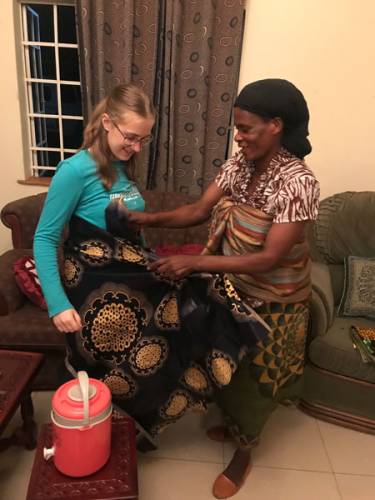
Rayna Neszpaul, a member of Pittsburgh Presbytery’s 2019 Youth Pilgrimage to Malawi, learns how to wear a Chitenge — traditional Malawian wrap — as instructed by Edith Makuluni of the Mbenjere congregation of the Church of Central Africa Presbyterian in Ntaja, Malawi. (Photo by Dave Carver)
When Pittsburgh Presbytery’s International Partnership Ministry Team began thinking about a way to  create space for young Malawians and young Pittsburghers to meet together for mutual enrichment, encouragement and growth, the idea for a youth pilgrimage to Malawi was born.
As moderator of the International Partnership Ministry, I led a 16-day youth pilgrimage to Malawi last July. The group included nine young people and five adults, representing five Pittsburgh congregations.
While many youth trips involve engaging participants in a particular task or act of service, we knew we wanted to do more than “arrange a tour” or “plan a project.” Instead, we invited travelers to leave behind the familiar and enter a place that is new and different with the expectation of seeing God at work there.
Partners in the Church of Central Africa Presbyterian Blantyre Synod suggested a theme for the youth pilgrimage, “Developing Leadership Through Partnership.” This theme was expressed through a series of workshops on topics such as “Challenges Faced by the Youth in their Christian Life” and “Dealing with Anxiety.” These youth conference workshops, organized by our partners and held in three different communities in the southern region of Malawi, served as anchor points of our experience and allowed our team to step out of their collective comfort zones in many ways.
At each event, there were 25 to 50 youth from the Blantyre Synod and nine youth from Pittsburgh, as well as the advisors and mentors. Even though there were cultural and theological differences, the youth were well-received. Everyone came away glad we had taken the time to walk through these topics together.
In the communities of Mulanje, Mangochi and Blantyre, groups of Malawian and American young people gathered for mornings of worship, large-group presentations, small-group breakout sessions and shared meals. Each youth conference was followed by an opportunity for more spontaneous relational time: hiking the base of Mount Mulanje, swimming in the waters of Lake Malawi or engaging in conversation in Malawi’s busiest commercial city, Blantyre. Along the way, our team visited mission stations, engaged in retreat, stayed in Malawian homes, worshiped in churches and prayer houses and planted dozens of trees.
While we were there, our hosts at the Grace Bandawe Conference Center showed us how well their new wood-fired pizza oven works. We worked together to sort through the nearly 700 pounds of medical supplies our team brought with us, using a list of needs compiled by our Blantyre Synod colleagues. The supplies were organized into suitcases to be shared with Malawians after tropical cyclones Idai and Kenneth caused catastrophic flooding, death and destruction in Malawi, Mozambique and Zimbabwe in March 2019.
Since my first visit to Malawi in 1995, I have sensed that God’s self has been revealed in quiet conversations and raucous worship services. I have learned there are ways of glimpsing life, living gratefully, and trusting in God and neighbor that are more readily experienced when we can step away from what we perceive as “normal” and look at life with fresh eyes.
 “I have found friendships in people with whom, before Malawi, I may never have even said hello to,” said Greta Snyder, 13, Bower Hill Community Church. “I have been finding that I’m constantly trying to find Malawi — to keep my body where my heart is, at least as much as possible. Every day, I increasingly feel Malawi breaking and then filling my heart. Nothing seems quite so clear anymore. I went to Malawi hoping to gain some, even if very little clarity. I came back to learn that for all you learn, the more you find you don’t know.”
Pittsburgh Presbytery and partners in Malawi and South Sudan have a longstanding partnership. Learn more by visiting the partnership website at pghpip.org.
Let us join in prayer for: 
PC(USA) Agencies’ Staff
Mary Jo Besspiata, Presbyterian Mission Agency
Barbara Betts, Administrative Services Group (A Corp)

Let us pray:

God our teacher, thank you for young people who have made good use of assistance and are taking up the role of helping the next generation. Amen.

Sunday, March 22, 2020

Today in the Mission Yearbook - Finding Jesus where we often forget to look

An inspiration for ministry: ‘I was in prison and you visited me’

March 22, 2020
During a prison ministry visit to Ntchisi Prison in central Malawi, a congregational prison committee brings food, hygiene items and Bibles to inmates and prison officials. Many congregations in Malawi have a prison committee. Representatives meet annually to report on their ministries, share struggles and victories, learn and plan the way forward. (Photo by Wickliff Kang’ombe Zulu)
LILONGWE, Malawi — If you were to visit Maula Prison, built on a hill in the capital city of Lilongwe, Malawi, you might notice that it feels outdoorsy and open. There are multiple layers of fences, but in between them is open, undeveloped space. The lack of shrubs and low trees allows clear sight for a long distance.
During visiting hours, you may also notice large numbers of people lining the inside fences. After visitors have navigated the front gate and walked the hundred yards or so to the fence surrounding the main yard and cell blocks, they spread along the fence to talk to the inmate they are visiting. The fence is double-layered, with a few feet in between serving as a pathway. On the other side of the fence opposite the pathway the inmates spread out, shouting to their visitors so they can be heard over the wind, traffic and other people. That is the closest they seem to get to a private visit during incarceration: a shouted conversation through two fences and across an open pathway, with other visitors and inmates nearby.
Last spring a weeklong training of trauma healing group facilitators attracted people from various denominations across the city and surrounding area. The Rev. Wickliff Kang’ombe Zulu, Church of Central Africa Presbyterian (CCAP) Nkhoma Synod prison chaplain, used his own money to attend.
Trauma Healing International has a clear pathway for people to become facilitators of a trauma healing group. First, they must attend a facilitator training session, like the one Zulu and I attended in April. Completing this initial training provides apprentice facilitator status, which is valid for two years. To become a full trauma healing group facilitator, each apprentice must attend an advance training, which Zulu and I completed in November.
Zulu and I worked hard to facilitate two groups together. At Kachere Youth Prison in Lilongwe, we met with nine young men. At Maula Prison, about 30 men attended.
The trauma healing program progresses through an understanding of God, suffering and evil, to teach about grief and how to grieve well, so we can heal. The program culminates with lessons on forgiveness and bringing our pain to the cross for Christ’s healing.
Both groups said the biggest impact for them was the concept of forgiveness. One youth said, “If I had known how to forgive, I wouldn’t have done the things that got me here.” Many of the men at Maula said, “Because I’m here, I am very bitter, and now I know I need to forgive in order to let that go.” In many ways everyone found the need to forgive and to be forgiven to be the most important and most healing aspect of the group. Whatever the circumstances that resulted in the men being in prison, a wrong had occurred. Whether it was a wrong they had done to someone else, or a wrong committed against them in the form of unjust incarceration, they were all aware of the need for forgiveness.
On one of our visits to Kachere Youth Prison, Zulu arrived after meeting with the CCAP Nkhoma prison committees. He was wearing the prison committee T-shirt, which quotes Matthew 25:36: “I was in prison and you visited me.” As a chaplain I’ve been asked in various settings what verse I use to motivate my ministry. And it has always felt like cheating to choose Matthew 25:36. After all, it seems like a command to me: Go visit people in hospitals and prisons! Somehow it seems that having gone through all the theological and counseling training I’ve been through, I should have a more nuanced motivational verse —one that would make people say, “Hmm” as they ponder the verse in a new light.
Choosing a verse that basically says, “Go be a chaplain” just doesn’t seem very fancy. But when I saw the verse on Zulu’s shirt, I thought: What better verse is there? People aren’t “the least of these” because they are somehow less worthy of love or value. Rather, they are the “least” because they are forgotten, overlooked or ignored by society. They are the people who don’t fit into our daily routine, or who remind us of the pain and suffering and complications that we can find everywhere. Those things are unpleasant, and most of us avoid spending much time thinking about them. But Jesus speaks right to that, saying, whenever you encounter someone who is forgotten, or reminds you of pain and suffering, or makes your life complicated, that’s where you will find me!
So go, visit, serve, love them and remind them that they aren’t alone and they aren’t forgotten! And who knows — you might just find that Jesus has been there all along, right wherever you’ve forgotten to look.
Jeremy Garbat-Welch, Mission Co-Worker
Let us join in prayer for: 
PC(USA) Agencies’ Staff
Gina Yeager-Buckley, Presbyterian Mission Agency
Alexandra Zareth, Presbyterian Mission Agency

Let us pray:

Gracious and loving God, you know the struggles and challenges of people who are often forgotten and of people who seek to serve the underserved. May we join our hearts and lives  in ways that will glorify your holy name. In Jesus’ name we pray. Amen.

Thursday, February 13, 2020

Today in the Mission Yearbook - Sharing a dance of joy across the continents

Mission co-worker in East Central Africa has a clear view of God’s work

February 13, 2020
The Rev. Paula Cooper says she’s “entrusted with a ministry and a message to share about how God is using me and what God is doing across the ocean.” (Courtesy of Paula Cooper)
As one of the newest regional liaisons hired to serve East Central Africa, I have been traveling a lot, and sometimes it feels as though I am living in and out of airports more than in my home in Lusaka, Zambia. You know what, though? I can’t complain! As I travel within the countries that I serve — Kenya, Malawi, Rwanda and Zambia — I have the opportunity to see God’s amazing work through the hands, voices, eyes and feet of our international Presbyterian partners. Partners who are trying to repair the brokenness among God’s children. Partners who, in their own ways, are attempting to serve and provide for “the least of these” — through means like building and maintaining community schools and theological institutions; building health facilities and clinics; and ministering in hospitals, clinics and prisons.
“For, ‘Everyone who calls on the name of the Lord shall be saved.’ But how are they to call on one in whom they have not believed? And how are they to believe in one of whom they have never heard? And how are they to hear without someone to proclaim him?” (Romans 10:13–14)
All projects and ministries are designed with the intentions of assisting God’s children to see the transforming hope and light that God offers to all of us and to break the bond of brokenness. 
In addition to efforts of transformation, in spite of what appears to sound or be broken or hopeless within the large populations of the countries that I serve, there is an unexplainable dance of joy exulted in the worship services of “the least of these!”
“The Word (of God) is near you, on your lips and in your heart.” (Romans 10:8)
When I travel home to the States to visit congregations and presbyteries or attend mission network conferences to share my ministry and experiences, the attendees want to know more about our partners. I hear questions like, “what can we do to build relationships? What can be done for us to join in that dance of joy that our brothers and sisters demonstrate in worship?” They want to hear more stories of that despair being transformed into hope and joy, and I see them trying to envision how they can share in the struggle and the hope of our partners in Africa. They are inspired. They are interested. I hear it on their lips. I feel that it’s from their hearts. They want to come alongside our partners; to join in the work that God is doing across the ocean. 
“And how are they to proclaim him unless they are sent? As it is written, ‘How beautiful are the feet of those who bring good news!’” (Romans 10:15)
I respond, exclaiming, “Let’s explore those questions. Let’s explore how we begin long-lasting relationships by reviewing mission resources. Let’s explore the idea of short-term mission trips. Let’s go join our partners in their worship services.  Let’s just go and join them in the dance! Let’s join them in the work that God called us to do. Let’s go and see, learn, teach, share, talk, cry, laugh and pray together.”
“So, faith comes from what is heard, and what is heard comes through the word of Christ.” (Romans 10:17)
As I said earlier, it appears that I live in airports, but for the most part I can laugh about it because for some crazy reason, I love it! I think I love it because I am entrusted with a ministry and a message to share about how God is using me and what God is doing across the ocean. Also, I love talking about God! I have the opportunity — the blessing — to bring a message from Africa to the U.S.A. and vice versa! 
What a gift — to be able to link, to connect struggles, joys and desires of people who want to join hands with one another across the oceans; to see and hear how others get inspired and say they want to dance to that joy!
Let us all possess the “beautiful feet of those who bring good news” by sharing the wonderful ways God is using us to fulfill God’s missional work.
Rev. Paula Cooper; Mission Co-Worker in Kenya, Malawi, Rwanda and Zambia; Presbyterian Mission Agency
Let us join in prayer for: 
Mission Co-workers:
Rev. Catherine (Kay) Day (Rwanda)
Sherri and Dustin Ellington (Zambia)
Melissa and Charles Johnson (Zambia)
Rev. Janet Guyer (Malawi)
Rev. Cheryl Barnes (Malawi
Rev. Jeremy and Luta Garbat-Welch (Malawi)
Tyler Holm (Malawi)
PC(USA) Agencies’ Staff
Alex Spoelker, Presbyterian Mission Agency
Champaka Srinivasan, Presbyterian Mission Agency

Let us pray:

God, take us beyond our boundaries to see the brokenness among your children. But don’t stop there — move us to get involved; to build relationships. Move us to dance with you in the struggle and the joy! Move our feet, Lord! Give those who are involved and serving the energy and tenacity to stay in the dance! In Jesus’ name, we pray! Amen!

Mission Yearbook: Author discusses ‘Sacred Curiosity’

Image Britney Winn Lee (photo courtesy of Britney Winn Lee) Author Britney Winn Lee literally wrote the book on sacred curiosity, and she ha...