Showing posts with label Inclusion. Show all posts

Monday, January 9, 2023

Today in the Mission Yearbook - Diversity, Equity and Inclusion: why they are marks of the church, and how we can practice these values in our congregations and mid councils

Economics can be an important component of a church’s faithful witness

January 9, 2023

Photo by Torfiqu Barbhuiya via Unsplash

When we read about the first band of Christ followers selling their possessions and “distributing the proceeds to all, as they had need,” (Acts 2:45), we clap our hands, lauding such noble sacrifice, but snicker under our breath, whispering, “Now that’s a bit too much!” We eye their sudden dispossession as fanatical, what uncouth cults do: they sell everything and go up to the mountains because they are cocksure of Jesus’ return date and time. We have (and have had) many Christian-freaks/fringes who abandoned human society to welcome the end of the world, only to return poorer. Here we are, 2,000 years later, and the human society is still humming, and money still matters, so let’s live out our faith in “decency and order.”

The early church’s dispossession only makes sense, we reason, if they believed in the imminent end of the world because in the apocalypse, money is as valuable as toilet paper. The early church got a lot of things right, but dispossession is not an imitable plan of action. We are good with breaking bread and making sure no one is left out of the dinner invitation. But opting out of the economic system on a belief that Jesus is returning and going to blow up the whole global economic system doesn’t sound reasonable or Christian.

It is one way of dismissing their actions. But they weren’t motivated by the end of the world. They had a contemporary Jewish movement who prepared for the end by not just dispossession but by leaving it all. The Essenes left land and money and went to the mountains to wait for the great washing of the world. The early church, however, didn’t follow their lead and leave the “unrighteous” society. They embedded themselves even more. They sold their possessions, but they also assimilated and prayed at the temple.

The Rev. Samuel Son, the Presbyterian Mission Agency’s Director of Diversity and Reconciliation, preached during Synod School worship last summer. (Screenshot)

The disciples weren’t waiting for the end of the world because they were already living in the end of the world, the end of the worldly reign. I have argued that the end of the days started with Jesus’ resurrection. Jesus’ return is the official coronation. Jesus was firmly ruling, and it was this reality that led this Jesus-community to create a different economic system aligning with Jesus’ new policy of equity. In those ancient Middle Eastern days, when a new ruler sat upon the throne, one of the kicks of being an emperor was you get to have your profile stamped on coins (having time count from your reign was also another benefit). As Emperor, not only did you change the tax code, but you also got to change the currency with which your subjects paid your tax. So, like other emperors, with Jesus’ rule, economics changed. The disciples were not dispossessing their lands out of fanaticism. They were taking the most reasonable actions to live by the new ruler of the Earth.

With Jesus as Lord, the old economic system based on hierarchy and oppression wasn’t tenable. The early church saw that possession isolated, ruined mutuality and distorted one’s view of self, others and moral responsibility. It created power dynamics that made attempts at mutuality a farce. With the proceeds of possession in one shared account that belonged to no single individual, they were wrestling with the root of hierarchy.

And when the proceeds were shared according to needs, the situation of need (or abundance) was no longer tagged to the value of a person. Receiving was no longer a matter of deserving. And to be in need wasn’t judged as a curse from God or individual deficiency, but temporary impact of the many shifting fates of life. Removing “deserving” out of the equation was another way to protect the value of a human person out of the whims of an economic system. The early church’s economic practice, much like the preaching, baptizing and breaking bread, are the regular practices of the people of resurrection.

I don’t think that today’s church works on economic equity the same way the early church did. But that commitment to economic equity must be equally strong because we still live in the same end of the days, the rule of the resurrected Jesus.

Rev. Samuel Son, Manager of Diversity and Reconciliation, Presbyterian Mission Agency

Let us join in prayer for:

PC(USA) Agencies’ Staff

David Myers, Director, Finance, Board of Pensions
Lisa Myers, Communications Specialist, Presbyterian Association of Musicians

Let us pray

O God, in your eyes, all lives are of equal value and all human beings bear your image and receive your love. Drawing from the wellspring of your compassion, may we be servants of justice and agents of your reconciling peace. Amen.

Monday, September 27, 2021

Today in the Mission Yearbook - ‘Diversity, Equity and Inclusion’ are not trends

They’re fundamental Christian values

September 27, 2021

Photo by airfocus via Unsplash

These days, every organization is coming up with a Diversity, Equity and Inclusion — commonly referred to as DEI — strategic plan. The hiring of diversity and inclusion executives has grown 113% in the last five years. As of February 2021, half of Standard & Poor’s 500 companies have a chief diversity officer. The national agencies of the Presbyterian Church (U.S.A.) are also putting together DEI plans as a response to the General Assembly mandate for a Race Audit in 2018. However, this is not the church jumping on the latest business trend. DEI has been a core value from the birth of the church. In fact, the church practiced them first. Consider the basic definitions of DEI and how they were present in the early church, from its Pentecost birth.

  • Diversity is the presence of difference in a setting. In Pentecost, the message was preached in multiple languages! No one’s difference was erased. Everyone heard the story of Jesus in the language they dreamed in. The interpretation service of Pentecost makes today’s United Nations system of interpretation look antiquated.
  • Inclusion is the practice of ensuring people feel a sense of belonging. Luke tells us that the believers “spent much time together in the temple, they broke bread at home and ate their food with glad and generous hearts” (Acts 2:46). When they went to Herod’s Temple, they still had to abide by the division of people forced by the structure of the temple, its stoned walls creating Court of Gentiles, Court of Women, Court of Israel, and Court of Priests. But in the homes, everyone sat around the same table and broke bread together. No one was left out. There is no more a powerful and visceral way of experience belonging than breaking bread together.
  • Equity is the process of ensuring that processes and programs provide equal possible outcomes for every individual recognizing that no one starts from the same place. The Pentecost church knew that inequity ravages most fundamentally in economic structure. So, they had the courage and the logistic intelligence to create their own economic system where they “distributed the proceeds to all, as any had need” (Acts 2:45).

Don’t dismiss or treat DEI terms as trendy corporate terms. They are fundamental Christian values. I even offer them as Marks of the Church. The Reformation lifted gospel preaching and administration of sacraments (Calvin added discipline of the church) as marks of the true church in order to recognize church work independent of a 1,000-year-long hierarchy of papal authority. It was a bold move. We need an equally bold move today. Because American Christianity, its theology and practice, has been deeply compromised by the ideology and practice of white supremacy. Robert P. Jones, the author of “The End of White Christian America,” writes, “American Christianity’s theological core has been thoroughly structured by an interest in protecting white supremacy.” The three values of DEI as marks of the Church create a critical perspective to discern where our churches have strayed from their mission to be a community where all belong and used to justify and protect white privileges.

Theology has always been a conversation between God’s work now and God’s work in history, between news and Scripture. All truths are God’s truths. This also means we have much to learn from our faith parents. And in the book of Acts, we witness what compelled and propelled the church to be more diverse, equitable and inclusive (though those are not the exact words they would use) was the reality of the resurrection. The experience of resurrection serves as the rationale and the energy for this fresh understanding of God’s people that includes all.

The Rev. Samuel Son, Presbyterian Mission Agency’s Manager for Diversity & Reconciliation

Let us join in prayer for:

PC(USA) Agencies’ Staff

Philip Woods, Associate Director, Director’s Office, World Mission, Presbyterian Mission Agency
Dianna Wright, Director, Ecumenical Relations, Office of the General Assembly

Let us pray

Gracious and wonderful God, we thank you for the magnificent world you created. We thank you that you have made us a people who seek relationships with others and with you. Keep us ever mindful of your presence among us. Amen.

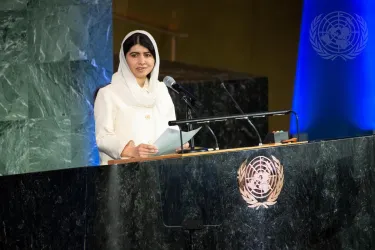
Mission Yearbook: Justice must be for all, human rights activist says

In a searing message at the United Nations, human rights activist Malala Yousafzai expressed deep disappointment in the continued plight of ...