Showing posts with label ‘A Matter of Faith’ podcast. Show all posts

Friday, May 8, 2026

Mission Yearbook: Author and Episcopal priest discusses everyday objects of spiritual people

Image
A Matter of Faith with the Rev. Laurie Brock

The Rev. Laurie M. Brock, an author and Episcopal priest in Lexington, Kentucky, recently stopped by the virtual studios of “A Matter of Faith: A Presby Podcast” to talk about her new book, “Souvenirs of the Holy: Encountering God Through Everyday Objects.” Listen to her 54-minute conversation with podcast hosts the Rev. Lee Catoe and Simon Doong here.

Brock said she has wrestled with the question, “What place are possessions taking in your life?”

While we’re not all called to be monastics, “I also think having so many things that you don’t even know what you have gets in the way of our relationship with God,” Brock said. “If you need 48 lip balms, go see a dermatologist. Something’s wrong.”

As Christians, we ought to be having a conversation with ourselves about how much is enough, Brock said.

A thing can bring us joy, Doong noted. “There’s a difference between that and you deriving joy from the purchasing and having something,” he said.

That’s true, Brock said, and advertising is largely to blame. “Advertising works on the simple belief that we’re going to tell people that they aren’t enough,” she said. “Compare that to the Christian message that you are enough, full stop.”

Image
Souvenirs of the Holy book cover

“Not only are you enough, but you’re enough in your messiness,” she said. “You can’t buy your way to enough.”

Brock wondered if we can “stand up to the advertisers who are constantly telling us what is quite honestly an anti-Christian message, which is, ‘you’re not enough.’ God says, ‘no, you are, and nothing that you buy will make you enough.’”

“It’s OK to derive joy from things,” Brock said, “but the accumulation and the process of trying to be enough is never going to work for you.”

Catoe wondered: “What does it look like to look at material goods differently?”

Do more than just consider the price of things, Brock suggested.

With community-supported agriculture, “I know the local farmers. It’s a deep connection,” Brock said. “The money that I put into that is an investment in holiness and grace. What if I did that same process as much as I could” with everything else she buys, she said. We can start with the question “why?”

“Why is a powerful and holy question we don’t ask enough in our world,” Brock said. “Sometimes we Christians don’t think our faith walks with us as we walk into stores. It does, and it should dictate how we consume things and the things we keep around us.”

Noting that Brock’s book features a cast-iron skillet on the cover, Catoe said that image takes him back to his grandmother and great-grandmother. “An object can invoke the senses. I can smell their cooking,” he said. “Objects are the fingerprints of the past and of our loved ones. I think some objects can enhance our spirituality.”

“God is always speaking to us, wanting us to stop and listen,” Brock replied. “I have realized that everyday items in our lives have so much to say about love and how hard and complicated love is sometimes, and amazing and breath-taking.”

Every time she cooks with her own cast-iron skillet, which she inherited, “I know my grandmother and great-aunts are with us. The fat bonds with the iron, I think,” Brock said. “I am cooking with molecules that have existed for a hundred years.”

Objects can hold both memory and love. Sometimes the memory they hold is painful. “Filling our space with the things that matter give us a way to be present with God and those who have loved us through eternity,” Brock said.

Brock said she wonders what happens “when we as Christians begin to think about the things in our lives that have stories.”

“Not everything has one. Cheap faith? Cheap grace? Cheap is not generally good,” she said. “I think frugality is a wonderful value, but cheap drives down value.”

New editions of “A Matter of Faith: A Presby Podcast” drop every Thursday. Listen to previous editions here.

Mike Ferguson, Editor, Presbyterian News Service, Presbyterian Life & Witness (Click here to read original PNS Story)

Let us join in prayer for:

Ken Green, Church Consultant - Chicago, Illinois, Engagement & Church Relations, The Board of Pensions
Paul Grier, VP, Project Regeneration, Development Office, Presbyterian Foundation  

Let us pray:

May the peace of God, which surpasses all understanding, guard your heart and mind in Christ Jesus. Amen.

Sunday, October 13, 2024

Today in the Mission Yearbook - Lifting up singleness and found family

Podcaster Mary B. Safrit is a recent guest on the ‘A Matter of Faith’ podcast

October 12, 2024

Mary B. Safrit

Mary B. Safrit, a communicator, creator, coach and the host of the Found Family podcast, did the hosts of “A Matter of Faith: A Presby Podcast” a favor in a recent broadcast, appearing as the guests of Simon Doong and the Rev. Lee Catoe on an episode of “A Matter of Faith” called “Knowing Ourselves (and Singleness).” Listen to their 67-minute conversation here.

“It’s exciting to have a fellow podcaster with us,” Catoe told Safrit. “It’s always good to connect with someone who does something similar.”

The hosts posed this question to Safrit: “Let’s talk about everyone’s favorite subject: ourselves! How does knowing and understanding ourselves impact the kinds of friendships we make and the community that we seek, both inside and outside the church?”

“When I think about the church and my relationships with people at church, it’s had a huge impact on me since I moved to New York,” Safrit said. An admitted “recovering people-pleaser,” Safrit said if “I see myself as this irreparably damaged person, of course I’m going to show up in my relationships with a posture that’s not very empowered. Therefore, I will accept all sorts of nonsense from other people because I don’t think I deserve better.”

Safrit “turned a corner through therapy and empowering relationships.”

For Safrit, family “has always been a pretty expansive term. It’s really about a prioritization of relationships.”

“When we talk about ‘found family,’ it’s not found by biology or a legal agreement,” such as marriage, Safrit said. “It’s something we can define for ourselves based on our values and what works for us. It’s something I’ve learned a lot about since joining the queer community for sure. There’s such a rich history of chosen family and found family in the queer community.”

Safrit spent about five years podcasting and writing on singleness in the church. Recently, “I’ve branched out more on inclusion” since coming out.

In addition, some churches “don’t know how to celebrate single people. It’s not a disease or a problem,” Safrit said. “They are human beings looking for a community who have a lot to contribute to the community.”

“Church is not supposed to be a place where hierarchy exists,” Safrit said. “What if we did the Jesus-y thing and flipped the tables and said, ‘These people who don’t have social privilege or power — what is the goodness of the gospel in those people’s lives?’ How can we showcase them, so we know God better? To me, it’s a missed opportunity in a lot of churches.”

There’s a difference between “interacting with a big group of people, which is what the church can be, and our found family, our people we have deep relationships with or are cultivating deep relationships with,” Safrit said.

Doong told Safrit he’d never thought about being single as a lower rung in institutions including the church, where invariably “there will be questions about ‘are you on dating apps?’ or ‘are you seeing anybody?’ People don’t need to be asking those questions. It implies there is a direction your life should be headed. I applaud you for bringing this up,” Doong told Safrit.

During podcasts, Safrit enjoys discussing “the specific value that single people bring to the church outside their usefulness or marriageability. What I noticed when I got into the singleness conversation was that there are lots of folks focusing on getting single people unsingle and a lot about getting singles content, which in a lot of ways means getting them to stop complaining. ‘Be quiet and do your service and be faithful. Go over there and stop bothering us,’” was the message single people often received.

“I was more interested in, if our goodness and identity isn’t contingent on our relationship status, what is the inherent goodness that God has for people who are single?” Safrit said. “Who are we leaving out when we relegate [leadership] to this tiny corner of how singles can be useful to the church, and how they can get unsingle. There is so much we are missing.”

New episodes of “A Matter of Faith: A Presby Podcast” drop every Thursday. Watch previous editions here.

Mike Ferguson, Editor, Presbyterian News Service

Today’s Focus: Podcaster Mary B. Safrit, guest on the ‘A Matter of Faith’ podcast

Let us join in prayer for:

PC(USA) Agencies’ Staff
Angie Stevens, Manager, Communication Specialist, Presbyterian Church (U.S.A.) 
Cameron Stevens, Mission Associate II, Constituency Relations, Presbyterian Disaster Assistance, Presbyterian Mission Agency 

Let us pray

Loving God, we know you through your Son, Jesus Christ, and we serve you as led by the Holy Spirit. May we respond to your call as servants even as we seek to be leaders in your church. Amen.

Monday, September 16, 2024

Today in the Mission Yearbook - Getting organized without getting partisan

The Rev. Dr. Aaron Stauffer is a recent guest on the ‘A Matter of Faith’ podcast

September 16, 2024

The Rev. Dr. Aaron Stauffer

Are there elements of community organizing that churches can learn from?

That was among the questions the hosts of “A Matter of Faith: A Presby Podcast” had for the Rev. Dr. Aaron Stauffer, Director of Online and Lifelong Learning and the Associate Director of the Wendland-Cook Program in Religion and Justice at the Vanderbilt Divinity School during a recent episode. Listen to Stauffer’s 55-minute conversation with Simon Doong and the Rev. Lee Catoe here.

“The question of polarization is exactly where to start,” said Stauffer, author of the book “Listening to the Spirit: The Radical Social Gospel, Sacred Value, and Broad-Based Community Organizing,” an academic work that carries this discount code: AAFLYG6. Stauffer begins his book recounting a listening campaign he helped a congregation engage where the pastor told his flock, “I want to make sure everyone knows this is not a political meeting.”

“He told me later that some in the congregation were fearful we were encouraging the congregants to vote a particular way. I said, ‘You know, that’s partisanship. That’s not politics,’” Stauffer said. Politics is “about the contestation and the production, consumption and distribution of the things we hold in common,” such as health care and education, he said, and “Christian faith is deeply concerned about that.”

People often conflate partisanship and politics, according to Stauffer, “instead of thinking about how my local community is really doing or what are the statewide policies that are hurting my neighbors or myself. What are the federal policies that I really need to be concerned about? Politics is something that’s at the heart of our collective life, and Christian faith and the Christian tradition have something to say about that.”

“A Matter of Faith: A Presby Podcast” with the Rev. Lee 

Catoe and Simon Doong drops each Thursday.

For churches, the work is about building “relationships of liberation and love,” he said. A benefit is that community organizing efforts often build strong churches. “It’s about developing people and building leaders,” he said, and in many churches, that leader is the congregation’s matriarch, “the one who in their very person holds the identity of the community.”

In the Kansas church where Stauffer grew up, “if I wanted to get something done, I went to Sally. I didn’t go to the pastor. Sally had been there for 40-plus years. Sally got things done,” he told Doong and Catoe. “More often than not, the pastor took orders from Sally. That’s just how it worked.”

After Stauffer completed his undergraduate studies, he spent a year in the Young Adult Volunteer program in San Antonio, Texas, working with the Industrial Areas Foundation, which was founded by famed community organizer Saul Alinsky. “It was hard work. It really kicked my butt,” he said. A senior organizer there told him that organizing “is about building power.”

“There are really important lessons in faith traditions and in churches that can help organizers organize better. Many people organize because of their faith values,” Stauffer said. “It’s listening to God who’s calling us into deeper relationship with each other and pushing us out into the public. You move inward into the congregation and then out into the public.”

Organizing is different from protest, Stauffer said, and power “is effective only if it is grounded in relationships. It takes time attending to the human who’s next to you.” He called that “the practical, mundane aspect of organizing. These are very sacred spaces. It’s pastoral in a lot of ways.”

Some organizations — even some churches — engage in “purity politics. If you don’t do this, you’re not radical enough,” Stauffer said. “That’s just not going to work. It’s not democratic or inclusive.” When he did anti-Islamophobia work as a seminarian, Stauffer heard an evangelical pastor say, “I feel called by Jesus to quit this hate in my heart.”

“I had never heard a progressive pastor speak that honestly about their own prejudices, their own Islamophobia, their own anything,” he said.

New editions of “A Matter of Faith: A Presby Podcast” drop every Thursday. Listen to previous episodes here.

Mike Ferguson, Editor, Presbyterian News Service

Today’s Focus: Rev. Dr. Aaron Stauffer is a recent guest on the ‘A Matter of Faith’ podcast

Let us join in prayer for:

PC(USA) Agencies’ Staff
Carol Rusciano, FDN Trust Officer, Presbyterian Foundation 
Joseph Russ, Mission co-worker, Coordinator for Migration Issues, Advocacy & Mission with the Northern Triangle, Presbyterian Mission Agency 

Let us pray

Gracious and loving God, give us humble hearts so that we can recognize the gifts of others and encourage the use of those gifts for the building up of your church for the fulfillment of your mission. In the name of the One we call Teacher, Jesus Christ. Amen.

Tuesday, November 14, 2023

Today in the Mission Yearbook - The PC(USA)’s Mid Council Ministries director looks at how a connectional church works

The Rev. Jihyun Oh is the guest on the recent ‘A Matter of Faith’ podcast

November 14, 2023

The Rev. Jihyun Oh

If you want to know how and why the Presbyterian Church (U.S.A.) is known as a connectional church, ask the Rev. Jihyun Oh.

That’s precisely the connection Simon Doong and the Rev. Lee Catoe, the hosts of A Matter of Faith: A Presby Podcast, made last week. Listen to their conversation with Oh, an assistant stated clerk and the director of Mid Council Ministries in the Office of the General Assembly, here.

Noting some people’s perceived disconnect between the national church and local congregations, Catoe and Doong asked Oh, “How can we be better connected, especially in today’s society?”

“We are now in an age of relationship,” Oh said. “There is high value on authenticity and relating,” and the nation is experiencing an epidemic of loneliness, Oh noted.

There are things Presbyterians can do as congregations and as individuals “to participate in God’s mission and ministry in the world,” Oh said. “We think doing that together is better than doing it ourselves. … Being interdependent in order to be more faithful in life and in ministry are the fundamental ways in which we talk about the connectional church.”

“As a denomination we have said, ‘We can have more impact in the world if we can make those decisions together and discern the will of Christ together,’” Oh said. While other faith communities are designed in a more hierarchical structure, “our power is in those mid councils, in presbyteries,” Oh said, citing as an example the way that overtures are introduced by mid councils during General Assembly. “It’s folks saying, ‘This is a really big deal for our community. We want the entire denomination to think about this particular issue and discern what God is telling us to do about it.”

“A Matter of Faith: A Presby Podcast” with the Rev. Lee 

Catoe and Simon Doong drops each Thursday.

“Participation is really important in our denomination as part of being that connectional church,” Oh said. “Anybody in a congregation who says, ‘Hey, we really should be thinking about this’ — bring it before your session and then send it on to your presbytery.” That act could lead to a redetermination of “how we’re resourcing certain communities that are being under-resourced” or for the PC(USA) “to give more thought about how we’re engaging with particular communities that have been under-supported or whose voices are not prominent or have been silenced for too long. … People are discerning the movement of the Spirit and saying, ‘I think the whole denomination should think about that.’”

Studies show that “the church [in the U.S.] continues to move to the margins of society,” Oh said. However, “if we can think about the margins having the possibility of being a place where we can look to the center and critique the center, we can meet people and imagine new possibilities that are not possible in the center. Is there a way to embrace the margins?”

But the church is growing in the Southern Hemisphere, Oh said. “They are bringing fresh eyes and some critique to the way we are living the gospel in the U.S. and the ways we think about connection and how we think about the sharing of resources.” A critique from church partners in Eastern Europe “asks us to think about our ties to capitalism and how we think about money and resources. Those critiques can be hard to hear, but some of those values can get in the way of us connecting and listening to people who are part of the communion themselves.”

Oh put in a plug for OGA’s Along the Road podcast series, which features new episodes each Wednesday. “We were thinking about how can we be a connectional church together where more leaders feel empowered and equipped to live out their calling as leaders in the church,” Oh explained. “How do they understand their responsibilities? How are they tending to their spiritual life?” The longer editions, 30 minutes or more, focus on polity, Oh said, while the shorter versions, which are 10-20 minutes each, are devoted to spiritual practices. The creators “took a breather in the summer,” Oh said, but are once again relaunching the series.

New episodes of “A Matter of Faith: A Presby Podcast” drop every Thursday. Watch previous editions here.

Mike Ferguson, Editor, Presbyterian News Service

Today’s Focus: Rev. Jihyun Oh, guest on ‘A Matter of Faith’ podcast

Let us join in prayer for:

PC(USA) Agencies’ Staff
James Rissler, President & CEO, Presbyterian Investment & Loan Program
Leslie Rizzo, Production Clerk, Hubbard Press, Administrative Services Group (A Corp)

Let us pray

We pray that these and other efforts throughout our denomination will raise up new disciples of Jesus Christ. May they help to spread the good news of the gospel both near and far. In his holy name we pray. Amen.

Friday, June 9, 2023

Today in the Mission Yearbook - ‘A Matter of Faith,’ a PC(USA) podcast, explores creating worship spaces for people who feel they don’t belong there

The Rev. Michiko Bown-Kai is the guest

June 9, 2023

The Rev. Michiko Bown-Kai

The Rev. Michiko Bown-Kai, a pastor in the United Church of Canada, recently discussed during “A Matter of Faith: A Presby Podcast” how people who feel they don’t belong in religious spaces can indeed feel that sense of belonging.

Hear the conversation on “Decolonizing Spiritual Spaces and Practices” with Bown-Kai and hosts the Rev. Lee Catoe, editor of Unbound: An Interactive Journal of Christian Social Justice, and Simon Doong of the Presbyterian Peacemaking Program, by going here.

Bown-Kai described themselves as a “nonbinary queer person of color doing ministry within congregational settings.”

“It’s been my passion to be connected with all kinds of justice movements,” Bown-Kai said, including with people who “felt they didn’t belong in religious spaces,” some of them struggling “on a spiritual level with no tools or community of faith.”

How do we decolonize practices and traditions, Doong asked, helping people to make them their own?

“For me, these questions come back to power: Who has it and how is it being used?” Bown-Kai said. Often when we talk about spiritual practices, “the norms are that there is a professional, someone who knows what’s going on and therefore they get to control what a spiritual practice looks like. If they are leading it, it is deemed as a worthwhile practice.”

“Part of my philosophy of ministry is empowering people with the tools to say, ‘We are all spiritual beings, and we all have a relationship with God, and so we all have the capacity within us to imagine,’” Bown-Kai said. “We know best where we’re feeling called, where the Spirit is stirring within us in terms of our own needs for healing, and what is drawing us to community.”

Rather than a colonial model of worship, “which would be hierarchical, top-down thinking, how do we empower from the ground up,” Bown-Kai said, “giving people agency to name what is meaningful and important to them?”

Colonization and white supremacy “in any form rely on this idea of scarcity and fear to maintain control,” Bown-Kai said. “I think spiritual practices can help us resist fear … and can enable us to see abundance in our lives, to be connected to God and able to see God’s definition of abundance. … It can be so nourishing for us as individuals and as communities.”

“We preach progressivism, and we want to dismantle racism and white supremacy,” Catoe said. “But oftentimes we miss a vital connection into how we create models of worship and ritual and spiritual practices that are very much dismantling those systems. Sometimes I think we preach a good game, but we don’t often reflect that through our practical theologies.”

“How might we create rituals and practices that dismantle these systems?” he asked Bown-Kai. “What’s your experience?”

“What I’ve found helpful,” Bown-Kai responded, “is to create spaces that are more workshop-like to create that shift in people’s approach.”

“Of course, when I do a workshop, I like to make it accessible and for people to participate as they feel comfortable.,” Bown-Kai said. “I think there’s a certain among of community-building and intimacy that can be created that oftentimes, sadly, we don’t do in worship. I often wonder, how can worship be more like a workshop? I often feel connected to God and community in workshop spaces in a way I can’t access in worship.”

Another tool “is to pay attention to where ritual already exists in our lives and to figure out ways to pay attention to that more and lift that up,” Bown-Kai said. When something happens that’s distressing to us, “we often see people know how to sit vigil,” Bown-Kai said. “They know how to gather in a community space and light candles. There’s an understanding that being together in a space, sharing stories and music are all meaningful ways to express how we’re feeling as a community.”

The work of reclaiming ritual includes determining “what was going on here? Why was this so important?” Bown-Kai said. “At the time it was developed and first practiced, what was the messaging? What was the meaning behind it? Then you can adapt it in a way that feels true and honest.”

Mike Ferguson, Editor, Presbyterian News Service

Let us join in prayer for:

PC(USA) Agencies’ Staff
Susan Dudgeon, Operations Specialist, Presbyterian Foundation
Kate Duffert, Manager for GA Business & Per Capita Promotion, Office of the General Assembly

Let us pray

God of grace, hear our prayers for those who do the work of the kingdom in difficult circumstances. Stand with them and inspire us by their example. May we find new ways to speak the words of faith to our neighbors as we share the gifts you have given us through Christ. Amen.

Thursday, January 5, 2023

Today in the Mission Yearbook - A former PC(USA) Young Adult Volunteer and current medical student talks to the ‘A Matter of Faith’ podcast hosts about providing health care from a faith perspective

Akilah Hyrams plans to get to know her patients in order to help heal their whole selves

January 5, 2023

Akilah Hyrams

Fourth-year medical student Akilah Hyrams isn’t a doctor quite yet. Once she does start practicing, she’ll no doubt have a long line of willing patients following her recent appearance on “A Matter of Faith: A Presby Podcast.” Listen here. Hyrams, a former Young Adult Volunteer and the daughter of a Presbyterian pastor, enters the conversation with hosts Simon Doong and the Rev. Lee Catoe at 27:25.

Hyrams was asked two questions: What’s it like working in the medical and health field as a person of faith? How does your faith inform the work you do and your perspective on the nation’s health-care system?

“I’m going to get sappy,” she told the hosts, “but you’re working with God’s creations. You’re entrusted with their health and well-being. It’s super humbling and a privilege to be called into the health field,” because “it’s God working through you to help people and heal people. To be honest, that’s kind of rough. You are there for people’s worst days as well as their best days. They can ask you super hard questions, like ‘Why is this happening to me?’ and ‘What did I do wrong?’”

“As humans, we don’t like not knowing stuff,” Hyrams said. “It’s hard sometimes to trust that things are going the way they’re supposed to go. It may not be the way I wanted it to go, but it’s God’s will, and so we roll with it. It’s rewarding but difficult at times.”

She urged listeners considering a course of study to take a look at a career in health. “Please consider it,” she said. “You don’t have to go to seminary to be a faithful leader.”

“A Matter of Faith: A Presby Podcast” with the Rev. Lee Catoe and Simon Doong drops each Thursday.

As an adherent to the Golden Rule, Hyrams said she treats every patient she’s seen during her medical training with respect, kindness and dignity, “even if I don’t necessarily get that in return. I try to take care of not just the body, but the mind and the spirit too.”

She said she spends a few minutes during each appointment trying “to connect with the patient. I try to understand who they are, what they believe in, and what their health goals are and their life goals in general. What are their physical and socio-economic and systemic barriers? It could be their faith or trauma from the past that’s causing a barrier, or familial or romantic relationships.”

Hyrams plans to practice family medicine. “I will work with your general health and well-being, a unique position where I can address people’s barriers to health,” she said. “But some things I can’t address, and that leads me to the second part of your question.”

“A lot of us aren’t satisfied with the current system, me included. The current system values money over human life, and I’m not OK with that. We have a huge health disparity problem. I’m supposed to be taking care of God’s creations, but I’m in a system that values a paycheck over a human’s life.”

That level of disparity “makes me an advocate for my patients. My faith is driving my advocacy, because this is what I was called to do,” Hyrams said. “Obviously I’m not alone. There are hundreds of thousands of people who want to see change.” As a physician, “I’ll be in a position where I can work from the inside out. By being in the system I can help change the system. … I’m not going to achieve all these goals, but I can at least start.”

Hyrams said sometimes she’s wanted to give up. “This is super hard and super depressing. How am I supposed to help? I’ve been there, and sometimes I still go there,” she told Catoe. “But I have surrounded myself with people who know what I want out of my life, and I have them to talk to when I feel that way.”

“It’s easy to feel jaded because you feel like you’re going in a circle and nothing’s changing,” she added. “But if you surround yourself with people who know your goals and can keep you accountable and inject a little hope and faith when things get a little darker, that’s what’s helped me the most.”

Mike Ferguson, Editor, Presbyterian News Service

Let us join in prayer for:

PC(USA) Agencies’ Staff
Clorinda Moore, Development Associate, Presbyterian Historical Society
Joseph Moore, Ministry Relations Officer, Presbyterian Foundation

Let us pray

Dear God, as we face the future, encourage us to do so boldly with the assurance that you walk with us. Strengthen us for the tasks ahead and assure us that as you have been with us in the past, so will you be with us in every new day. Amen.

Monday, November 28, 2022

Today in the Mission Yearbook - Reimagining Jesus as an Ivy League track and cross-country coach

‘Closely knit’ Presbyterian Women’s group honors beloved member’s memory with a gift of sewing machines from the Presbyterian Giving Catalog

November 28, 2022

Hannah Chappell-Dick

If Jesus coached women’s track and cross country at an Ivy League university, what would that look like?

“It’s kind of a crazy question,” Hannah Chappell-Dick, the women’s cross country and assistant track coach at Brown University in Providence, Rhode Island, said during a recent episode of the “A Matter of Faith” podcast, which can be heard here. “Obviously I fall far short of that standard, but it’s one of those things where you constantly have to challenge yourself.”

“To me, that mostly means being someone who’s a supportive, safe space for the athletes to come to,” Chappell-Dick told podcast hosts the Rev. Lee Catoe and Simon Doong. “From the top to the bottom of my roster, I try to see people for who they are rather than just what their performance is. … When it comes down to it, athletes thrive in an environment where they feel safe. I don’t mean just in a safe space, but a space where they aren’t afraid to fail because they know the support from their coach and from their teammates is going to be unconditional.”

Chappell-Dick grew up in the Mennonite tradition and is a 2016 graduate of Eastern Mennonite University in Harrisonburg, Virginia. “We very much focus on the works, the countercultural way that Jesus approaches the world,” she said of her Mennonite faith. “In the national discourse surrounding Christianity, that’s something that’s nontraditional, in my experience. … If being a Christian isn’t making you a better person here on this Earth, then why are you taking the time to practice your faith?”

Athletes attending Ivy League universities can feel pressure both in both the classroom and the stadium. “Sometimes it’s by parents or communities or guidance counselors who saw potential in them, or even just themselves,” Chappell-Dick said. “It can be really crushing, that kind of pressure. I view the value of participating on a college track team as learning how to handle pressure in a more healthy way, figuring out that the pressure is there but it’s actually an opportunity, a gift for me to use this potential I’ve been given. … If a coach and a team can approach it in a healthy way, it’s an awesome training ground for handling pressure in other areas of your life.”

Photo by Nicolas Hoizey via Unsplash

Catoe asked: “What kind of training might be an analogy to faith?”

Chappell-Dick said that typically when people hear she’s a runner and a track coach, they ask her one of two questions: “What’s your fastest mile time?” or “Did you run a marathon?” The answer to that second question is a definite no, she said, because Chappell-Dick focused on shorter races when competing. “But I do feel the marathon analogy is applicable to people who aren’t in the running world,” she said. “I love that it’s entered the pop culture because that’s exactly what anything good in life is like. It’s like training for a marathon in the sense of delayed gratification and learning how to take care of yourself.”

If the first mile of your marathon is the fastest mile you’ve ever clocked, “obviously you are not going to finish if you are exhausted in mile 1,” she said. “Anytime you’re approaching the expectations the world has set out for you, you have to think about the long term when it comes to self-care, and also when it comes to putting in the work. Both of those things can be true, and you have to find that balance. It’s one of the biggest challenges to being an adult, in my opinion — learning how to balance fighting the good fight and taking time for yourself to sit back and just be.”

“Faith is a good way to do both those things,” she said. “On the one hand, it can challenge you to be better and live for something bigger than yourself, and on the other hand it can remind you to take some time for prayer and meditation, tapping into that spiritual side.”

New editions of “A Matter of Faith: A Presby Podcast” drop every Thursday. The podcast is produced by the Presbyterian Peacemaking Program and Unbound: An Interactive Journal of Christian Social Justice. Hear the recordings here.

 Mike Ferguson, Editor, Presbyterian News Service

Let us join in prayer for:

PC(USA) Agencies’ Staff

Unzu Lee, Mission co-worker serving in South Korea, Presbyterian Mission Agency
Chris Lega, Manager, General Ledger Office, Finance & Accounting, Administrative Services Group (A Corp)

Let us pray

Loving God, we know that the church is not a building but the congregation that worships within. Help us to live this truth. May we honor you by giving what we have while trusting that you will provide what we need. Amen.

Friday, November 25, 2022

Today in the Mission Yearbook - ‘Two ideas trying to share space’

Faith-based organizations shouldn’t shy away from conflict, consultant tells ‘A Matter of Faith’

November 25, 2022

The Rev. Dr. David Anderson Hooker

Conflict, the Rev. Dr. David Anderson Hooker likes to say, is just two ideas trying to share space.

“There’s a Christian narrative that says people should get along and go together, but conflict itself is excellent. It’s necessary to advance,” Hooker said during a recent episode of “A Matter of Faith: A Presby Podcast,” hosted each week by Simon Doong, mission specialist in the Presbyterian Peacemaking Program, and the Rev. Lee Catoe, editor of Unbound: An Interactive Journal of Christian Social Justice. “Usually, though, what happens is people make conflict personal. We say, ‘There’s a problem between us’ or ‘There’s a problem with you if you don’t agree with me.’ But conflict can show up from so many places. There’s structural conflict, interest and values differences, history — all of those can be sources of conflict that have nothing to do with relationships.”

Hooker, the principal and founder of Counterstories Consulting LLC, worked with Presbyterian Mission Agency leaders for about 18 months to help redesign the structure and purpose of the agency to better carry out the Matthew 25 vision. Listen to Hooker’s conversation with Catoe and Doong here.

Responding to a question from a podcast listener, Hooker spoke to Catoe and Doong on how churches can better manage internal conflict.

“The first thing to do is to figure out what we are conflicting about,” Hooker said. “Do we have two different ideas that are both trying to compel us going forward? If that’s the case, then great. Let’s look at them to see what’s possible and what there is to mine from these different ideas that will allow us to go forward” or to “find a third idea that wasn’t necessarily articulated in either of ours but is going to allow us to move forward.”

“What often happens, though, is the way to try to resolve those conflicts is by power. … We use power-based rules, ‘Robert’s Rules of Order’ and other kinds of deception. We withhold our resources to force people to accept our idea. … How do we find a space where we can all flourish?”

“The idea, I think, is that faith-based organizations are trying to create spaces for more and more people to be able to flourish, and so we have to look at what of your idea advances the possibility for many of us to flourish and what of my idea does that, and how do we take on those ideas within the constraints of our system?”

“A Matter of Faith: A Presby Podcast” with the Rev. Lee Catoe and Simon Doong drops each Thursday.

When two ideas vie to share the same space, it might be wise to shake up the space.

“None of those structures are organic or naturally existing or divinely ordained,” Hooker said. “They are because we created them, and so how do we reimagine our structures in order to allow more people to flourish, to allow a thousand flowers to bloom?”

For faith-based organizations, often the underlying values are assumed, Hooker said.

“People come in and say, ‘If you were being the church, you wouldn’t do it this way’ — which is really my narrative of what it means to be church and not necessarily a shared narrative or an agreed narrative about being church.”

However, as Doong pointed out, “faith-based organizations also need financial resources to continue being the church.”

“How do you see them doing the work in the community,” Doong asked Hooker, “while making sure there is enough money to do said work?”

Often, what happens, Hooker said, is “We have values, but we allow those values to be forwarded only if there is someone willing to pay for them. Often, it’s the case that the conditions we are trying to change have made possible the profit that other people have to now spend.”

“The question is, are we inviting the people who are profiting from injustice to be the ones to determine the proper valuation for the justice that we’re seeking?” Hooker asked. “Sometimes you have to do things without necessarily getting the financial support. … If people aren’t willing to pay for that, it’s probably because that’s not a world they have imagined for themselves.”

New episodes of “A Matter of Faith: A Presby Podcast” drop each Thursday. Find new editions here.

 Mike Ferguson, Editor, Presbyterian News Service

Let us join in prayer for:

PC(USA) Agencies’ Staff
Jeannette Larson, Consulting Editor, Flyaway Books, Presbyterian Publishing Corporation
Patrick Lauture, Guest Services, Stony Point, Presbyterian Mission Agency

Let us pray

Gracious God, by your Spirit you inspire our efforts to feed the hungry, preach the good news and share your love. Your people, all your children, are hungry for food, for friends, for peace and for the good news. As you have fed us, bless our efforts to feed each other for we serve in our name. Amen.

Mission Yearbook: Record gift supports Ghost Ranch’s future

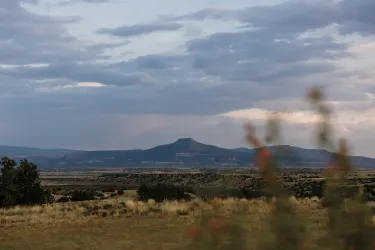
Image Ghost Ranch Education and Retreat Center is about 65 miles northwest of Santa Fe, N.M. (Photo courtesy of Ghost Ranch) The National Gh...