Wednesday, September 22, 2021

Minute for Mission: Native American Day

September 22, 2021

Tutuilla Presbyterian Church, est. 1882, Confederated Tribes of Umatilla reservation, Pendleton, Oregon. (Irvin Porter)

Jesus was asked, “… And who is my neighbor?” (Luke 10:29)

America’s history with Indigenous peoples hasn’t always been neighborly. In the past five years, the General Assembly has taken actions to change that legacy, and to be neighbors not conquerors. Those actions have included:

    • An Apology to Native Americans, Alaskan Natives and Hawaiians for Presbyterian cooperation with the Indian boarding school experiment
    • Repudiating the Doctrine of Discovery
    • Reporting on the Background of the Doctrine of Discovery with Recommendations for congregations
    • Expanding the Response on the Doctrine of Discovery
    • An Initiative to Repair Infrastructure of Native American churches and Properties
    • A Report on Native American Church Properties
    • A Report from the Native American Coordinating Council.

More needs to be done in each on each of these issues. A good start has been made, however.

I work with the 97 Native American Presbyterian congregations. Our leadership has been very busy giving presentations and workshops informing Presbyterians about Native issues.

After three-centuries-plus, Elona Street-Stewart, of the Delaware-Nanticoke tribe, became the first Native American to be elected as a Co-Moderator of our denomination’s highest elected position in 2020.

We are not a numerous constituency. Our first congregation was formed in 1741, making a difference and working to help Presbyterians understand who we are, our issues and inviting “neighbors” into partnership with mutual respect and trust.

Get more information about your Native American congregations. Seek relationship with those who have been your “neighbors” for centuries.

Mr. Irvin Porter, Associate for Native American Congregational Support, Racial Equity & Women’s Intercultural Ministries, Presbyterian Mission Agency

Let us join in prayer for:

PC(USA) Agencies’ Staff
Ryan and Alethia White, Mission co-workers in Germany, Presbyterian Mission Agency
Bryce Wiebe, Director, Special Offerings, Presbyterian Mission Agency

Let us pray

Creator of all that we are and will be, give us hearts to be neighbors who care, listen and support each other. We seek to “rejoice and be glad” in this day you have granted to us. Make sunrise in our hearts now and forevermore. Amen.

Tuesday, September 21, 2021

Minute for Mission: International Day of Peace

September 21, 2021

The International Day of Peace, which was established by the United Nations, is observed all around the world on Sept. 21 each year.


The theme of peace is prevalent at the United Nations. Its founding in 1945 came after the devastation of the second World War, and it was created “to save succeeding generations from the scourge of war, which in our lifetime has brought untold sorrow to [hu]mankind” (U.N. Charter, preamble).

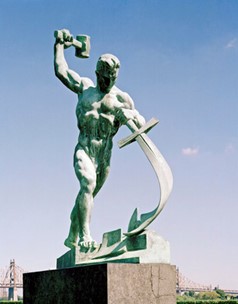
This theme of peace is showcased in the artwork donated as gifts by the member states over the years.  The artwork collection ranges from murals, tapestries, stained glass windows and sculptures in and around New York headquarters.     

There is one artwork that stands apart for me. It’s called “Let Us Beat Our Swords into Ploughshares.” If the title sounds familiar to some, it’s because the words come from the Book of Isaiah 2:4: “He shall judge between the nations, and shall arbitrate for many peoples; they shall beat their swords into plowshares, and their spears into pruning hooks; nation shall not lift up sword against nation, neither shall they learn war anymore.” 

The artwork shows a man holding a hammer in one hand and sword in the other. He is in motion, ready to swing his hammer on the blade to continue bending the metal into a curved ploughshare symbolizing the human desire to put an end to war and convert tools of destruction and death into a tool for the upbuilding and life for the world.   

This bronze sculpture was created by Soviet artist Evgeny Vuchetick and presented to the United Nations by the government of the USSR in 1959 during the height of the Cold War, a poignant reminder that the desire for peace is universal. 

The U.N. has called on member states to observe 24 hours of non-violence and cease-fire on the International Day of Peace. How can Presbyterians observe this day? One way is to engage with the Presbyterian Ministry at the United Nations’ (PMUN) U.N.’s Sustainable Development Goals Study & Devotional Guide (goal No. 16 is peace) in order to build a more sustainable world. So let us work for peace in the world. 

Sue Rheem, Representative to the United Nations, Presbyterian Ministry at the United Nations, PC(USA)

Let us join in prayer for:

PC(USA) Agencies’ Staff
Laura Wampler, Operations & Accounting Associate, Presbyterian Publishing Corporation
Kimberly Wells, Mission Specialist, World Mission, Presbyterian Mission Agency

Let us pray

God of Peace, we say we desire peace and yet humankind has perpetuated cycles of violence and war throughout the ages. Today, we come before you with heavy hearts, and pray for those regions where there is conflict and war and so much human suffering, inflicting unspeakable pain and misery on one another. But we know there is a better reality. … O how good and pleasant it is when kindred live together in unity. We long for your peace. May we dismantle the weapons of destruction and create tools for flourishing of your creation. Amen.

Monday, September 20, 2021

Today in the Mission Yearbook - A Matthew 25-inspired Stations of the Cross

New worshiping community leader says Holy Week had a whole new meaning after a year of ‘being in the tomb’

September 20, 2021

The Rev. Jeanie Shaw participates in Eventides “Giving Caravan” by sharing food and items to keep warm with a person experiencing homelessness in Sacramento, California. (Photo: Nancy Disher)

For the Rev. Jeanie Shaw, leader of Eventide Community, a new worshiping community in Sacramento, California, Holy Week had a whole new meaning this year. As an active member of the Presbyterian Disaster Assistance National Response Team, people in her community are used to being sent into neighborhoods across the nation and around the world to work on PDA-connected projects.

Because of the pandemic, Eventide members haven’t been able to be present and face to face with those impacted by disaster. They haven’t met in person over a year, and Shaw’s volunteer work with PDA has been limited to providing emotional and spiritual care via Zoom to presbyteries dealing with disaster events.

“We’ve experienced being in the tomb, but we can see the beginning of the tomb being opened,” Shaw said, “where we can begin to hug our families, and worship together person to person.”

This truth came to Shaw when a small group of volunteers helped reinvent Eventide’s “Giving Room,” which pre-pandemic was filled with sleeping bags, tents, jackets, gloves, socks and hats for their homeless siblings to take what they needed during Sacramento’s wet winter weather.

In early January, Eventide turned the room into a “Giving Caravan.” Along with items to survive the weather, the caravan was also loaded with pies, bread, cans of food, juice boxes, energy bars, and peanut butter and jelly. One person helping Eventide contacted many of their homeless friends to come to a parking lot. Shaw wrote about the experience here, describing it as “one of the most sacred meals” she’d ever seen.

As a worshiping community that has accepted the PC(USA)’s Matthew 25 invitation, which invites congregations to work at building congregational vitality, dismantling structural racism and eradicating systemic poverty, Eventide takes the mandate seriously. Shaw said they meet once a week “on holy Zoom” for Bible study related to the Matthew 25 invitation. Recently she and another Eventide leader, Nancy Disher, produced this “Stations of the Cross” for Good Friday, which she said was inspired by Matthew 25.

At each station is an image where members of Eventide have been on PDA mission trips over the years. The 11th station, where “Jesus promises his kingdom to the good thief,” has the one picture of the one place they weren’t able to go to — the people’s memorial to George Floyd — taken by one of Shaw’s friends.

For Shaw, putting together the stations of the cross in this way reminded her of what she has learned during the pandemic. For centuries, she said, churches worked to get people to come to them, to their sanctuaries. But she believes the pandemic, which closed church buildings, has changed the direction from having people come to the church to church and worshiping community members going out into the world.

“We’ve made it very clear we are not going back to worship in a physical space,” Shaw said. “We are going forward, knowing it will not be the same. In Mark 16 a young man in radiant white tells the woman at the tomb to tell the disciples that Jesus has gone ahead of them to Galilee. Jesus is ahead of us too, leading us to a whole new understanding of God’s love, post-pandemic.”

Shaw is also a three-quarter time pastor for Truckee Lutheran Presbyterian Church on the California border near Nevada. Under her leadership the church created “Operation Gratitude and Support,” which focused on thanking a different group of essential workers every month, especially for their service during the pandemic. You can read about that here.

Paul Seebeck, Mission Communications Strategist, Presbyterian Mission Agency

Let us join in prayer for:

PC(USA) Agencies’ Staff
Jacklyn Walker, Mission Specialist, Asia & Pacific Office, Presbyterian Mission Agency
Judy Walton, Director, Credit Operations, Presbyterian Investment & Loan Program

Let us pray

Holy God, keep the eyes of your faithful always looking for those in need, and make our hands willing to serve, so that others may glimpse your kingdom until it comes in fullness. Amen.

Sunday, September 19, 2021

Minute for Mission: Evangelism Sunday

September 19, 2021

The Rev. Flora Wilson Bridges, Ph.D., preaches at Rendall.

Rendall Memorial Presbyterian Church is a small-in-numbers yet large-in-mission, Christ-centered, aging, progressive congregation in central (Black) Harlem. Its mission is to serve those in the community through the gospel of Jesus Christ. Evangelism happens at Rendall as a “by-product” of intentional, gospel-focused ministry that is relational, personal, spiritual and missional.

Since 2016, in partnership with the Department of Homeless Services of the City of New York, the church has hosted those who are without homes 365 nights a year from 7 p.m. to 7 a.m. with hot meals (breakfast and dinner), hot showers, clean beds, toiletries, small items of clothing and — vitally important — the safety needed to sleep in peace. Two other churches in the New York City Presbytery have since followed this model pioneered at Rendall. Rendall’s ministries to those in need attract younger adults to join the congregation.

Often in today’s world, millennials and Gen Xers question the “sound” of the trumpet call of the Christian church. Younger adults have joined Rendall teaming up with the session (which includes two millennial elders), deacons (currently all millennials), baby boomers and the greatest generation in joyful, intergenerational worship, biweekly Bible study (one taught by the baby boomer pastor and the other taught by a millennial), weekly prayer meeting (led by the greatest generation) and mission (administered by boomers and executed by millennials). Those who join believe Rendall is not simply talking about Jesus but being about Jesus. In Rendall’s compassionate service to the poorest of the poor, they trust the sound of the gospel.

The Rev. Flora Wilson Bridges, Ph.D., Pastor of Rendall Memorial Presbyterian Church

Let us join in prayer for:

PC(USA) Agencies’ Staff
Teresa Waggener, Manager, Immigration, Office of the General Assembly
David Walker, Executive Vice President & Chief Investment Officer, Board of Pensions

Let us pray

Dear God, let us not copy the behavior and customs of this world, but transform us into a new people by changing the way that we think. May we repurpose our lives and act accordingly. Amen.

Saturday, September 18, 2021

Today in the Mission Yearbook - Children’s book from Flyaway Books explores memory loss

‘Arthur and the Forgetful Elephant’ encourages compassion, patience

September 18, 2021

“Arthur and the Forgetful Elephant” by Maria Girón explores memory loss from the perspective of both those who forget and those around them. Inside the book, a young boy named Arthur meets an elephant who suffers from memory loss. After a playful day together, the elephant remembers enough to help him reunite with his family. The book, which is ideal for ages 3–7, encourages readers to have compassion for and patience with those suffering from memory loss and it features charming illustrations that progressively become more colorful throughout the story.

Kirkus Reviews gave the book a starred review, saying it’s “a tale of memory and kindness infused with warmth and a splash of color. … Powerful, playful, emotional, and so worth a place on the bookshelf.”

The book is available in a jacketed hardback format and the retail price is $18. A free discussion guide developed in cooperation with the Alzheimer’s Association and a complimentary coloring sheet featuring Arthur and his friend are available for download here.

“Arthur and the Forgetful Elephant” is now available for purchase where books are sold.

Flyaway Books is a picture book program dedicated to themes of diversity, inclusivity, compassion, and kindness. For more information, visit flyawaybooks.com.

Girón spent her childhood immersed in art. Since studying fine arts and illustration in Seville and Barcelona, she has illustrated 10 children’s books. In 2010, the Bologna Children’s Book Fair selected her work for a collective exhibition. For more information, visit mariagiron.com.

 Flyaway Books, Special to Presbyterian News Service

Let us join in prayer for: 

PC(USA) Agencies’ Staff
Flor Velez-Diaz, Manager, Judicial Process & Social Witness, Office of the General Assembly
Michael Wade, Production Clerk, Hubbard Press

Let us pray

Dear Jesus, friend of children, we are grateful for the love of children and love of learning, and for helping each child to become a grateful steward of the gifts you have given them.

Friday, September 17, 2021

Today in the Mission Yearbook - If the land could speak, what stories would it tell?

Coastland Commons worshiping community in Seattle takes steps to learn about redlining and gentrification

September 17, 2021

Coastland Commons, a new worshiping community, held community walks last fall to learn more about the history of redlining in Seattle. (Contributed photo)

After COVID-19 forced the cancelation of planned projects and in-person worship, Coastland Commons, a 1001 New Worshiping Community in Seattle Presbytery,  moved to Zoom discussions about their city’s history of land use by Black, Indigenous and people of color communities. After about six months of Zoom gatherings, they figured out a safe way to see Seattle anew through socially distanced community walks. They reached out to the Museum of History and Industry (MOHAI), which organizes redlining tours in Seattle’s Capitol Hill and Central District neighborhoods.

Although MOHAI’s guided redlining tours are canceled during COVID-19, the tour guide shared maps and information with the Coastland Commons group. “She was really generous,” said the Rev. Zac Calvo, organizing pastor of Coastland Commons and associate pastor of community and youth at Northminster Presbyterian Church in Seattle’s Ballard neighborhood. “She gave us all her materials, so we followed her instructions. We were super grateful.”

“We ended up talking a lot about gentrification and how it in some ways reinforces and reestablishes what feels like redlining — it just now is less explicit than racial covenants.”

One walk highlighted the history of Seattle and historic Indigenous sites around Northminster Presbyterian Church, the fiscal sponsor and partner congregation of Coastland Commons. Another walk took a route along the border of historically redlined neighborhoods. About 10–15 people participated in each walk, Calvo said.

“We read actual racial covenants that were in these leases and property documents. You look at it and you are like, ‘Oh, my word,’” Calvo said. “And, to this day there are still leases and mortgages where those things, though not enforceable, still exist on the books in some places — even in Seattle.”

Although less explicit than a racial covenant from the 1950s that might say something like “No person of color or Asian descent can live in this neighborhood,” many injustices continue today, Calvo explained. “Even though we’ve said like, ‘We’re better, we’re better, we’re better,’ the reality is that a lot of these things get upheld, even when we say they’re gone.”

The tour guide — who supplied the materials and guidance for the group — refused to accept payment. Instead, she asked the group to donate to nonprofit organizations in Seattle working with underserved communities to address equity in housing and social services. Coastland Commons donated part of their 1001 Pivot Grant to Byrd Barr Place.

In the donation discerning process, Coastland Commons learned about the work of several nonprofits, including some that do urban gardening. The experience of the redlining tours and this learning about nonprofit organizations in Seattle has inspired folks at Coastland Commons to make plans to volunteer for some of these organizations.

During the pandemic, Coastland Commons is having monthly “creative nights” on Zoom, which include a time of personal or creative reflection (15–20 minutes) and unstructured creative time (30–40 minutes). “We give people this time to kind of do whatever they want,” Calvo said. After creative time, everyone has an opportunity to regather on Zoom and if they would like they can share what they are working on or what having unstructured time meant to them.

One-time pivot grants of $1,000 were awarded last year to 1001 New Worshiping Communities recognized by their presbytery. These grants were used to assist with shifting programs, new training, unanticipated expenses due to the pandemic or racial injustices in their communities.

“In all of the ways our own program shifted in 2020, the ability to fund these small pivot grants for about 135 new worshiping communities has provided outsized impact, both in the local neighborhoods receiving the funds and in our own growing understanding of the ways the newest communities among us are breathing new life into the larger PC(USA),” said the Rev. Nikki Collins, coordinator of 1001 New Worshiping Communities. “We hope the sharing of their creative and faithful witness will inspire all of our congregations to consider new opportunities for connection with each other and the world around us.”

Coastland Commons began in 2014 with a few musicians and a Kickstarter campaign to fund an album, with music inspired by the Emmaus Road story in Luke 24. It evolved into a 1001 New Worshiping Community.

 Tammy Warren, Former Communications Associate, Presbyterian Mission Agency

Let us join in prayer for:

PC(USA) Agencies’ Staff

Miguel Vargas, Building Manager, Presbyterian Historical Society
Stephanie Vasquez, Senior Translator, Administrative Services Group (A Corp)

Let us pray

Dear God, our Heavenly Father, we give thanks to you. We pray, Lord, we are able to live lives worthy of you so that we delight you with our pure hearts, our truthfulness and our actions. Amen.

Thursday, September 16, 2021

Today in the Mission Yearbook - Rethinking stewardship approaches

Churches can start by thanking their donors and acknowledging what their gifts bring about

September 16, 2021

Photo by Aaron Burden via Unsplash

I am not usually a fan of a pastor or someone in my position using themselves as a good example. If pastors tell a story from their lives in a sermon, I think it should be a story about how they learned something about their faith because of a failing or a shortcoming, or a story about something funny that happened to them. I also think pastors should never use their children as examples, especially if the child is in worship. The last thing preachers’ kids need is to have more attention drawn to them.

I realize that my approach to pastors not using themselves as an example may come from my baby boomer sensibilities formed long before our current culture in which people share far more of their personal lives. You can “OK boomer” me about this. I’m just saying that what I am about to write is outside of my comfort zone, but I thought it might be instructive.

One of the areas of a congregation’s life about which pastors and other leaders are worrying right now is stewardship. The way we encourage people to give to congregations has been the norm for about 120 years. Before our current system of pledging and giving, members of congregations paid pew tax for the right to sit in a particular pew. In some European countries, churches are funded through taxes. All of this is to say that there are lots of ways to fund churches.

We can learn much from other not-for-profits when it comes to stewardship. For instance, I have been to workshops where people remind us that when the zoo asks us for money, they send us a picture of a baby giraffe. When the church asks us for money, they send us a line-item budget.

Churches are also notoriously bad at saying “thank you.” There is a mistaken idea that no one should know what a member gives to the church. Directors of other not-for-profits know exactly who their donors are and what they give. I had a member of a church where I was pastor tell me that she was not really comfortable having me know what she gave. I told her that if she was uncomfortable, she could give more.

So, here is the story about my family. We received our stimulus check in the last few months. We do not need it since we are doing fine meeting our needs. We were watching the nightly news with a story about how many people are hungry. The Midwest Food Bank in Peoria, Illinois, is an organization that we know very well and we know that they do good work. We sent them a check for the whole amount of our stimulus check and my husband wrote a note to the director, whom he knows. We got back a handwritten note thanking us for our $1,200 check and telling us that this amount provides $36,000 worth of food through the food bank. Very specific; very impactful; very helpful as we consider further gifts.

As you work at making sure your stewardship program at church is robust and that it is truly encouraging members to be generous, what might you do to be specific, impactful and helpful? Can you tell people exactly what their $1,000 or $10,000 contribution accomplishes? Can you tell them a story about how worship and companionship in the lives of your members helps to mold them into Christians who change untold numbers of lives as they go about their work and leisure? What have you thought about that might change the way you encourage stewardship?

It takes dedication and faith and the love of God to do our work. It also takes money to continue to bring hope in the name of Jesus.

 Sue Krummel, Executive Presbyter, Presbytery of Chicago

This piece was originally published on Where Your Heart Is…A Weekly Offerings Stewardship Blog.

Let us join in prayer for:

PC(USA) Agencies’ Staff

Tina Valdes, Customer Service Representative, Presbyterian Publishing Corporation
Kris Valerius, Manager, Denominational Rolls and Statistics, Office of the General Assembly

Let us pray

Through the power of your Holy Spirit, loving God, may the ministries we offer in the name of our Christ lead to the transformation of our world, our churches and ourselves. Amen.

Mission Yearbook: Justice must be for all, human rights activist says

In a searing message at the United Nations, human rights activist Malala Yousafzai expressed deep disappointment in the continued plight of ...