Showing posts with label Synod School. Show all posts

Tuesday, December 30, 2025

Mission Yearbook: Synod School class explores modern-day mystics’ wisdom

Susan Stabile, an experienced spiritual director and retreat director trained in the Ignatian tradition, led a popular class during this year’s Synod School called “Learning from Modern-Day Mystics.”

Image
Meritt Thomas Unsplash
Photo by Meritt Thomas via Unsplash

Synod School is put on each summer at Buena Vista University by the Synod of Lakes and Prairies.

Stabile defined a mystic as “a person who is deeply aware of the powerful presence of the divine spirit,” someone who “seeks, above all, the knowledge and love of God and who experiences to an extraordinary degree the profoundly personal encounter with the energy of divine life.”

Mystics “often perceive the presence of God throughout the world of nature and all that is alive, leading to a transfiguration of the ordinary all around them,” according to Ursula King. Father Richard Rohr called it “experiential knowledge of the Holy, the transcendent … God,” adding that “even one little peek into one little corner of the mystery is more than enough.”

Forebears of modern African American mystics include Sojourner Truth and Jarena Lee, the first Black woman to publish an autobiography and, along with Truth, part of the Second Great Awakening.

No less a theologian than Dr. Howard Thurman called mysticism the “response of the individual to a personal encounter with God within his own spirit.” Thurman “believed the mystic is motivated by a desire that everyone have the opportunity to experience holiness and a personal relationship with God,” Stabile said. “Social action for Thurman is sacramental. The mystic does not retreat from life but is here to promote God’s vision for this Earth.”

Stabile’s second session focused on “The Poet as Mystic.” She read Mary Oliver’s “Praying” and called poetry “one of the most useful expressions of a mystic’s inner experience.” The poet who was considered in depth during this class session was Gerard Manley Hopkins, especially his “God’s Grandeur” and “Pied Beauty.”

“Hopkins led a relatively short but passionate life,” Stabile said. “He had a relationship with Jesus Christ that seems at times to be so intimate as to remind us of those women mystics from the late Middle Ages who emphasized their spiritual union with Christ.”

Hopkins converted to Catholicism and became a priest, initially burning all his poetry and then starting all over. But “he always put his responsibilities as a priest ahead of his poetry,” Stabile said.

Image
Susan Stabile cropped
Susan Stabile

On the third day, Stabile explored mystics’ use of imagination and storytelling. The Jesuit priest, Father Anthony De Mello, was an important figure on this day. De Mello defined an awakened person as “a person who no longer marches to the drums of society” but is rather “a person who dances to the tune of the music that springs up from within.”

Thich Nhat Hanh once called the beginning of mindfulness “when something we do in ordinary life can become a profound meditation with enough attention to the present.” An apostle of peace and nonviolence, Hanh was nominated for a Nobel Peace Prize by the Rev. Dr. Martin Luther King Jr.

On the final day of class, Stabile looked at other modern mystics and some of the characteristics of deep religious experience. She opened with Julie Fehrenbacher’s poem “The Most Important Thing,” which ends with these words: “I whisper hallelujah to the friendly sky. Watch now as I burst into blossom.”

The mystics for this day included Evelyn Underhill, Rabbi Abraham Joshua Heschel, Thomas Merton and Simone Weil.

Stabile called Underhill “a quiet giant in the world of mysticism.” She was the first woman to lecture clergy in the Church of England and one of the first women to offer a retreat. Her “Practical Mysticism” is an effort “to demystify mysticism,” Stabile said.

Heschel was among the giants in the civil rights movement. Deported by the Nazis in 1938, he viewed ecumenism as the necessary means to combat racism.

Merton is “a favorite of mine,” Stabile said. To Merton, contemplation is “the response to a call: a call from [One] who has no voice, and yet who speaks in everything that is.”

Mike Ferguson, Editor, Presbyterian News Service (Click here to read original PNS Story)

Let us join in prayer for:

Martha Reisner,  Director, Affiliated Markets, Engagement & Church Relations, The Board of Pensions
Tina Rhudy, Director, Building Services, Administrative Services Group      

Let us pray:

Welcoming God, teach us the importance of hospitality as a means of sharing Christian love. Give us opportunities to extend hospitality freely and sincerely, and hearts to receive it with grace. Amen.

Thursday, October 3, 2024

Today in the Mission Yearbook - East Texas PC(USA) pastor celebrates Creation during solar eclipse

Synod School’s closing worship preacher wasn’t so sure he’d get to witness the rare cosmic event

October 3, 2024

The Rev. Brendan McLean, associate pastor of First Presbyterian 

Church in Tyler, Texas, preaches during closing worship at Synod 

School Friday. He displayed pictures his friends tool of the April 

8 solar eclipse. (Photo by Kim Coulter)

The Rev. Brendan McLean is associate pastor of First Presbyterian Church in Tyler, Texas, one of the communities shrouded in darkness for nearly two minutes during the April 8 solar eclipse.

Only just before it happened, someone forgot to urge the clouds over Tyler to go away.

“I felt like I had a front-row ticket,” said McLean, the preacher during closing worship at this year’s Synod School. “But I was watching it from the balcony behind a pillar.”

But at 1:43 p.m. Central Time, the sky grew dark like twilight, the clouds parted, “and I could see the total solar eclipse,” he said. “How incredible it was to see it with my own two eyes — with solar eclipse glasses on.”

For two minutes, McLean and millions of other North Americans “experienced a world fundamentally different than the ordinary world we experience every day, a world where we experienced the shadow of night when we virtually always experience the light of day,” he said. “It was other-worldly.”

Later, he and his friends shared pictures of what they’d seen via social media. He called the nearly two minutes “unadulterated and unfiltered communion with the cosmos,” and he preached at Synod School using Job 12:7–13 as his text.

“This passage from Job tells us the whole of Creation — every part of the universe — calls us to awe and reverence of God.”

Job’s “beautiful theological statement” is the answer to Job’s “friend,” Zophar, who’s sure Job did something wrong to justify all his suffering. “Job knows this is entirely untrue,” McLean pointed out. “Our suffering is not connected to God’s retribution.”

The wisdom of God is not something we can grasp, “and yet all of Creation — the entirety of the cosmos — has something to tell us about God,” McLean said. If we want to encounter God, “all we need to do is simply ask the cosmos, the world around us, at any given time. We are surrounded by the beauty of Creation that calls to us. … We are made and claimed as God’s children and are redeemed and resurrected in Jesus Christ.”

“Friends, all of Creation is waiting to tell us something about God,” he said. Unlike that solar eclipse, “the window of opportunity to observe something about God is as wide and big as you can imagine — and yet more.”

“All we need to do is stay curious and ask, open our ears and our eyes to see that God is good and that Christ died and rose for us, all of us,” McLean said. “The God who is more than we can ask or imagine — it is that God who loves you, who cares for you, and who wants you to flourish — not because you’ve earned anything, but because you are you, and God loves you for it. Amen.”

As part of worship, children and youth were given special sunglasses and told, “When you put them on, you can see the kingdom of God.” They and all the others in worship were the recipients of a reproduction of a two-sided watercolor signed by most of the 540 people who attended Synod School and bearing this saying: “Remember, God is able to do more than all we ask or even imagine.”

Synod School celebrated its 70th anniversary this year. It’s put on each summer by the Synod of Lakes and Prairies and held at Buena Vista University in Storm Lake, Iowa. Learn more here.

Mike Ferguson, Editor, Presbyterian News Service

Today’s Focus: Synod School’s closing worship preacher celebrates Creation during solar eclipse

Let us join in prayer for:

PC(USA) Agencies’ Staff
Natalie Smith, Product Manager, General Reader Books, Presbyterian Publishing Corporation 
Stephen Smith, Security Trading & Assistant Portfolio Manager, Trust Services, Presbyterian Foundation

Let us pray

Creator God, we thank you for this day. We give thanks that each of us can reach out to those in need around us; help us to be particularly mindful to children in need. Guide us each and every day as we strive to serve you. In Jesus’ name we pray. Amen.

Sunday, September 29, 2024

Today in the Mission Yearbook - Synod Schooler who’s 101 is thrilled to be back where she belongs

Mary Conklin of Winnebago, Minnesota, contributes to worship back home by playing the organ

September 29, 2024

Mary Conklin of Winnebago, Minnesota, is attending Synod School along with her granddaughter, Elizabeth, and greatgrandchildren Orion and Rosemary. (Photo by Kim Coulter)

Even though she’s 101 years old, Mary Conklin of Winnebago, Minnesota has not attended every edition of Synod School, which debuted in 1954. But she has been a part of most of the past 50 or so versions of the beloved gathering, put on each year by the Synod of Lakes & Prairies and attended by about 540 people this year, ranging in age from 5 months to 101 years.

“I taught [at Synod School] almost every year until 2009,” Conklin said. The children “kept me on my toes.”

A retired educator, Conklin still works as the organist at First Presbyterian Church in Winnebago, the church her late husband, the Rev. Robert Conklin, served from 1974 through 1984.

Asked to identify what she likes best about Synod School, Conklin hardly knew where to start. When she called to request a buggy — the Synod School name for a golf cart — to take her from, say, class to lunch, it was there in minutes.

“There are people I don’t see often who are special people” who attend Synod School, like Conklin does, year after year. This year, she’s accompanied by her granddaughter, Elizabeth, and Conklin’s great-grandchildren, Orion and Rosemary. It was Elizabeth who got her grandmother to return to Synod School after Conklin missed a few years during the pandemic.

Elizabeth and her children live in Blue Earth, about a dozen miles from Winnebago. Conklin lives alone, “but Elizabeth takes care of me. She comes by once a week and does what I can’t manage. I don’t do ladders anymore, so she takes care of the windows.”

“We brought Elizabeth to Synod School when she was little,” Conklin said. “That did something for her that makes her want to come back.”

Jill Emery, a commissioned ruling elder, recently began serving First Presbyterian Church after it had been without a pastor for about five years. “We are a small church. Many pastors don’t want to go to a small town far away from a big city, which we are,” Conklin said. “But we have maintained ourselves very well, which I think is remarkable.” The gift of a farm allowed for the renovation of the sanctuary “to update it to get us to the 21st century,” Conklin said with a smile.

“When I go home, I share the whole experience. I always tell people they need to come to Synod School,” she said. Each year the church offers scholarships to help members and friends attend.

Asked to dig into her memory bank for meaningful events of Synod Schools past, Conklin recalled adding her voice to the alto section in the choir. “You learned so much new music because the director would bring it” to try it out, she said. “It was fantastic to sing with that group.”

Conklin marvels at the care Synod Schoolers show one another, herself included. “I am so well cared for, and I don’t think that’s unique to me,” she said. “I think they help everyone. They’re a fantastic support. You see little groups of people having conversations and making new friends — some of them you’ll never see again.”

“There are no strangers here,” she said. “Once you’re here, you’re part of the group.”

Conklin attended the University of Dubuque and completed her studies at what was then Dickinson State College in North Dakota. Then her husband heard God’s call to attend the University of Dubuque Theological Seminary and serve in the ministry.

She started her teaching career at a country school in North Dakota, where she had 18 pupils in seven grades. Later, she taught high school English and grade school music. She was the education specialist for the Presbytery of Minnesota Valleys during the 1980s.

She and her husband retired to Arkansas, but retirement didn’t take for Conklin, who went to work at the University of the Ozarks, teaching Christian education halftime for a couple of years. She also was a Christian education director at a church in Fort Smith before moving back to Minnesota to be closer to her beloved family.

“All that education paid off,” she said, again with a smile.

Mike Ferguson, Editor, Presbyterian News Service

Today’s Focus: Mary Conklin plays organ at Synod School at age of 101

Let us join in prayer for:

PC(USA) Agencies’ Staff
T. Clark Simmons, Senior Church Consultant, Atlanta GA, Board of Pensions
Alex Simon, Multimedia Specialist, Communications Ministry, Presbyterian Church (U.S.A.) 

Let us pray

Lord Jesus, you are the vine, we are your branches, feed us, nourish us prune us that we might grow stronger, bearing fruit for you. Let the fruits we bear bring glory to you. Amen.

Thursday, September 26, 2024

Today in the Mission Yearbook - Gamers can help us see and shape the future

Synod School convocation speaker: Four tools employed by gamers can be helpful for faith communities, too

September 26, 2024

Photo by Samsung Memory via Unsplash

A longstanding practice at Synod School is to offer a talk-back session with the convocation speaker each evening. At the start of his talk, Dr. Corey Schlosser-Hall, this year’s convocation speaker, shared some of what he learned during the previous evening’s talk-back.

One participant said we might consider attaching our FOMO — the fear of missing out — to what God’s doing right now.

Another noted that much of discipleship formation is built around conserving and preserving. “I wonder if more can be built around what Jesus said in John 20: “Peace be with you. Now go,” said Schlosser-Hall, the deputy executive director of Vision, Innovation and Rebuilding in the Presbyterian Mission Agency. “Then [Jesus] breathes the Holy Spirit on them.”

He said he also heard from people who want faith communities to grow better and more attuned to “memorializing and sacramentalizing when something has completed its lifecycle,” he said. “Could we do better with honoring, blessing and letting go?”

“It was a good, robust conversation,” Schlosser-Hall said.

Turning to the day’s material, Schlosser-Hall showed a couple of TV ads to help spur discussion. The first examines the calamities that can occur when one’s cable goes out. “It’s catastrophizing,” Schlosser-Hall said. “How do you see that lived out in your life?”

“It’s a slippery slope,” said one Synod School-goer. “If we let them in, who else will come?”

“People assume your ideas are bad even before you try them on,” said another.

Then the 540 or so people gathered at Buena Vista University in Storm Lake, Iowa, viewed a second ad, one for a handheld computer that celebrates people who are filled with passion. “What kind of future is this depicting? Schlosser-Hall asked.

“A sense of possibility, hope and anticipation,” said one.

Jane McGonigal, who wrote “Imaginable: How to See the Future Coming and Feel Ready for Anything, Even Things that Seem Impossible Today,” develops social games about relating to the future. One of McGonigal’s concepts, Schlosser-Hall pointed out, is time spaciousness, which encourages people, faith communities and organizations to plan and dream in 10-year windows, rather than next month or next year or even five years from now.

Dr. Corey Schlosser-Hall (Contributed photo)

Schlosser-Hall asked Synod Schoolers to take a brief McGonigal quiz using a rating scale of 1 to 10:

  • Over the next 10 years, do you think things will mostly stay the same or that most of us will dramatically rethink and reinvent how we do things?
  • Are you mostly optimistic or mostly worried?
  • How much influence do you feel you have in determining how the world and your life will change over the next 10 years?

“We live in a VUCA world,” Schlosser-Hall said, an acronym for volatile, uncertain, chaotic and ambiguous. But so did the people who lived in gospel times, he said.

“Hope is not a feeling you hope lands on you one day,” he said. “It’s a choice we seek to live into. It’s less something that happens to us and more about what we might choose.”

McGonigal says gamers are good at seeing and shaping the future. They employ four tools to help them do that.

  • Urgent optimism, the desire to tackle an object combined with the belief there’s a reasonable chance of success. “It’s worth trying, and trying now,” is their approach.
  • Social fabric. “They are virtuosos at weaving a tight social fabric,” Schlosser-Hall said.
  • Blissful productivity. “When they’re engaged, they lose themselves,” he said of gamers. “They’re happier working hard at the game than relaxing and just hanging out. It can be a deeper kind of energizing. We need to relax and renew, but we also need to be engaged in blissful productivity,” he said.
  • Epic meaning. Schlosser-Hall held up The Legend of Zeldaand World of Warcraft as examples. As for The Legend of Zelda, “the depth of meaning this invites people into is almost a spiritual experience. It’s pretty profound,” he said.

“What better place for these qualities to show up than in our congregations, our presbyteries and our communities? It’s about finding our identity in something way bigger than ourselves and doing it better,” Schlosser-Hall said. “Maybe we can get really darn good at the future. Amen?”

Mike Ferguson, Editor, Presbyterian News Service

Today’s Focus: Gamers can help us see and shape the future shares Dr. Corey Schlosser-Hall at Synod School

Let us join in prayer for:

PC(USA) Agencies’ Staff
Effie Shipp, Associate for Lending Services, Presbyterian Investment & Loan Program 
Elaine Shilstut, Cataloging & Metadata Librarian, Presbyterian Historical Society 

Let us pray

God, thank you that you are a God of peace and love. We pray for those who need healing from confusion, pain and despair. We ask your blessing that we might bear rich fruits. Amen.

Wednesday, September 25, 2024

Today in the Mission Yearbook - Try ‘shalomify’ next time you’re playing Scrabble

Dr. Corey Schlosser-Hall coins a word and leads a thoughtful discussion during his first talk at Synod School

September 25, 2024

Photo by Clark Tibbs via Unsplash

Few Synod School convocation speakers can get away with birthing new words on the spot the way Dr. Corey Schlosser-Hall did.

The word was “shalomify,” as in the way God asks us to build places of shalom, justice, peace and well-being in the places where we live and work and worship. “You can have projects of shalomification,” Schlosser-Hall, the Presbyterian Mission Agency’s deputy executive director of Vision, Innovation and Rebuilding, told those attending Synod School, which is offered each year by the Synod of Lakes and Prairies at Buena Vista University in Storm Lake, Iowa.

Although he lives in the Pacific Northwest, Schlosser-Hall has roots in the Synod of Lakes and Prairies, having been born in Fort Dodge, Iowa, and having spent his formative years in Aberdeen, South Dakota, and Bismarck, North Dakota.

He showed a slide of a line sliding downward from left to right, and many people guessed it represented the PC(USA)’s membership trend: about 4 million in 1970 and about 1.2 million in 2020. But what if, as one Presbyterian told Schlosser-Hall and others present on a Zoom call a while back, that represents a line of possibility?

“God is doing more than we can ask or imagine,” he said, picking up on the Synod School theme during its 70th year. “We might want to be part of it.”

Schlosser-Hall has seen the T-shirts with the four qualities spelled out during ordination questions: Do you promise to serve the people with energy, intelligence, imagination and love?

Dr. Corey Schlosser-Hall (Contributed photo)

“We want to escalate the role of imagination to create new stories and [employ] imagination’s cousin, innovation,” which someone once defined as “imagination applied,” Schlosser-Hall said. “My hope [this week] is that we will see our circumstances in an ecosystem of possibility.”

Schlosser-Hall, a PC(USA) ruling elder who’s married to a pastor, shared photos of some of the places in Eugene, Oregon, that mattered to the couple when they were younger.  The Koinonia Center, a former Victorian home where Schlosser-Hall worked as a janitor, is now a towering apartment building. Hayward Field, a beloved place for track fans, was leveled in 2018 and rebuilt in time to host the world championships in 2022. But the church where the two used to worship has remained largely unchanged.

He wondered — and he asked those present to think along with him — whether there’s something going on that makes it more difficult to exercise “that blue-sky imagination, to take steps with great risk and great possibilities.”

He asked the crowd for their ideas. Among them:

  • People are invested in their past accomplishments.
  • Comfort means complacency.
  • We’re scared of the chaos that can occur between the former and the future.
  • A group of churches told one pastor, “We welcome new ideas that will help us keep on doing what we’ve always done.”
  • There is a fear of loss, and we don’t like fear. Even when it’s good change, change always involves loss.
  • We forget that God calls us to be resurrection people.
  • What we let go of might be a faith anchor for some people.

“Discipleship is being able to hold more than one emotion, reality or observation at the same time. That creates maturation as disciples,” Schlosser-Hall said. “It’s not one or the other. It’s grief and newness together.”

But “if we rush in with new zeal saying, ‘This is what we’re going to do. Get on board or get off the bus,’ that can be harmful for people,” Schlosser-Hall said. “We need that influence, but we need to find a way to take good steps out of good Spirit-led choices.”

Our job is to find out what innovation God is already orchestrating, he said. He quoted from Dr. Linda Hill, who along with three others wrote “Collective Genius: The Art and Practice of Leading Innovation.”

“Ordinary people can do extraordinary things,” the authors wrote. “Everyone has a slice of genius. The innovative leader’s role is to unleash it, harness it and use it for the collective good.”

Mike Ferguson, Editor, Presbyterian News Service

Today’s Focus: Dr. Corey Schlosser-Hall speaks at Synod School

Let us join in prayer for:

PC(USA) Agencies’ Staff

Ellen Sherby, Associate Director, Global Connections, World Mission, Presbyterian Mission Agency 
Alejandra “Alex” Sherman, Executive Assistant, President’s Office, Administrative Services Group (A Corp)

Let us pray

Lord God, we lift up all who work to spread your love, made known to us through Jesus Christ. May congregations and clergy touch more lives with the good news of the gospel. May they be an inspiration for us as we work to spread the message of Christ in our own communities. Amen.

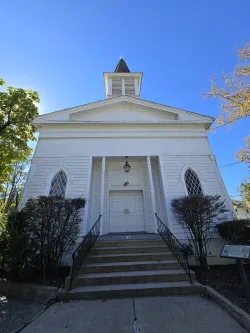
Mission Yearbook: A small congregation, a legacy of hope

Image Exterior of the Witherpoon St Presbyterian Church (Lia Abrams) Witherspoon Street Presbyterian Church in Princeton, New Jersey, has a ...