Showing posts with label Presbyterian Association of Musicians. Show all posts

Thursday, November 19, 2026

Mission Yearbook: Podcast guest discusses importance of embodied worship

Image
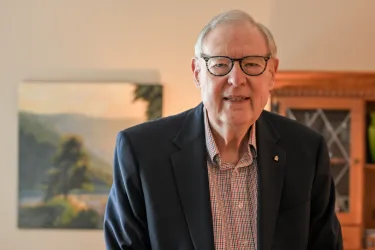
Rev. Dr. Ron Byars in his Lexington, Kentucky home
The Rev. Dr. Ron Byars is a retired pastor and former Professor of Preaching and Worship at Union Presbyterian Seminary. (Photo by Rich Copley)

Current podcaster and former pastor and seminary professor the Rev. Dr. Ron Byars came to his Presbyterian faith in part because of a Catholic friend who enjoyed theological debates with young Byars from the comfort of the friend’s 1941 Plymouth.

Byars, a retired pastor and Professor Emeritus of Preaching and Worship at Union Presbyterian Seminary, was a recent guest of hosts Sarah Abushakra and Jeremy Roberts on “Sounding Board,” a podcast of the Presbyterian Association of Musicians. Listen to their 58-minute conversation here.

Byars recalls his friend, who attended parochial school, driving up in his Plymouth “honking from a block away. He would tell me what he was learning in parochial school, that the Catholic church was the only true church. Well, I was suspicious of that.”

Byars was convinced his own Sunday school teachers “were people of some honor and some faith. I couldn’t imagine they were not part of the one true church, and so I began to figure out how I could respond to this.”

He began by reading the New Testament. “By the time I got to the end, I had moved from being someone just looking for ammunition to use against my friend,” he said. “There was a change that had happened, but I couldn’t give you a time or a date or a specific experience.”

Image
PAM podcast sounding board logo

He’d been baptized at age 9 in a “believer’s baptism: I pretended to believe, and they pretended to believe me,” Byars told the hosts. “When I [returned to church] it was after this discovery. Simply being in worship meant something to me. … I felt engaged, and I was paying attention to what the person preaching was actually saying.”

Byars had read the Catholic liturgy, which “seemed alien to me, and yet there was something appealing about it,” he said. “When I became a pastor, it became even more important for me to think, what is the nature of this kind of assembly that we’re having? It’s not a classroom. It’s not a place for entertainment, although there are overlaps in that. What’s it all about? That’s where my focus began to develop.”

In Byars’ podcast, “What Language Shall I Borrow: Reflections on Faith,” he looks at worship language use that can be subjective, including music. 

“When we sing words of our faith, it has a way of working its way down into our hearts and becomes what we believe,” Abushakra said. “As church musicians, it’s an important job to choose the music that we choose for our congregations. We’re placing words onto people’s lips that eventually becomes what they believe.”

Musicians “often know more about liturgy than pastors do,” Byars said. “What kind of music might help us to gather? Sometimes it’s between the lines and not exactly in the text itself.”

One pastor Byars knows doesn’t appreciate the congregation’s tradition of saying the Apostles’ Creed together in worship every Sunday. “It’s deeply embedded. They can say it without thinking about it,” he pointed out. “When they’re in a nursing home and they don’t recognize anybody, they’ll be able to participate in it. They’ve made it their own, and that has value.”

Byars also spoke of the importance of embodied worship.

“I like it in our church when we go forward for communion and the bread is placed in our hands. That’s a physical thing. You’re making a statement of faith simply by getting up and moving,” he said, “and you’re re-enacting the whole journey of life, which is headed toward the new creation, the wedding banquet that’s being prepared for all of us.”

“That’s why I also believe so firmly, and I’ve spent so much time trying to convince people of weekly Eucharist,” he said. “Word and sacrament go together.”

He said he’s grateful for the option of worshiping via livestream, “but if you can find a way to be there [in person], it matters. It feels different, and I can’t tell you exactly why.” 

“We don’t worship a God who’s somewhere else,” Roberts pointed out. “The worship of Jesus is God made flesh, among us and present.”

Mike Ferguson, Editor, Presbyterian News Service (Click here to read original PNS Story)

Let us join in prayer for:

Joanna Graf, Administrator, Finance, IT, Strategic Initiatives, The Board of Pensions
Denise Gray, Supervisor, General Ledger Office, Presbyterian Church (U.S.A.), A Corporation 

Let us pray:

We thank you, Lord Jesus, for your churches for their heartfelt worship and commitment to sharing the gospel in word and deed. May we be faithful partners who respect the gifts, hopes and plans of these churches and learn from their vibrant witness. Amen.

Wednesday, September 24, 2025

Mission Yearbook: Drumming brings spirit and connection at Worship & Music Conference

Daniel Otu learned to play the djembe drum growing up in Ghana. At this year’s Worship & Music Conference offered by the Presbyterian Association of Musicians, he taught more than 30 students what drumming can do for them as well.

“For me, drumming refreshes your soul. It brings people together and bridges every race, every creed, every religion — no matter what,” he said following a class session. “It’s a workout, and it builds your blood flow.”

Image
Daniel Otu drumming class
A 40-minute African drumming class can be quite a workout for students and for their teacher, Daniel Otu. (Photo by Alex Simon)

Otu first came to the United States from Ghana in 2003 to attend the Worship & Music Conference. He was invited back in 2005 and 2008 to lead classes in African drumming. Since moving to the U.S. and making his home in Douglasville, Georgia, where he works as an insurance underwriter, he has continued his drumming and is the proud father of two children.

Otu arranged students in a large semicircle in the classroom on the grounds of Montreat Conference Center. Even with the windows and doors closed, the drumming can be heard across a large swath of Montreat.

Otu reviewed a couple of drumming patterns he taught the class earlier in the week and discussed their appearance in worship. “They asked me, ‘Can you play something while people are leaving?’” he told the class. “But people stayed and listened.”

His classroom style this week is to use familiar hymns from the Glory to God hymnal and apply patterns the students know to those hymns. This day, students are alternating between “Holy, Holy, Holy” and “Jesu, Jesu, Fill Us with Your Love,” which is based on a folk tune from Ghana.

“I’ll play and you follow me. You have to keep the flow going,” he said during the first time through “Holy, Holy, Holy.” Periodically, Otu would stand up and move among the students, clapping and singing and air-drumming, always encouraging.

Image
African drum W&M
The African djembe produces a pleasant sound (photo by Alex Simon).

After a few times through “Jesu, Jesu,” he had drummers “bring it down a little” by asking half of them to quit playing for a verse. After that, the other drummers took a break, too.

When Otu joins the drumming, he bangs his drum forcefully to augment the students’ rhythm. The typical ending to the hymns was eight straight beats on the drum followed by a satisfying flourish.

“I’ve liked learning the rhythms and having the tactile experience of touching the drum,” said Daryl Mullee of First Presbyterian Church in Gainesville, Florida. “It’s holy and spiritual, kind of an awakening.”

“I feel a real connection with the other drummers. It’s a visceral feeling,” Mullee said. “It gets to my heart and soul, and it doesn’t require age or gender. Anyone can play.”

After a break — for many students, the drumming proved to be quite the workout — Otu returned to “Jesu, Jesu. “I know it’s difficult to sing and play at the same time, but it helps you to keep up your rhythm,” he told students. “When you are playing, let your body move. It helps your nerves.”

Indeed, as more students sang along, they stayed together more readily.

“It keeps me young,” he said once the 40-minute class had concluded. Students have expressed their appreciation, telling Otu, “it’s awesome” “it’s great,” “it’s different” and “we love it.”

Mike Ferguson, Editor, Presbyterian News Service (Click here to read original PNS Story)

Let us join in prayer for:

Laura Bryan, Manager, Financial Aid for Service, Interim Unified Agency       
Lucy Bryant, Online Service Client Relations Specialist, Operations, The Presbyterian Foundation

Let us pray:

Gracious God, we pray for those who long for your acceptance and grace in their lives. Give us the courage to step out where you send us and to respond with compassion and love. Amen.

Mission Yearbook: Webinar offers tips on suicide prevention

Image (Photo by Dan Meyers | Unsplash) “Preventing Suicide: A Conversation About Hope” was a recent Disaster Care Academy installment put on...