Showing posts with label International Day for the Elimination of Violence Against Women. Show all posts

Tuesday, November 25, 2025

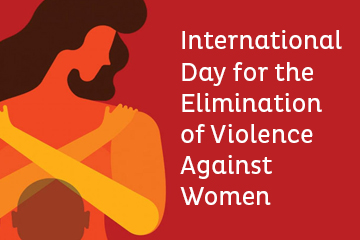
Minute for Mission: International Day for the Elimination of Violence Against Women

Image
Mirabal Sisters
League of Women Voters

The designation of this particular day as International Day for the Elimination of Violence Against Women is a result of the Nov. 25, 1960, assassinations of the Mirabal sisters, siblings and activists from the Dominican Republic. The Mirabal sisters were Minerva, María Teresa and Patria (they also had a fourth sister, Dedé). Born into a farming family in the Dominican middle class, the sisters lived under the brutal dictatorship of Rafael Trujillo.

Under the code name “Mariposa” (Butterfly), the sisters became leaders in the anti-Trujullo resistance movement. Alongside their husbands, they effectively organized against the dictator – and were then targeted by government mass arrests. On a trip to visit their husbands in prison, the sisters were assassinated by the Trujillo government.

But the resistance did not die with them. In fact, it grew. Surviving sister Dedé strove to document and get the word out about what happened, and the sisters became national and international icons. Outraged by their murders, the international community solidified in its resistance to the Trujillo regime. Both the sisters’ lives and their resistance methods became a clarion call to others to reject human rights violations, corruption and dictatorships. In this way, the Mirabal sisters were instrumental in toppling a dictatorship.

Image
hermanas-mirabal
Patria, Minerva, and Maria Teresa Mirabal

Today, the sisters are international symbols of resistance and the rights of women and girls. Their story highlights the need to reject and end violence against women. It also highlights that violence against women is a political issue as well as a personal one. 

In honor of the Mirabal sisters, and in an effort to raise awareness of and end violence against women, in 1999, the United Nations General Assembly designated Nov. 25 as the International Day for the Elimination of Violence Against Women. As well as a museum and other landmarks in the Dominican Republic, the corner of 168th Street and Amsterdam Avenue in Manhattan has been designated Mirabal Sisters Way. There are monuments worldwide honoring the sisters' resistance against dictatorship. The sisters were also the inspiration for Julia Alvarez’s book “In the Time of the Butterflies,” which was made into a film starring Salma Hayek in 2001.

Today, violence against women is still one of the most prevalent human rights violations worldwide. An estimated 736 million women “have been subjected to physical and/or sexual intimate partner violence, non-partner sexual violence, or both, at least once in her lifetime.” That's nearly one in three women — and this figure does not include sexual harassment. Furthermore, it’s estimated that every 10 minutes, a woman is killed by a partner or family member.  

We see this problem not just on a global scale, but within the United States. Data from the U.S. Centers for Disease Control and Prevention indicates that nearly half of women experience sexual violence, physical violence or stalking by an intimate partner. One out of every five women in the United States has experienced attempted or completed rape. While women are not the only people impacted by these forms of violence, they are affected at disproportionately high rates.

As League members, we know that women cannot live their fullest lives, let alone participate equally in society, when living under the threat of violence. As the Mirabal sisters demonstrated, women’s safety and political involvement are directly intertwined.  

To increase public awareness of this issue and inspire action, the U.N. is hosting 16 Days of Action Against Gender-Based Violence. 

The 16 Days of Action, which begins Nov. 25 and culminates on Dec. 10 (International Human Rights Day), aims to help legislators, advocates, diplomats, and the public make the connection between violence against women and human rights violations. It’s a time to “revitalize commitments [and] call for accountability and action from decision-makers.”  

You can help by participating in the U.N.’s 16 Days of Action Against Gender-Based Violence.

You can also help establish legal protections on the basis of sex in the U.S. by demanding that the president pass the Equal Rights Amendment.

Together, we can create a safer world for women and girls.

Chris Sagona, one of the League of Women Voters’ representatives to the United Nations

Let us join in prayer for:

PC(USA) Agencies’ Staff:

Rebecca Kueber, Operations & Production Associate, Publishing & Editorial, Presbyterian Publishing Corporation
Amy Kim Kyremes-Parks,  Growing Faith Resources & Church Relations, Growing Faith Resources, Presbyterian Publishing Corporation

Let us pray:

God, in whose household all are equally valued, thank you for the courage, persistence and resilience with which partners across the world are denouncing all forms of violence perpetrated against women. May their efforts bear fruit so that one day, violence against women may indeed be eliminated. May those affected by this violence find a safe space to seek comfort and recover, and may their daughters be protected against it. We thank you for Presbyterians across the U.S. who express their solidarity in word and deed, including Presbyterian Women in the PC(USA), staff of the Presbyterian Ministry at the United Nations and those resourcing global connections alongside our ecumenical partners and civil society. Amen.

Monday, November 25, 2024

Minute for Mission: International Day for the Elimination of Violence Against Women

November 25, 2024

This year marks the 25th anniversary of the U.N. General Assembly’s designation of Nov. 25 as the International Day for the Elimination of Violence Against Women. The day serves as an annual reminder of the power of collective solidarity, which is needed from one year onto another to change the structural inequities posed by violence against women. The day also launches 16 Days of Activism Against Gender-Based Violence organized by civil society around the world, including the Church, to join forces to address violence against women as the most pervasive breach of human rights worldwide. The annual campaign concludes on International Human Rights Day, Dec. 10.


Achol Kur (Evangelical Presbyterian Church in South Sudan, SSPEC) speaks on child, early and forced marriage.

In a statement to the 64th Session of the Commission on the Status of Women in 2020, “the Presbyterian Church (U.S.A.), its international mission partners, and the Presbyterian Women in the Presbyterian Church (U.S.A.), recognize the important roles that women play in sustainable development and ending hunger and poverty. The Presbyterian Church (U.S.A.) work plan prioritizes addressing the root causes of poverty, particularly as they impact women and children, as a focus of its work.”


The Rev. Christine Ngalula (Presbyterian Church in Congo, CPC) shares about the CPC’s Women’s Rights campaign to address harmful widowhood customs.

Women leaders in PC(USA) partner churches across Sub-Saharan Africa consistently point to patriarchy as one of the deep-seated traditional cultural norms in their societies that tramples on women’s basic human rights. As is voiced here by several of current and former leaders, patriarchal societal systems engender various forms of systemized violence against women that take different forms according to the context with long-lasting consequences. In agricultural societies, for example, where families subsist on the food they grow, denying women the right of land inheritance and ownership leads to hunger and poverty in their families. Because this gender-based inequity is deep-seated and perpetuated from one generation to another, the violence and violation of rights is considered structural. In most of these societies, the legal framework that in theory supersedes cultural systems to protect women is absent, weak, or not enforced. This makes women vulnerable to additional, intersecting structural inequities that also affect the well-being of their children. When in a patriarchal system, where women marry into their husband’s family and become their property, parents consider investing in their daughters’ education a net loss for their family, the daughter is cheated out of opportunities to prosper, and her children may in turn be more vulnerable to diseases of poverty, for example. Structural violence against women often starts with rights violations of young girls.


The Rev. Helivao Poget (Church of Jesus Christ in Madagascar, FJKM), explains the relationship between domestic violence, migration and human trafficking.

Biblical stories seem to exemplify that violence against women may be as old as humanity. Still, women stood up for their rights in peaceful resistance against man-made structures while seeking the ear of champions to rally for their cause. Dismantling structural injustices cannot be done in isolation but need sustained, collective expressions of solidarity to change attitudes, practices and policies, and Scriptures call the Church to work toward equitable relations and structures worldwide.


The Rev. Berthe Nzeba (Presbyterian Church of Kinshasa, CPK, former General Secretary of the ECC Women and Families Department) expresses concern and frustration about sexual violence in resource-fueled armed conflict.

The ecumenical Federation of Protestant Women in Ituri (FFPI) models the way the Church can join forces with others to make an impact. The FFPI is organized under the umbrella organization Church of Christ in Congo (ECC), and an active participant in a province-wide civil society platform of women’s associations. Every year on Nov. 25, the federation launches a “16-days campaign of activism and awareness building” that includes daily worship, prayer and thematic workshops, and culminates in a call to the political elites, militia leaders, and local communities to end violence against women perpetrated in multiple armed conflicts in Ituri and East Congo in general. The women persist on their inclusion in peacemaking processes. 


The Rev. Rebekkah Bara (Evangelical Church of Niger, EERN) lays out challenges for the church to reach women in a context where wives live in seclusion.


Marie Kabazaire (Federation of Protestant Women in Ituri, FFPI and Anglican Church in Congo) lays out the importance of the inclusion of women in peacemaking processes to end armed conflict and associated sexual violence.

Christi Boyd, Mission Co-Worker  in the Democratic Republic of Congo, World Mission

Today’s Focus: International Day for the Elimination of Violence Against Women

Let us join in prayer for:

PC(USA) Agencies’ Staff
Denise Anderson, Director, Compassion, Peace & Justice, Presbyterian Mission Agency 
Monty Anderson, Vice President, COO & Corporate Treasurer, Presbyterian Publishing Corporation

Let us pray

God, in whose household all are equally valued, thank you for the courage, persistence and resilience with which partners across the world are denouncing all forms of violence perpetrated against women. May their efforts bear fruit so one day, violence against women may indeed be eliminated. May those affected by this violence find a safe space to seek comfort and recover, and may their daughters be protected against it. We thank you for Presbyterians across the U.S. who express their solidarity in word and deed, including Presbyterian Women in the PC(USA), staff of the Presbyterian Ministry at the United Nations and those resourcing Global Connections alongside our ecumenical partners and civil society. Amen.
Minute for Mission: World Community Day

Image World Community Day began in 1943 as a day for church women across denominations to come together to pray and participate in ecumenica...