Sprunt Lectures address interreligious wisdom in the ‘post-truth’ era
July 23, 2024

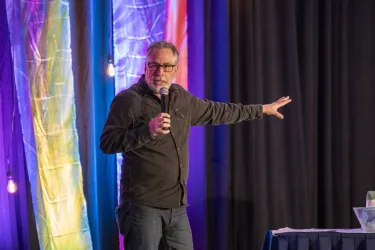
The Rev. Dr. James Thatamanil in a kafiya scarf
given to him by an attendee of the Sprunt Lectures
at Union Presbyterian Seminary. (Screenshot)
“What is truth?” Pilate retorted to a Jesus on trial. According to John’s gospel, Jesus had told Pilate that he came into the world to testify to the truth and to be heard by those who “belong to the truth.” Despite finding no case against him, Pilate consented to Jesus’ crucifixion. Pilate was not the first or last person with power to believe truth could be bent to human will.
How, then, are humans to resist the delusions and lies of the ego, media, politics and culture and to “belong to the truth,” as Jesus proposes?
Over the course of four lectures titled “Seeking Interreligious Wisdom in a Post-Truth Era,” the Rev. Dr. John Thatamanil, professor of theology and world religions director at Union Theological Seminary, addressed an audience in person and online at the 113th Sprunt Lectures at Union Presbyterian Seminary. He built his case on a medical model defining the diagnosis, etiology, prognosis and therapy for a contemporary existence estranged from truth.
“Our collective incapacity to agree about just what the facts are may strike us as a peculiar feature of our moment in a highly mediated, postmodern world,” Thatamanil said as he explored the most recent examples of how we have become overwhelmed by information, manipulated by social media, polarized by politics, susceptible to conspiracy theories and incalcitrant to facing inconvenient truths about the destruction of our earth.
“The post-truth problem in our time revolves around the ways in which the circulation of misinformation and disinformation does not require a central agent or a regime,” said Thatamanil, who explained how, unlike Orwell’s time, “no one compels us by brute force to accept conspiracy theories or lies.” We do so because we want to or are manipulated to want to believe the ideas of those around us as we grant social media agencies and corporations access to our habits, networks, likes and dislikes until “we know only what we want to know and come to inhabit polarized communities, each in possession of its own facts,” said Thatamanil.
In his second lecture, Thatamanil turned to etiology and how humankind came to be people who as Jack Nicholson’s character said in “A Few Good Men,” “can’t handle the truth.”

The Rev. Dr. John Thatamanil leads a compassion meditation
practice at the end of the 2024 Sprunt Lectures at Union
Presbyterian Seminary. (Screenshot)
“The problem is a bifurcation of mind and heart,” posited Thatamanil, encouraging us to embrace ancient wisdom and recent neuroscience that show that emotions play a role in what we know. Philosophy means “love of wisdom” which suggests that truth is born from both desiring and knowing. “If the problem is a problem of desire,” said Thatamanil, “then it will not do to treat a problem of distorted desire with the remedy of more information.”
He proposed that our religious traditions are designed to tutor the heart, not just the mind. Therefore the prognosis for humankind is good — or such was the hopeful tenor of the third lecture, which explored the sage advice and transformative practices of ancient religions through sources in the Hebrew Bible and Christian Gospels to wisdom passed down through Theravada, Mahayana, Vajrayana Buddhisms and the Advaita Vedanta school of Hinduism. All these traditions illumine a path in which distorted, self-limiting desires based on untruths can be transformed into positive, other-invested desires based on a reality rooted in relationship and an interconnected existence. “The task of human life is to be trued to the real,” said Thatamanil, who said truth is “more than a set of statements,” but reality itself: “Truth is interbeing. Truth is God.”
The final lecture centered on the therapy of desire and included a 10-minute contemplative practice of compassion meditation. Thatamanil advised that we “invest ourselves in the reclamation of our attention” so that “our desiring is not left to the mercy of others.” But he also warned that we as individuals are not isolated patients curing personal desires. “The patient in question is the entire culture,” which he described as “a set of intersecting and nested global systems that wound and traumatize persons and communities.”
“We cannot rectify public desire without surrendering the thinking/feeling binary,” said Thatamanil, calling the underlying assumption that has for centuries dominated many cultures, especially in the West, a “deficient anthropology.”
Beth Waltemath, Communications Strategist, Presbyterian Church (U.S.A.)
Today’s Focus: 113th Sprunt Lectures at Union Presbyterian Seminary
Let us join in prayer for:
PC(USA) Agencies’ Staff
Lucy McDermott, Mission Specialist, Presbyterian Disaster Assistance, Presbyterian Mission Agency
Robyn McEvilla, Accountant, Central Receiving Services, Administrative Services Group (A Corp)
Let us pray
O God, the source of blessing and abundance, help us to see that your call to mission is our opportunity to give as we have received. We ask that you would bring peace to the nation and provide for all its people. In Jesus’ name. Amen.