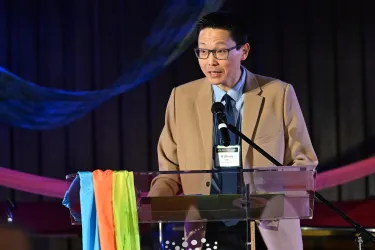
The Rev. Cindy Ray, executive director of the Presbyterian Association of Homes and Services for the Aging, was in her wheelhouse when she recently offered a workshop on the intersections of faith, stewardship and advanced care planning during the Presbyterian Older Adult Ministries Network annual conference.

She opened with a slide of her parents, Jerry and Gerry, who were married for 70 years. Her dad suffered a massive stroke four years ago and was placed on a respirator, even though it was his wish not to be kept alive by artificial means and to die in the company of his family. Her mother had to decide when to take him off the respirator. “I was so glad to have that advance directive,” Ray said. “We told our mom, ‘you are honoring his wishes.’”
Ray said that any conversation on advanced care planning should be multigenerational. “I encourage families to bring their grandkids into it, especially if they are grown,” she said. “It also allows them to grapple with the fact that the lead generation won’t be with them forever.”
The biggest question to be answered is, who will speak for you if you can’t speak for yourself? Not only is it a planning process for making decisions about future medical care, it’s “a matter of faith,” Ray said, since “God is the sovereign author of our life” and life is “a sacred gift, but our bodies are vulnerable.”
“Death is a reality, but it is not the final word,” Ray said. “Our hope is in the resurrection and the promise of eternal life.”
Someone who agrees to implement health care instructions on your behalf if you are unable must be able to answer “yes” to a few questions, Ray said, including:
- Are you willing to take on this role and responsibility?
- Do you understand my wishes for future health care?
- Can you make the decision I would want to make, even if you disagree?
- Can you make important health care decisions under stressful situations?
- Do you feel you can strongly advocate in the face of family members and others who may challenge my wishes?

Ray also discussed what a power of attorney and an advanced health care directive do. The latter includes medical treatment you want and don’t want, how you want your agent to make decisions, how you want your pain to be managed, where you want to receive care, your preferences regarding mental health care treatment, your desire to donate organs and tissues, and plans for your funeral arrangements.
Ray noted that 9 in 10 people say talking with loved ones about end-of-life care is important, but Pew Research reports that fewer than 3 in 10 people have done so. “Those have been some of the most blessed moments in my ministry,” Ray said.
She also had ideas about how to open the conversation:
- Choose a comfortable and private setting to avoid interruptions or time constraints.
- Initiate the discussion by saying something like, “I know this isn’t easy to talk about, but if I get sick or have an accident and can’t make decisions for myself, I’d like to share what would be important to me so you could be my decision-maker.”
- Share your thought process. Explain that you have been thinking about the future and want to be prepared. Frame the conversation in a way to help the family and ensure wishes are respected.
- Focus on your faith, stewardship and values. Talk about what you appreciate about life and how your values and beliefs are guiding your preferences for medical care.
- Explain the why. Let your family know that talking about this now can help them make decisions later and avoid conflict and guilt.
- Explain the default. Clarify that without a directive, health care providers’ default is to “do everything,” Ray said, which may not align with your wishes.
- Be prepared for discomfort. Acknowledge that these conversations can be uncomfortable for everyone, but sharing your feelings can help launch the discussion.
- Take your time. It’s not necessary to cover every detail in one meeting. Ray’s advice was to start with “a brief chat, and let it evolve into a series of ongoing conversations.”
Mike Ferguson, Editor, Presbyterian News Service (Click here to read original PNS Story)
Let us join in prayer for:
Christopher Abney, VP, Director of IT, Presbyterian Foundation
Susan Abraham, Associate, Mission Program Grants & Mission Development Resources Committee, Interim Unified Agency
Let us pray:
Faithful God, you are the giver of life and the holder of our days. Grant us wisdom and courage to speak honestly with those we love, to plan with care and to entrust each other with sacred decisions. When conversations are hard, remind us of your presence and the hope that carries us through every beginning and every ending. Amen.



No comments:
Post a Comment