| |||||||||||||||
| |||||||||||||||
|


Image
| |||||||||||||||
| |||||||||||||||
|
| |||||||||||||||||||||||||||||||||||
|
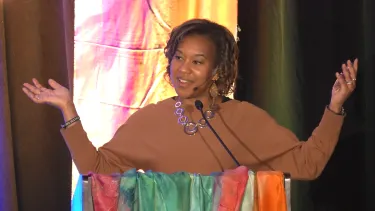
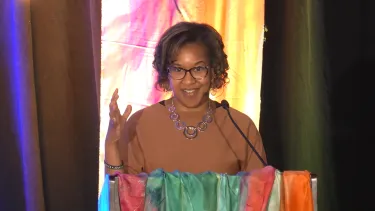
“How do you imagine the abundant life?” the Rev. Ayana Teter opened her plenary at the Luminosity Conference with that simple-sounding question, quoting theologian Dietrich Bonhoeffer.
Teter is the Associate Dean for Students and Formation at Pittsburgh Theological Seminary and a consultant to congregations and nonprofit organizations. She spoke during the plenary on the first day of the Luminosity Conference, a gathering for PC(USA) pastors and church leaders held last spring. The conference was organized and sponsored by the Presbyterian Foundation.
In American consumer culture, we are tempted constantly by the illusion of abundance. But Teter cautioned listeners to beware of the temptations and desires that draw us away from God.
“When we are overtaken by desire,” she said, “our joy in God is being extinguished in us. We seek joy in the other desire, and in that moment God becomes quite unreal to us.”
Teter then reframed this individual distraction in terms of the American economic system, calling it an “arch-temptation” that places us in a constant cycle of sin and suffering. “Our culture and our communities are defined by this undercurrent of competition. Everything that is, somebody owns; everything we can do, we can charge for or have to pay for.”
This economic system, she reminded those in attendance, is one that leads to a scarcity mentality and a zero-sum game. Our culture has developed into one where everyone is trying to hold on to what they have, she noted. Gains are privatized, but losses are socialized.
In this mindset, even the “historic virtues of our faith and the fruits of the Spirit are viewed as finite resources.” These virtues “have been distorted and replaced because they represent abundance.” Now, they have been assimilated into our culture of scarcity. Teter argued that this distortion is something the church needs to recover from.
Citing Jonathan Wilson-Hartgrove’s book “God’s Economy,” which was a corrective to the idea of a “prosperity gospel,” Teter explained that in New Testament Greek, the word “oikonomia,” from which we get the word “economy,” relates to the care and management of the family business.
Thus, in his ministry, Jesus instructed his disciples to “travel light.” Such a discipline helps us remember, in Teter’s telling, “What pours forth from God is generous caregiving independent of our ability to give back or even to steward.”
Teter noted that Paul in Ephesians writes about salvation being freely offered not because we have already created communities with righteous living, but because we needed it. And she gestured to the Communion Table as the place where we receive God’s gift of community.
So, how can we rest in the economy of grace? What do we practice if we are to manage and care in God’s family business? Teter offered four practices to cultivate communities reflective of God’s economy of grace:
Teter suggested that one way we can practice liturgies of gratitude is to read James 1, then give thanks to the people and the ideas and the things that you see God doing in your life.
She explained extravagant generosity by saying, “Thanksgiving is not a commodity that depletes with use. It is lavish and we need to share it with all; it gives us a new view in what could be possible with God.”
Critical solidarity is a phrase created by the East German church during the Cold War. It is a form of dissent that asserts that freedom and love go together. Freedom in Christ is the freedom to love others as God has loved us, and should lead us to share the goods of the world with everyone, starting with the ones most in need.
The concept of “communing” is related to that sharing. It simply says, “what’s mine is yours.” Teter pointed out that “when we pull things together, we can live more freely in our individual and collective vocations.”
Jody Mask for the Presbyterian Foundation (Click here to read original PNS Story)
Angela Duffy, CFO, Trust Services, The Presbyterian Foundation
Lindy Ebbs, Raiser's Edge Data Administration, Funds Development Operations, Presbyterian Church (U.S.A.), A Corporation
Creator God, thank you that through your Spirit, creative solutions flow. Help us to let go of practices that no longer serve you or your people and to rise in Christ to the new opportunities to which you call us. Amen.
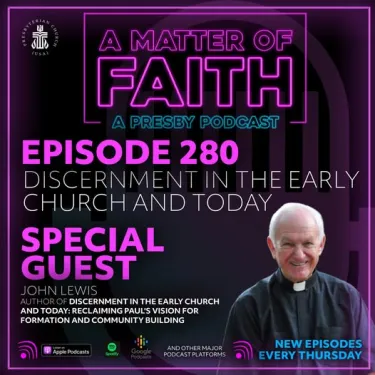
The early church, especially the faith communities that Paul started, prioritized moral formation and community building, and employed practices of communal discernment that modern-day people of faith can learn from.
Last year, the Rev. Dr. John Lewis published “Discernment in the Early Church and Today: Reclaiming God’s Vision for Formation and Community Building.” Lewis, who founded St. Benedict’s Workshop and is the theologian in residence for the Iona Collaborative at Seminary of the Southwest, stopped by the “A Matter of Faith: A Presby Podcast” virtual studios to discuss the early church with podcast hosts Simon Doong and the Rev. Lee Catoe. Listen to their 61-minute conversation here.
Worship in those early churches wasn’t anything modern worshipers would recognize, Lewis said. “The idea that every person needed to be formed in the image of Jesus was the centerpiece of what worship in the early church was about,” he said.
When a problem comes up for a person of faith today, “we look at it, make a decision and move forward. The early church was trying to break down those barriers by having that conversation be a community practice,” Lewis said. “The patience required to have a deliberative conversation with people who are very different from you was crucial to this process of formation that we see.”
“Being able to discuss those in my small Christian community was what allowed me to become a person of humility and a person of practical wisdom,” he said. “It informed the community as one of accountability, where we both encouraged and built-up others and, with humility, received critique from time to time of our practice.”
“That takes vulnerability and trust,” Catoe noted.
In those days, “how to live Jesus was highly contextual,” both in the life of the individual and the community. “Life in Corinth was very different from life in Ephesus or life in Philippi,” Lewis said. “Part of what’s happened over centuries is we try to move toward unification, which in some cases means standardization as opposed to what does it look life for me to live my life here in San Antonio, Texas, in a particular Episcopal Church setting? That differs even from some of the churches down the street.”
In our current political and social climate, “it feels like discernment and ongoing learning is not possible,” Doong said.
Coming to a place of knowledge and truth was far from what people in the early church thought being a Christian was about, Lewis replied. They’d descended from centuries of having the Torah, the Jewish law, “to help them shape how they lived holiness in daily life.”
They soon focused “on the person of Jesus for how to live and how to do things that are pleasing to God. In that way, we become conduits in the world for this life-giving power of God to encourage and build up other people. … That’s how they saw their life of living Jesus. Week in and week out, they would come together and share with one another actions and consequences, some that bore wonderful fruit in the lives of other people and some that clearly became problematic.”
“By sharing both the fruits and the challenges over time, the group was shaped to come to a practical wisdom, a wisdom of understanding how to live Jesus that brought life to the world,” Lewis said. “Today, when people can’t even talk to each other, we’re not sharing. We’re not deliberating on the practices of living Jesus that bear fruit, and some of the actions that we take trying to live Jesus create chaos.”
“There’s no discernment about that, because we don’t talk to people, except the people we agree with on fundamental issues,” Lewis said.
In Paul’s community, “while I’m looking to discern how Jesus comes alive in me, the point of Jesus coming alive in me is so I can reach out in love by giving myself to other people in particular ways,” Lewis said. “You become a conduit for that life-giving power of God that builds up the body of Christ and builds up your community.”
New installments of “A Matter of Faith: A Presby Podcast” drop every Thursday. Listen to previous editions here.
Mike Ferguson, Editor, Presbyterian News Service (Click here to read original PNS Story)
Susan Jackson Dowd, Executive Director, Presbyterian Women
Christopher Drane, IT Specialist, Information Technology, The Presbyterian Foundation
Dear God, help us to notice those folks who need us. Speak to us through them of your abundant grace. Give justice to all who live in our societies. In Jesus’ name. Amen.

The Assistance Program has a longstanding history of supporting active and retired members of the Benefits Plan of the Presbyterian Church (U.S.A.) and their families in times of need. With 12 grants, it is a concrete representation of our connectional Church.
“Through the Assistance Program, we support members in all corners of the PC(USA) during challenging times or when unexpected needs arise,” said Andrew J. Browne, Executive Vice President, Engagement & Church Relations for the Board of Pensions. “We are grateful for the opportunity to support our faith community through the Assistance Program, and as its needs evolve, we continue to find ways to meet those needs.”
In 2025, the Assistance Program awarded more than 1,500 grants totaling nearly $8 million and made several enhancements to program offerings, including expanded eligibility for Minister Debt Relief and the addition of memory care facilities as qualified living situations for Housing Supplements.
“The Assistance Program, available to members of the Benefits Plan of the PC(USA), supports the pursuit of wholeness,” said Browne. “Supporting those we serve through all life’s challenges is foundational to our mission at the Board of Pensions and to who we are as Presbyterians.”
In 2026, further enhancements were made through the introduction of a new Child Care Support grant, effective April 1, which offsets a portion of child care needs for children ages 0-6 years. The initial pilot phase of this grant provides $500 per month per child and up to $1,500 per month per family. The Child Care Support grant is available to PC(USA) ministers of the Word and Sacrament and commissioned pastors employed by PC(USA) congregations who meet the eligibility requirements.

"Supporting the high cost of child care is one of the most practical and meaningful ways we can bolster church leaders and their families,” said Ruth Adams, Director of the Assistance Program. “We want them to thrive. Child Care Support offers one more helpful resource as they fulfill their calling to serve others.”
Grants from the Assistance Program provide financial support across a variety of needs, with eligibility requirements varying by type of assistance. Benefits Plan members, both ministers and employees who serve the Church and members who work for PC(USA)-affiliated organizations, are eligible to apply for assistance grants.
Grants available through the Assistance Program provide support for the following:
More details on eligibility and application information are available here.
The Board of Pensions supports wholeness in the Presbyterian Church (U.S.A.) community and care for Benefits Plan members. For information, contact info@pensions.org. (Click here to read original PNS Story)
Dawn Diggs, Manager, Compliance, Operations, The Presbyterian Foundation
Carla Dobson, VP, Director of Philanthropic Services, Trust Services, The Presbyterian Foundation
Dear Lord, the source of our strength, you are good to provide for our needs in whatever circumstances we find ourselves. Thank you for your guidance and wisdom to carry out the work you have called us to do. In Jesus’ name we pray. Amen.
Rabbi Sharon Brous, senior and founding rabbi of IKAR in Los Angeles, urged church leaders to resist isolation, embrace vulnerability and d...