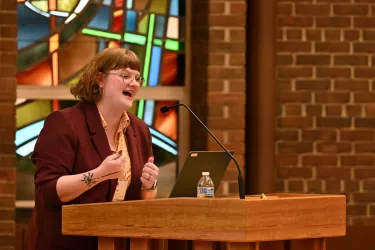
Kate Trigger Duffert, who leads General Assembly Planning, recently stepped away from those duties to preach during a Chapel Service that included mid council leaders from across the country receiving their orientation.
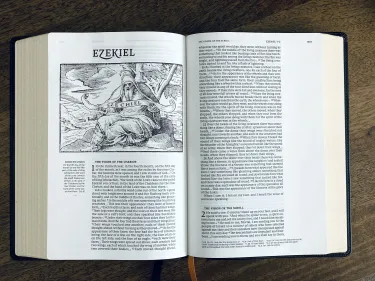
Calling her sermon “The Messy Bits,” Duffert preached on Ezekiel 37:1–14, which lays out the prophet’s vision of a valley of dry bones. We can place ourselves in Ezekiel’s shoes, she said.
“We hear the story and imagine how we might be called to be a prophetic witness to those around us,” she said. But “if you’re anything like me, you may be feeling a bit more like you are a part of the multitude of dry bones in the valley.”
We’re living in a time where the world seems intent on wearing us down to the bone, she said. “We carry in our bones the stories of ancestors who were harmed and who harmed. We carry DNA altered by generation after generation surviving times of sickness, hunger, upheaval and violence.”
“We are bone tired,” she said, “and so today I can’t help but find myself in our story laying out in the sun-bleached bones.”
And yet, we’re people of faith and hope. “We have the benefit of knowing what’s on the other side of Ezekiel’s vision and the stories of Bible,” she said. We know God takes “what feels tired and useless” and shapes “life-giving witnesses to the world.”
But unlike the Creation accounts in Genesis, where God “sculpts and forms,” the image given to Ezekiel “is not one where nothing becomes something.” Instead, God “layers the deeply embodied, physical components of a person into bones before the spirit is breathed in.”
This new creation doesn’t remain bone, “jingling about like a Halloween decoration clanking bone on bone,” she said. Instead, Ezekiel’s vision is centered on a step we hope God might have skipped: It’s “the messy bits, the deeply human parts of encountering the sinews, the muscles, the tendons, the organs and blood and fluids that build upon our bones to make us alive.”
That got Duffert to thinking about the 1999 film “The Mummy,” whose skeleton is enfleshed as the film goes on. “The stuff of humanity builds upon him like scaffolding until he is finally recognizable as his former, living self,” she said. “The scenes are not pleasant. … They are messy, goopy and meant to make the viewer squeamish.”
As one “feeling like dry bones, I have to say that the idea of being alive and made new is incredibly appealing,” Duffert said. While the idea of layering on sinews and flesh “does not seem like an enjoyable way to get there, God-who-can-do-all-things makes it clear that it is a necessary part of the process. God shows us that if we are to be alive, we must engage with the muck and mire of being human.”
There are times in the church “when we are so fixated on becoming what God wants us to be that we forget our embodied humanity,” Duffert said. “We seek to disinfect our stories rather than admitting the painful truths at play. We will ourselves into the cleanliness of sun-bleached bones, forgetting that means we are no better than dead.”
But we’re called “to do the human work of being people in community, with all its mess,” she said. “When we fail to engage with the fullness of our globs of humanity, we choose to stay dry, dead bones.”
The Hebrew word “ruach” means both breath and spirit, “the same breath that is that root of not only respiration but inspiration,” sharing oxygen and carbon dioxide in a cycle back and forth with all of Creation. “It’s when we have taken on the messy work of humanness that we open ourselves up to God’s profound inspiration and the community that is Creation,” Duffert said.
Mike Ferguson, Editor, Presbyterian News Service (Click here to read original PNS Story)
Let us join in prayer for:
Thomas Soadwa, 1001 NWC Apprentice, 1001 New Worshiping Communities, Presbyterian Life & Witness
Joaquin Lopez, 1001 NWC Apprentice, 1001 New Worshiping Communities, Presbyterian Life & Witness
Let us pray:
Lord, we thank you for the privilege of being able to support your mission here and around the world. Give us the wisdom daily to do your work. Amen.



No comments:
Post a Comment