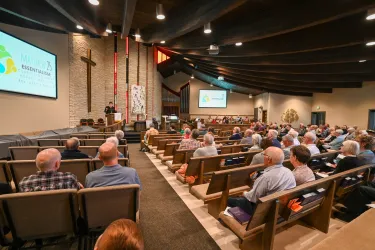
As the ECIC gathering in Rome opens, what is the significance of this network for churches in Europe? Godfrejów-Tarnogórska: ECIC is a unique network for cooperation, the exchange of experiences, and learning from one another. It is also an opportunity for church communicators to discuss current media-related topics, such as the impact of technology on media development, digitalisation in churches, or the most topical issue of the moment: the use of artificial intelligence. At the same time, ECIC is a space where media specialists can learn about the situation in other churches and maintain direct contact with one another, for example, in cases where fake news or disinformation about a particular community appears in the media. Thanks to the relationships we have with one another, we can identify the source of a particular piece of news and have access to direct information. Another component of the network is its spiritual and ecumenical dimension. ECIC provides an opportunity for prayers and building communion. By visiting different European countries, participants learn about the churches and ecumenical situation in each country. As your term as president of ECIC comes to an end, what are the major issues from past conferences that are strong in your memory? Godfrejów-Tarnogórska: Since my first conference in 2015, each subsequent one has been a chance for me to discover something new, or to explore a topic in greater depth that isn’t always addressed in this way in the churches in my country. This has given me a unique impulse for growth every time. In fact, I could mention every single one of the conferences. I remember what a revelation gamification was for me, and the ways it can be used in youth work, for example the Fisucraft platform created in the style of Minecraft by the Church of Finland. An interesting topic was discovering which emotions matter online and how they can be used not only for good, but unfortunately also for manipulation. In Warsaw, when I was the local organiser, we explored the topic of virtual reality, pondering what a virtual community might be. In a way, we were ahead of our time, because in 2020, with the COVID-19 pandemic, certain topics became particularly relevant. In subsequent conferences, various aspects of artificial intelligence became an increasingly prominent topic: the misuse of AI for disinformation, the creation of fake news or deepfakes, but also a focus on the ethical aspects of AI use within the churches. After organizing so many ECIC annual gatherings, what is your message of hope for the future of ECIC? Godfrejów-Tarnogórska: I hope that the ECIC network will endure and that “in-person” conferences will continue to take place. Although many of us operate in the digital space, ECIC has allowed me to discover that online is not enough for us. When putting together the programme for each conference, we try to find space for networking because it is the participants' wish. I believe this is no coincidence, because as Christians we need a real community where we encounter the living Christ, where we get to know our sisters and brothers, and where, drawing strength from this community, we can build bridges in the increasingly divided world. European Christian Internet Conference (ECIC) ECIC conference in Rome | 




No comments:
Post a Comment