| ||||||||||||||||||||||||
|


Image
| ||||||||||||||||||||||||
|
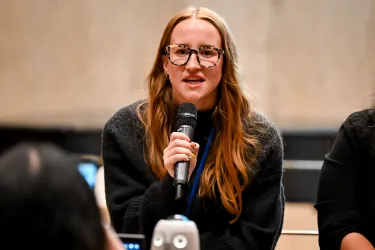
Ecumenical Women recently hosted its annual “Girls on Fire” panel, an event highlighting young women’s perspectives in advocacy on justice, leadership and what it means to stand up for girls in their generation. Alongside three other women from Canada, the Netherlands and India, I was honored to be invited to participate in the panel while attending the 70th session of the Commission on the Status of Women (CSW70) as a Presbyterian delegate.
Advocacy has always been an important expression of my faith. I began contacting my elected officials in middle school through emails and phone calls to express my concerns, and by ninth grade, I was arranging in-person meetings with local leaders. The first place I drove after receiving my learner’s permit was to a school board meeting addressing concerns about gun violence. For two summers, I had the privilege of serving as a fellow with the Presbyterian Office of Public Witness in Washington, D.C., where I continued to communicate the concerns of the General Assembly. Now, I serve as a Young Adult Volunteer (YAV) at the U.S./Mexico border, living and working in the communities of Agua Prieta, Sonora, and Douglas, Arizona.
Earlier this year, I was part of a joint delegation of almost 70 Presbyterians who traveled to New York City for CSW70, the United Nations’ annual review of gender equality. During the event, delegates have the opportunity to attend sessions hosted by both U.N. Member States and nongovernmental organizations.
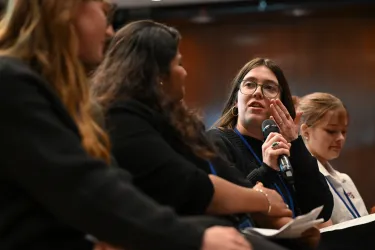
During the panel at the Church Center for the United Nations, we were asked a variety of questions related to justice and inclusion, particularly for women and girls. When asked which women or girls inspire us to care about justice, we all shared that our mothers and grandmothers were instrumental in planting that seed within us. I also spoke about how deeply I am inspired by women serving in clergy and other church leadership roles, especially given that this remains a polarizing topic across denominations. When asked about moments in which we have witnessed injustice toward women or girls, I reflected on the stories I encounter daily while living alongside the community at the U.S./Mexico border during my year of service.
When I think about the word “justice,” I am drawn to the themes woven throughout Scripture, which reveal a God of love, kindness, and mercy. In passages such as Micah 6:8, Matthew 25, Psalm 82:3, Isaiah 1:17, Deuteronomy 32:4 and Psalm 89:14, justice is not exclusive, as women and girls are included among those celebrated as being created in the image of a loving God.
Throughout the week our delegation attended CSW, the fruits of the Spirit of love, joy, peace, patience, kindness, goodness, faithfulness, gentleness and self-control were evident in the actions of those within the faith community. The most common theme shared was hope: hope as we walk humbly with God, trusting that all people may experience the justice promised to them in Scripture.
Learn more about Olivia Phelps here, and view a young adult vlog about various CSW-related activities and topics here.
Olivia Phelps, Young Adult Volunteer (Click here to read original PNS Story)
Kendra Bright, Operations and Accounting Associate, Presbyterian Publishing Corporation
McKenna Britton, Communications Associate, Presbyterian Life & Witness
God, bless those who minister with our young adults. Amen.
| ||||||||||||||||||||||||
|
Who are today’s widows?
Relying on Luke 18:1–8, Jesus’ parable of the widow and the unjust judge, the Rev. Ashley DeTar Birt, who preached during a recent Chapel Service, gave online worshipers enough background on this persistent widow to help them identify who might be her modern-day equivalents.
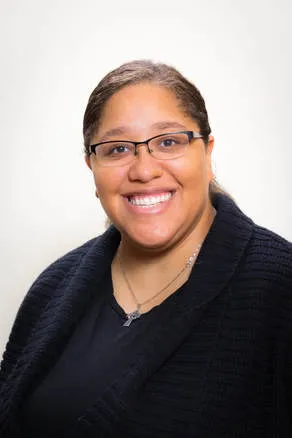
DeTar Birt is co-director of the Center for Jubilee Practice, program manager for New York Unitarian Universalist Justice and a member of the PC(USA)’s Advocacy Committee for LGBTQIA+ Equity, known as ACQ+E.
The Bible can be a complicated text — except when it comes to widows, she said, “one of the few things [the Bible] is consistently clear on. Over and over again, throughout both the Old and New Testament, Scripture commands that we look out for the widows.”
Jesus even warns here and here against the scribes who walk around in long robes but devour widows’ houses, she pointed out. “It is clear that special assistance must be given to the widows,” she said, “that something about those societies left widows vulnerable and powerless.”
She said the lesson for today is this: “In a society that leaves certain people vulnerable and powerless, it is our responsibility to act until that society has changed.”
Jesus’ parable pits a “vulnerable and supposedly defenseless woman who was just trying to get justice” opposite a judge “who we know lacks respect for everyone, even God,” DeTar Birt said. The widow asks for justice daily and is denied each time.
Eventually her steady efforts prevail, and the judge relents.
“She wins! Hooray! Her persistence pays off,” DeTar Birt said. “This is a great story about the importance of never giving up and keeping the faith — right?”
“I want to focus on what’s not in this parable. This is a text about a widow, and as we have previously established, if there’s one group of people to help, it’s the widows,” she said.
“So where are the helpers? Who was there to assist this woman? In this woman’s time of need, why was she fighting this judge all alone?”

Scripture talks about two types of widows, she said — the named and the unnamed.
“The named widows in Scripture have a husband who died, but still have access to some resources,” such as Ruth, who has a family to go back to but chooses not to, and Naomi, who ends up with Ruth, “who ends up taking care of her when [Ruth] is with Boaz.”
Unnamed widows are the ones who have no one — no power and no finances, she noted, and if they are of child-bearing age and either had no children or were unable to have children, “they feel extra shame.” These women and their children, if they have children, “were routinely ignored by the men of their time, and thus God had a particular concern for them.”
Because of all this, “protecting and caring for widows was considered a faithful act,” she said, while “harming them was considered worthy of punishment.”
“That’s what makes today’s parable all the more shocking,” she said. This unnamed widow “manages on her own to defeat the odds and convince this corrupt judge to do what’s right.” It’s a “testimony to her inner strength and righteousness that even though she had so little, she was still able to do this.”
But how can we help, and what should we do?
We can start by asking ourselves, who are the widows of today?
“So many of our trans siblings,” especially trans women of color, “are left nearly invisible, vilified and vulnerable,” she said.
Immigrants and refugee women “fear for their lives while our government ruthlessly kidnaps them and their families,” she said. “All this is happening while families and communities are being torn apart.”
“We have spent most of last year and this year hearing about horrific sexual violence committed against women and girls,” she said, and yet “most of the attention has been on abusers rather than the feelings and needs of survivors.”
“There are too many widows, and none of them should have to fight alone,” DeTar Birt said. “Standing with them, supporting them, fighting alongside them — this is how we honor and celebrate them.”
Mike Ferguson, Editor, Presbyterian News Service (Click here to read original PNS Story)
Shonita Bossier, VP, Operations, Presbyterian Foundation
Terri Bowman, Customer Service Lead, Hubbard Press, Administrative Services Group
Holy God, you call us to love you with our minds. Bless those who are devoted to study and teaching. By their fruits strengthen our minds and wills and so bless your church. In Christ’s name we pray. Amen.
| |||||||||||||||||||||||||||||||||||
| |||||||||||||||||||||||||||||||||||
|
During the second of six online installments in a series called the Disaster Care Academy offered by Presbyterian Disaster Assistance and i...